
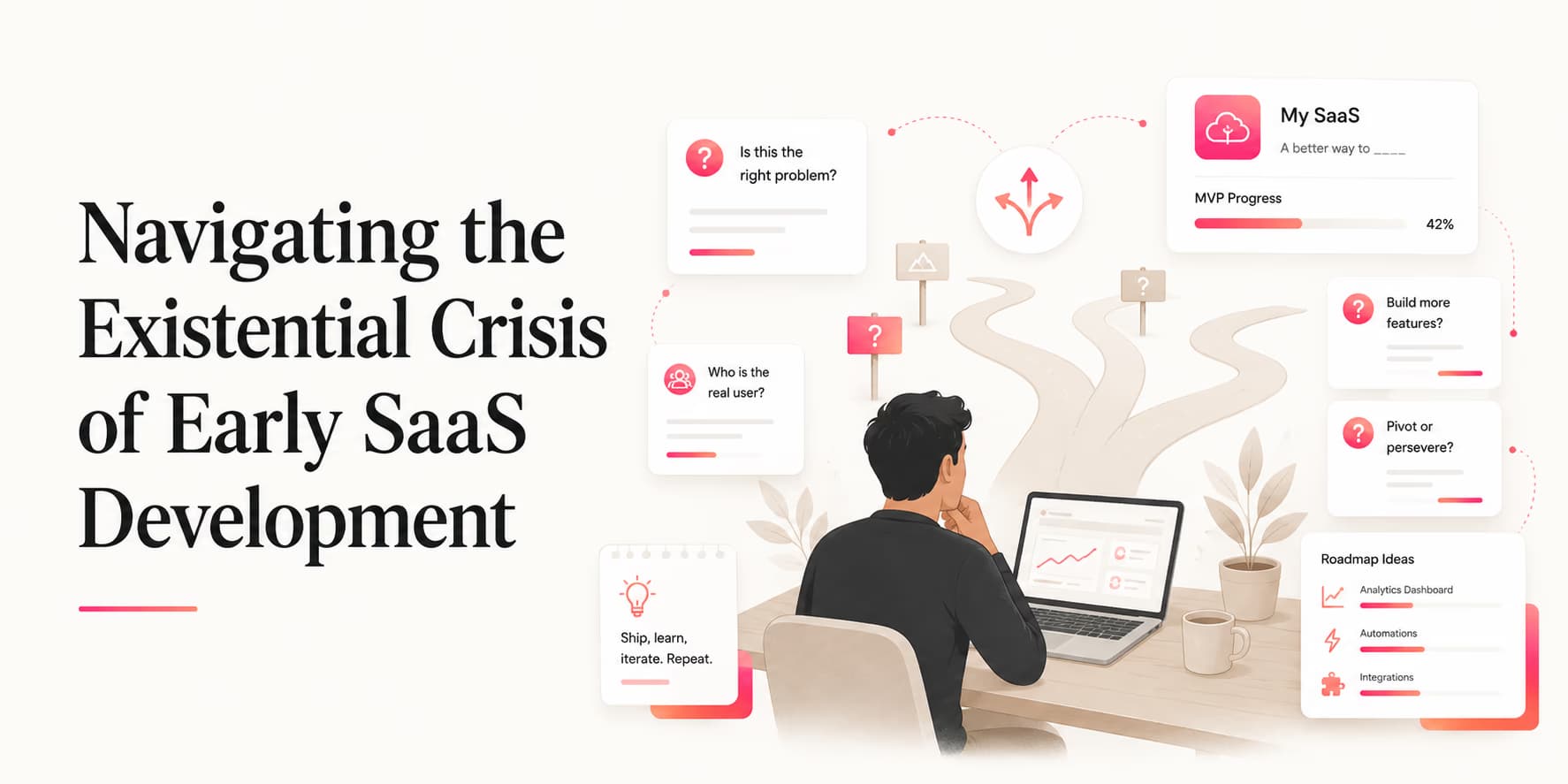
Bootstrapping a new B2B startup is a hard psychological stretch. Founders read industry coverage of funding rounds, fast revenue, and product launches. Those stories make growth look immediate and predictable.
For most teams, early-stage SaaS is different. Founders spend weeks working in isolation, managing code updates, fixing bugs, and reviewing marketing options, all while generating zero monthly recurring revenue (MRR).
This pre-revenue phase often triggers existential burnout. Founders start questioning product value, doubting targeting choices, and feeling overwhelmed by the work required to validate an MVP.
To get through that valley, manage the mindset. Move from feature-chasing distractions to consistent sales habits, and use direct outbound to validate demand.
The crisis is usually not "I need more features." It is "I do not know who this is for, and I am building anyway." Outbound is how you get a verdict before the next rewrite.
This is not medical advice, and serious anxiety or depression deserves real support from qualified people. But many founders do not need another motivational quote. They need a way to stop turning uncertainty into random work. The early SaaS crisis is often an evidence problem disguised as an identity problem: you do not yet know who wants the product, why they want it, what they will pay, or what they need next.
The way through is not to feel certain. It is to build a routine that produces evidence every week. Customer conversations, usage data, objections, failed demos, and paid commitments are all evidence. More isolated coding is usually not.
Separate emotion from evidence
Early founders often interpret every quiet day as a verdict. No replies becomes "nobody wants this." A demo that goes nowhere becomes "the product is bad." A competitor launch becomes "we are too late." Those thoughts may feel convincing, but they are not evidence until you inspect the actual inputs.
Replace the spiral with a short evidence check:
- Targeting: Did we contact buyers who clearly own the problem?
- Message: Did the opener reference a real trigger and ask a useful question?
- Offer: Was the next step low-risk and specific?
- Volume: Did we send enough high-quality attempts to learn anything?
- Feedback: What did prospects actually say, not what did we assume they meant?
This does not remove the emotional difficulty of building. It gives you a fairer way to interpret it. A failed batch may mean the segment is wrong, the trigger is weak, or the offer is unclear. That is different from "the company is doomed."
The trap of feature chasing
When outbound campaigns fail to convert immediately, technical founders often react by writing more code. They assume that adding another integration, redesigning the dashboard, or building an extra feature will convince prospects to subscribe.
This feature-chasing behavior is a distraction. Coding feels productive, but building features in a vacuum does not validate the offer.
Avoid adding features to your roadmap until:
- At least 3 active prospects have explicitly requested the feature.
- The buyers explain how the feature resolves their workflow bottleneck.
- The prospects commit to starting a trial or paying for the product once it is delivered.
Feature chasing feels safe because code has clear feedback. Tests pass or fail. UI changes are visible. Shipping a feature gives you the satisfaction of progress. Sales work is messier: buyers ignore you, objections are ambiguous, and the next step is not always obvious.
That is why you need a feature gate. Before building, write a one-page feature brief:
- Which buyer requested this?
- What exact workflow breaks without it?
- How many similar buyers have mentioned the same problem?
- Would this feature help close or retain a customer, or is it just interesting?
- What is the smallest version that proves the need?
If you cannot answer those questions, put the feature in a parking lot. The parking lot is not a rejection. It is a way to protect your week from anxiety-driven development.
For details on founder validation playbooks, read our guide to lessons from dropping out to build SaaS.
Use outbound conversations to stay oriented
The most useful antidote to existential uncertainty is customer contact. When you talk to target buyers directly, you gather real market feedback.
Even if prospects share objections, their responses provide direction:
- Objections clarify where your copywriting templates lack relevance.
- Feature requests define your product roadmap parameters.
- Connection acceptances verify that your target titles are accurate.
The most stabilizing thing a founder can do is talk to the market before interpreting the market. A quiet dashboard is not feedback. A real buyer saying "we already solve this with a spreadsheet" is feedback. A prospect saying "this belongs to RevOps, not the founder" is feedback. A design partner saying "I would pay if it handled this one handoff" is feedback.
Keep a small conversation quota. For example, aim to start 10 high-quality outbound conversations per week, not 200 generic sends. The point is not to win every conversation. The point is to create enough contact with reality that your next product decision is less imaginary.
Capture every reply in a simple format:
Prospect:
Segment:
Pain mentioned:
Objection:
Feature requested:
Willingness to pay:
Next action:
After a few weeks, patterns become visible. Those patterns are much better motivation than vague hope because they tell you what to build, who to target, and what to stop doing.
For verification guidelines, see our playbook for validating B2B MVPs.
A daily sales routine you can keep
To keep consistency, set an operating routine. Founders who only prospect when they feel motivated will watch the pipeline decline.
Block out the first two hours of your workday entirely for sales tasks. Do not open your code editor or check site analytics until you have sourced leads, reviewed message drafts, and managed reply threads.
If two hours is unrealistic, choose a smaller routine you can actually keep. A consistent 45-minute sales block beats an heroic four-hour sprint followed by silence. The routine should be boring enough to repeat on low-energy days.
A sustainable morning block might look like this:
- 10 minutes: Review yesterday's replies and decide the next step for each thread.
- 15 minutes: Find or approve a small number of high-fit prospects.
- 15 minutes: Edit outbound drafts so they reference real triggers and avoid generic claims.
- 5 minutes: Write one learning note: what did the market teach us?
This routine gives the day a sales pulse before product work takes over. It also prevents the most dangerous founder habit: using code to avoid uncomfortable conversations.
Mindset rule: accept the rejections
Rejection is a standard part of B2B sales. Founders who take negative replies personally burn out quickly. Treat every opt-out as data to refine targeting.
Set realistic early-stage MRR benchmarks
Keep your early-stage growth expectations realistic. Reaching your first $1,000 or $5,000 in MRR takes time.
Omentir is priced to help teams validate campaigns affordably:
- Pro ($49/month): Includes one user, one LinkedIn account, unlimited AI agents, leads, campaigns, AI automated campaigns, API access, email customer support, and a minimum of three bookings per week or you pay nothing.
- Enterprise: Includes unlimited users, unlimited LinkedIn accounts, all Pro features, plus SSO, dedicated onboarding, and priority support. Book a call to discuss your setup.
Focus on securing your first 10 paying customers before worrying about scaling your operations.
Early benchmarks should be behavior-based, not vanity-based. Instead of "we need to go viral," use targets like: 30 relevant prospects researched, 10 thoughtful conversations started, 3 qualified demos booked, 1 design partner closed, or 5 onboarding sessions completed. These goals are inside your control and tied to learning.
Revenue matters, but revenue is a lagging signal. Before revenue appears, track evidence that points toward it:
- Prospects describe the problem without you feeding them the words.
- Prospects ask for a workflow review, demo, or trial.
- Design partners use the product more than once.
- Customers object to price less than they object to missing proof or workflow fit.
- The same buyer segment keeps showing up in your best conversations.
These signals do not guarantee success, but they tell you where to keep digging.
Keep a decision log
A decision log is one of the simplest ways to reduce founder whiplash. Every time you change positioning, build a feature, pause a segment, or adjust pricing, write down the reason and the evidence. This prevents you from rewriting history when emotions change.
Use four fields:
- Decision: What changed?
- Evidence: Which conversations, metrics, or user behavior justified it?
- Expected result: What should improve if the decision is right?
- Review date: When will you inspect whether it worked?
The decision log turns the startup from a mood-driven project into a learning system. It also helps you avoid the trap of changing strategy every time a competitor posts a launch thread.
Protect profile health with throttling
Outbound campaigns still need safety boundaries. Pacing requests with random delays keeps campaigns looking organic.
Omentir manages this pacing automatically, protecting your profile deliverability. For safety guidelines, see our guide on pacing LinkedIn outreach campaigns.
The same principle applies to your energy. Do not try to fix a bad week by blasting more prospects. Low-quality desperation sends create bad data and can harm your profile. Keep outreach paced, reviewed, and narrow enough that every response is worth reading.
Daily 4-step founder operating routine
Manage the daily founder routine with these steps:
- Step 1: Sourced 10 target profiles matching your ICP criteria.
- Step 2: Review and edit campaign drafts in Omentir's outbox queue.
- Step 3: Respond to all incoming reply threads in your inbox.
- Step 4: Check campaign pacing and daily quota settings.
Add a weekly review on Friday:
- Which segment gave the clearest signal?
- Which objection repeated?
- Which feature request had real buying intent behind it?
- What one thing will change next week?
Keep the answer to one change. If you change the buyer, message, offer, landing page, and product at once, you will not know what worked. Calm execution is often just disciplined sequencing.
Omentir automates the administrative tasks so you can manage outreach in minutes.
Trade ambiguity for a weekly evidence loop
Existential burnout is a common hurdle in early B2B SaaS. Founders who keep building features in isolation will struggle to find traction.
By establishing consistent outbound sales habits, keeping a decision log, and building only from evidence, you keep development grounded in real customer demand. The tool is secondary. The log is what stops you from rewriting the product after every awkward call.
Frequently Asked Questions
Spending months developing features in isolation without market feedback creates uncertainty. Founders start doubting product value when they do not see immediate signs of demand.
Enforce a strict rule: never write code for a new feature unless at least 3 active design partners or paying clients have explicitly requested it and explained how it resolves their workflow bottleneck.
Omentir offers an affordable Pro plan beginning at $49/month, allowing founders to run discovery agents, set prompt variables, and manage safe connection pacing with minimal overhead.
Dedicate the first 2 hours of your day entirely to outbound sales (sourcing leads and managing conversation replies) before writing any code or modifying product features.