
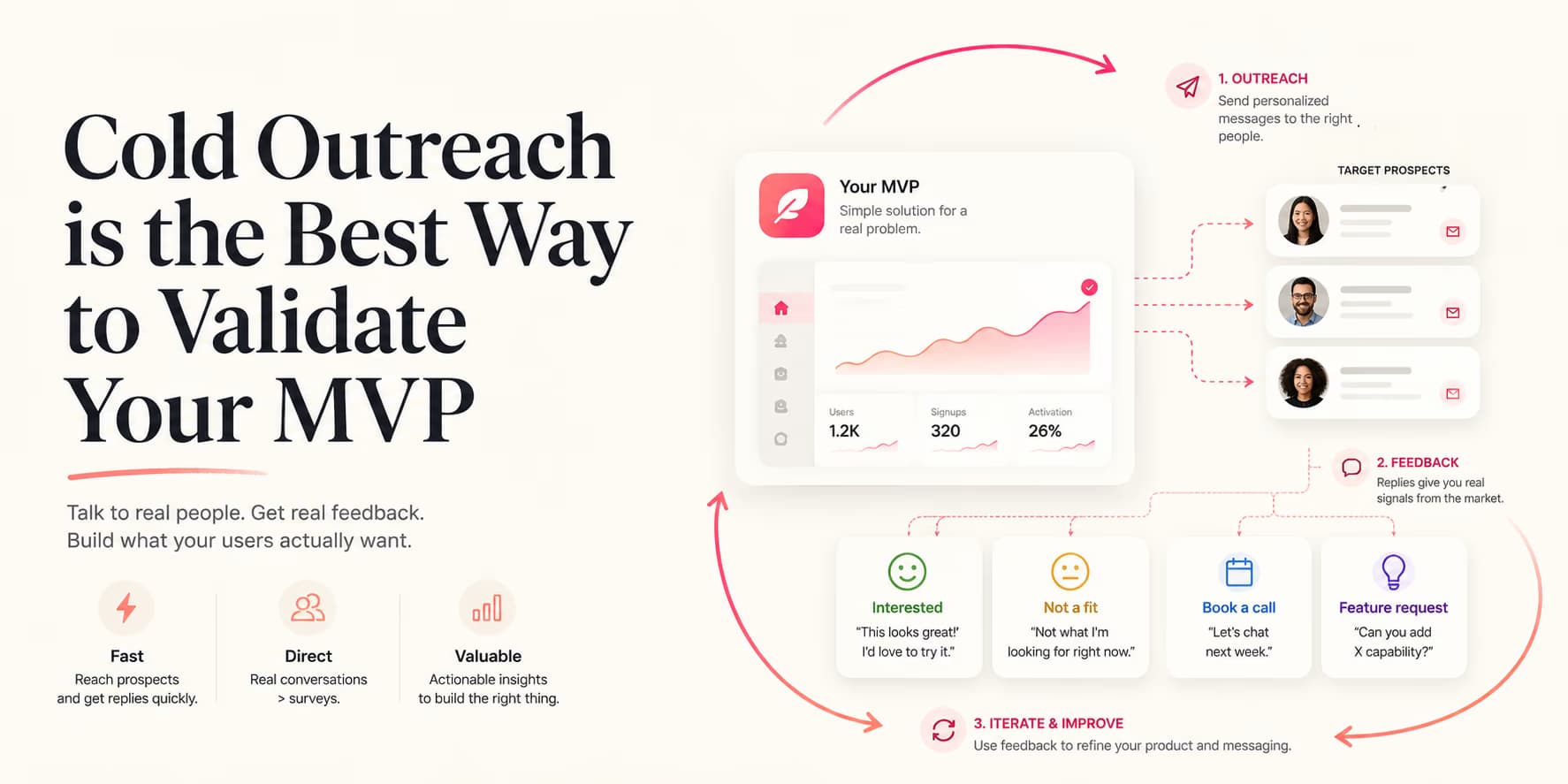
Building a minimum viable product (MVP) is a real milestone. Teams often assume that once the software exists, customer discovery will follow. That assumption is why a lot of software products fail.
Traditional validation (product pages, public surveys) gathers hypothetical feedback. A prospect might say they like the concept. They rarely commit time or budget once it is live.
Real validation measures behavior. Targeted cold outreach is a practical way to test demand. Pitch the value proposition to specific people, then judge interest from what they actually do.
Omentir can run that loop: discovery agents plus paced campaigns, so you can test ideas in minutes a day. The rest of this piece is how to build an outbound validation engine.
The key is to stop asking people whether they like the idea. People are polite. They will tell you something sounds interesting because that costs them nothing. Validation starts when a buyer gives you scarce resources: time, workflow detail, internal context, a referral, a pilot commitment, or money.
Cold outreach works because it puts your idea in front of a specific buyer and asks for a small behavior. If the buyer ignores it, objects to it, forwards it, books time, or asks for details, you learn something. A landing page cannot always tell you why someone left. A conversation can.
What validation actually means
MVP validation is not one yes-or-no event. It is a stack of evidence. At the bottom is attention: will the right people even respond? Above that is problem confirmation: do they describe the pain in their own words? Above that is urgency: are they trying to solve it now? At the top is commitment: will they pay, pilot, or change behavior?
Treat each layer differently:
- Attention: Connection acceptances, profile views, and first replies show reachability.
- Problem: Prospects explain the workflow pain without you forcing the language.
- Urgency: Prospects describe current workarounds, recent attempts, or a deadline.
- Commitment: Prospects book a call, join a pilot, introduce a teammate, or pay.
Do not confuse the lower layers for the top. A high acceptance rate means your target and profile may be relevant. It does not mean the product is validated. Validation gets stronger as the buyer gives up more time, detail, and budget.
The outbound validation funnel and metric proxies
To run a validation campaign you can learn from, track behavioral metrics as proxies for buying interest.
A validation funnel tracks three core conversion thresholds:
- Connection Acceptances (LinkedIn): Indicates how relevant your title and target market selection are to prospects.
- Conversation Reply Rates: Measures interest in the core challenge your software resolves.
- Call Booking Rates: Verifies willingness to invest time to evaluate your proposed solution.
These metrics are proxies, not verdicts. A campaign can have a modest reply rate but produce excellent learning if the replies come from exact-fit buyers. Another campaign can produce many replies from curious but poor-fit people. Segment-level interpretation matters more than aggregate vanity numbers.
Track four extra fields beside each metric:
- Buyer role: Who replied, and do they own the workflow?
- Problem language: What phrase did they use to describe the pain?
- Current workaround: How are they solving it today?
- Next-step strength: Did they ask a question, agree to a call, request a pilot, or disappear?
For details on list sourcing, see our guide on generating sales leads from LinkedIn.
Source and test different market segments
Your value proposition will land differently by role and industry. Identical messages to a broad list produce low conversion.
We recommend segmenting your list into three distinct sub-profiles:
- Segment A: Solo founders validating early growth processes.
- Segment B: VP of Sales managing active sales development teams.
- Segment C: Growth operators looking for integration APIs.
Test your value pitch across these segments to identify your most active buyer profile.
Keep segment tests clean. Do not test ten audiences at once. Pick two or three segments with a clear reason to care, then give each segment its own hypothesis. For example: "solo founders care about finding first customers," "VPs of Sales care about rep productivity," and "growth operators care about workflow integration."
Each segment should get a slightly different diagnostic question. The product may be the same, but the pain is not. A founder may respond to "Are you still doing prospect research yourself?" A VP Sales may respond to "How are you keeping lead quality consistent across reps?" A growth operator may respond to "Where does lead data break between sourcing and campaign launch?"
After the first batch, do not ask which segment had the most replies only. Ask which segment gave the clearest problem, strongest urgency, and easiest path to payment. The best validation segment is not always the loudest one.
Copy: a discovery script that is not a pitch
Validation campaigns need copy that does not sound like a close. Pitching features in the first note triggers opt-outs.
Write short, conversational notes that ask for feedback rather than meetings:
Hi {first_name}, saw {company_name} is hiring outbound roles.
I am testing a workflow that helps early teams review lead quality before reps send messages.
Are you doing prospect research manually today, or is that already centralized?
The short note lowers friction. You get feedback without forcing a meeting.
The message does not ask for a demo immediately. It asks a question that reveals the current workflow. If the prospect says "manual," you can ask what makes it painful. If they say "centralized," you can ask what tool or process they use. Either answer teaches you something.
Avoid pretending the product is more mature than it is. If you are validating, say you are testing the workflow or looking for operator feedback. Buyers respect clarity. They do not respect a fake enterprise posture from a product that is still changing weekly.
Classify replies into evidence
Replies should not sit in an inbox as anecdotes. Classify them so you can make decisions after the batch finishes.
- Problem confirmed: The buyer describes the pain or current workaround.
- Wrong person: The buyer says another role owns the problem.
- Wrong timing: The buyer understands the pain but has no active urgency.
- Proof needed: The buyer asks for examples, security detail, case studies, or product evidence.
- Commitment: The buyer agrees to a call, pilot, paid test, or referral.
This classification turns subjective momentum into usable evidence. If most replies are "wrong person," change the target role. If most are "proof needed," improve the demo or pilot offer. If several are "commitment," stop polishing and start onboarding.
Charge early
Do not give early users free access by default. Even a small fee is real validation. It proves the problem hurts enough that someone will pay.
Pull roadmap priorities from live threads
Active sales threads provide valuable insights for product development. When prospects explain why they cannot use your product, they share details about their workflow limits:
For example, if a prospect says "We would love to use Omentir, but we need our lead data to sync directly to our HubSpot campaigns," they are highlighting an integration requirement.
Use these details to prioritize your product roadmap, focusing development on features that drive conversions.
Not every feature request deserves the roadmap. Prospects often ask for features because it is easier than saying no. Before building, ask whether the request came from your target segment, whether it repeats across buyers, whether it blocks payment, and whether a smaller workaround could test the need.
Use this feature gate:
- Build now: Multiple qualified buyers say the missing capability blocks purchase or activation.
- Prototype: One strong design partner needs it and agrees to test a lightweight version.
- Park: The request is interesting but comes from a weak-fit segment or unclear urgency.
- Reject: The feature would pull the product away from the buyer segment you are validating.
This prevents cold outreach from turning into a scattered feature wishlist. Validation should narrow the product, not explode it.
Pace outbound safely during validation
Even during early validation campaigns, you must manage your sending volume. High outreach speeds will trigger automated spam blocks on your profiles.
Omentir protects your profiles by implementing safe connection quotas (keeping connections under 20 requests per profile daily). For pacing guidelines, see our guide on pacing campaigns safely.
Validation does not require high volume. In fact, high volume can make learning worse because you cannot inspect each reply carefully. Use small batches, review every draft, and give yourself enough time to respond thoughtfully. The goal is clean evidence, not maximum sends.
Keep discovery and sending separate. Build a larger research list if you want, but only send to the prospects with the strongest fit and clearest trigger. This protects your profile and improves the quality of the validation data.
SOP: the 14-day MVP validation loop
Implement this validation loop to test your product concept:
- Step 1: Find 100 prospects matching your target operator profile.
- Step 2: Configure Omentir to crawl their sites and draft custom discovery notes.
- Step 3: Review and approve drafts in the pacing outbox queue.
- Step 4: Track reply rates, grouping responses by category (objections, features, interest).
Use the 14 days like this:
- Days 1-2: Define two or three target segments and write a hypothesis for each.
- Days 3-4: Build small, high-fit prospect lists with visible triggers.
- Days 5-8: Send paced discovery messages and reply quickly when prospects engage.
- Days 9-11: Run calls, ask about current workflow, and avoid pitching before diagnosis.
- Days 12-14: Classify replies, update the roadmap gate, and choose the next segment or pilot offer.
At the end, write a one-page validation memo: which segment showed the strongest pain, what they currently do, what they would pay or pilot, which objections appeared, and what you will build or test next. That memo is more valuable than a vague feeling that "outreach went well."
Omentir handles the variable mapping and safety limits, allowing you to validate your MVP efficiently.
Let demand decide what you build
A B2B product needs market feedback. Targeted cold outreach is how you spend development time on problems buyers already have.
The best validation loop is calm and evidence-driven: pick a segment, ask a real question, classify the replies, and build only from repeated buyer proof. A yes that never becomes usage is not validation. It is politeness.
Frequently Asked Questions
Surveys gather hypothetical answers. Outbound outreach asks prospects for their time or commitment, measuring active behavior (like accepting a connection or booking a call) which correlates with purchase intent.
Start with a narrow, high-relevance batch before chasing sample size. The goal is not statistical perfection; it is enough repeated evidence from the right buyers to decide what to test next.
Omentir offers a Pro plan starting at $49/month, allowing you to run discovery agents, set prompt variables, and manage safe connection pacing affordably.
Look for repeated problem confirmation, qualified conversations, willingness to spend time, design-partner interest, and eventually payment. Acceptance and reply rates help, but they do not prove demand by themselves.