
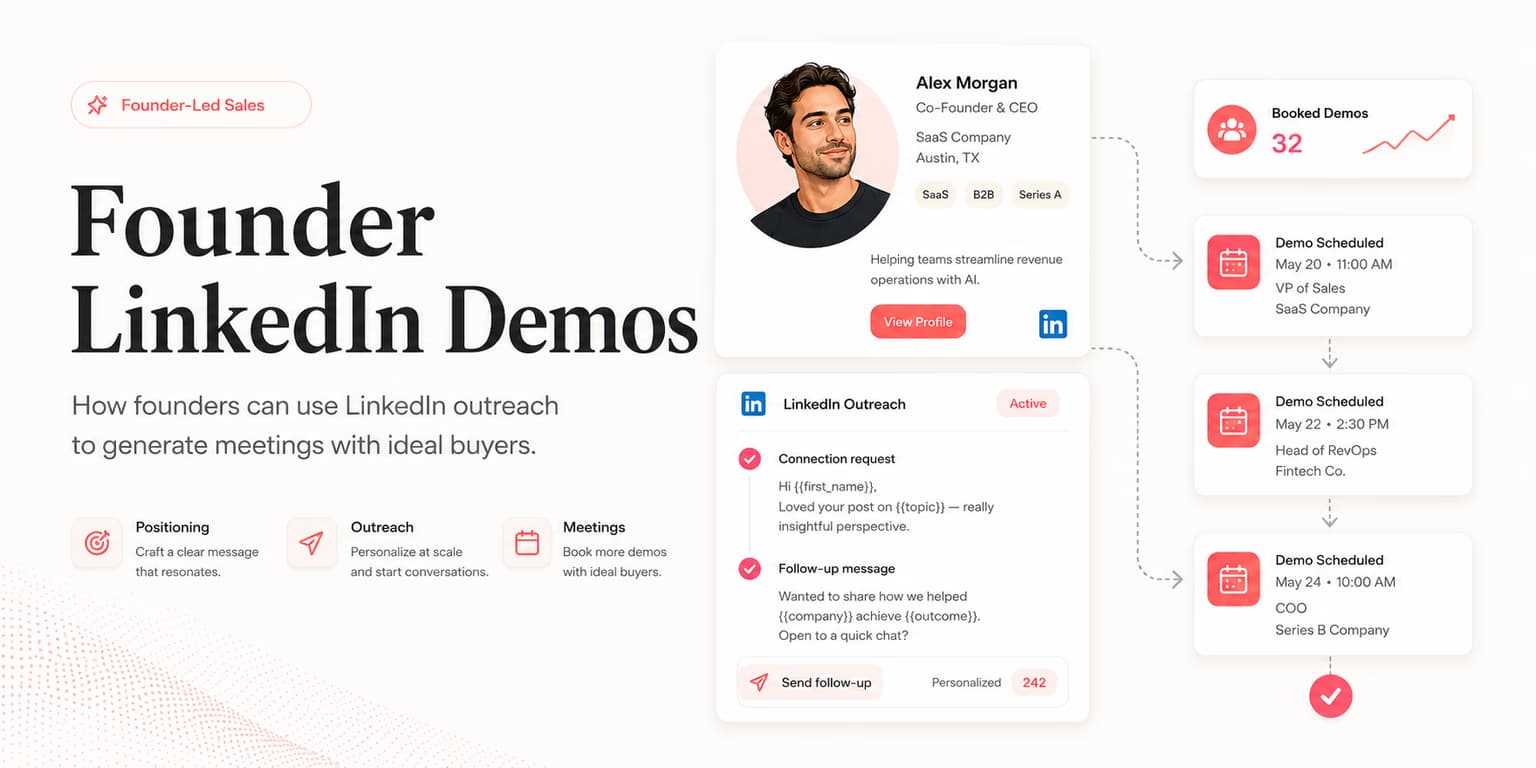
A founder demo sourced from LinkedIn is a live market interview with someone who matched your targeting, answered your outreach, and was willing to spend time on the problem you raised.
That makes the call more valuable than a normal product tour. You are testing positioning, urgency, workflow fit, budget awareness, buyer language, and trust. If you treat the demo like a slide presentation, you waste the most useful signal in early sales.
This article assumes you already know how to start conversations and book the meeting. If you need that upstream process, read the founder guide to booking early demos on LinkedIn or the narrower guide to turning interested replies into scheduled calls. Here, the question is what the founder should do once the prospect shows up.
The founder demo advantage
Founders have an advantage that hired sellers rarely have in the first months of a company: they can change the product, clarify the roadmap, and interpret buyer objections without waiting for someone else's notes. A founder can hear a prospect describe a messy process and immediately understand whether the product is wrong, the pitch is wrong, or the buyer is wrong.
That advantage disappears when the founder acts like a generic sales rep. If the call opens with ten minutes of company background, a canned deck, and a rehearsed feature list, the buyer learns very little and the founder learns almost nothing.
The better posture is builder-to-operator. You are there to understand the workflow, show the most relevant part of the product, and decide together whether the next step is worth taking.
The founder demo rule
You are not trying to prove every feature works. You are trying to learn whether this buyer has a painful problem you can solve now, and whether your product makes the next step obvious.
This is why founder-led demos should feel calmer than polished sales demos. The buyer should leave believing they spoke with the person closest to the product and the problem, not someone running through a script.
Prepare before the call
Preparation should take ten minutes, not an hour. The goal is to know why this buyer was worth meeting and what you need to learn from them. If you open the call with a generic discovery script, you erase the context that made LinkedIn outreach work in the first place.
Review the original LinkedIn trigger, the exact reply that led to the meeting, the buyer's role, and the company context. Then write one sentence that explains why this call exists.
"This call exists because the prospect is scaling a customer success team and said manual renewal tracking is becoming hard to manage."
That sentence becomes your anchor. It stops you from showing irrelevant features, and it gives the buyer confidence that the call is tailored to their situation.
Send a one-line confirmation before the meeting if the original LinkedIn thread was especially specific. Something as simple as, "I will come prepared around the renewal tracking issue you mentioned," reminds the buyer why they accepted the call and reduces the chance that the demo feels like a generic vendor slot.
- Trigger: What changed at the company that made the problem timely?
- Person: Why is this buyer close to the pain or the decision?
- Question: What do you need to learn before deciding whether to sell?
- Proof: What one example or workflow can make the product credible?
If you use Omentir for agent-assisted outbound, this preparation is where the unified inbox and intent context matter. The system can help surface the thread, score fit, and draft the campaign, but the founder still needs to decide what the live conversation is meant to prove.
Run the demo in layers
The easiest founder demo structure is layered. Start with context, move into discovery, show only the relevant workflow, then decide on the next step. Do not start by sharing your screen.
A simple thirty-minute call can follow this rhythm:
- Minutes 0-3: Confirm why you are speaking and restate the LinkedIn context.
- Minutes 3-12: Ask about the current workflow, owner, cost of the problem, and what they have already tried.
- Minutes 12-22: Show the smallest product path that maps to the pain they described.
- Minutes 22-27: Ask what felt useful, what felt wrong, and what would block adoption.
- Minutes 27-30: Agree on the next step, or honestly call out that there is no fit yet.
This format protects both sides. The buyer does not have to sit through a full platform tour. The founder does not have to guess what matters. The product appears only after the problem is clear.
It also prevents a common founder mistake: over-explaining the vision. Buyers care about vision after they believe the current pain is understood. If the current workflow is still fuzzy, a grand roadmap sounds like avoidance.
Questions that expose fit
Founder demos should include questions a normal seller might be afraid to ask. You need signal more than politeness. The buyer's answers should tell you whether the pain is real, whether the workflow is owned, and whether the product has a path into the business.
Use questions that force specificity without sounding like an interrogation.
| Question | What it reveals |
|---|---|
| "What happens today when this breaks?" | Whether the pain has a visible operational cost. |
| "Who notices the problem first?" | Whether you are speaking with the right owner or a secondary observer. |
| "What have you already tried?" | Whether the team has urgency or is only curious. |
| "If this worked, what would change next month?" | Whether the buyer can connect the product to a business outcome. |
Listen for the buyer's exact language. If three prospects describe the same pain in words that differ from your homepage, your positioning may need to change. That is not a failure of the demo. That is the demo doing its job.
Show less product
Founders often show too much because they are proud of what they built. The buyer does not need your entire architecture. They need to see the shortest believable path from their pain to a better workflow.
Choose one product story before the call. If you sell an AI sales agent, do not show every setting, every integration, and every campaign screen. Show how a prospect moves from ICP definition to qualified lead, from lead to approved outreach draft, and from reply to prioritized inbox.
In Omentir's case, a tight demo would focus on the buyer's actual outbound bottleneck. If the prospect struggles with finding ICP-fit buyers, show lead discovery and scoring. If they struggle with messy replies, show the intent-sorted inbox. If they are evaluating agent workflows, show the agent API and hosted MCP path without pretending every viewer needs it.
A focused demo also gives you a better close. Instead of asking, "What did you think?" you can ask, "Is this workflow close enough to your current problem that we should test it with your next batch of leads?"
Capture signals afterward
The five minutes after the call are as important as the call itself. Write notes while the language is still fresh. Do not only record whether the call went well. Record what the buyer taught you.
- Pain words: The exact phrases the buyer used to describe the problem.
- Trigger: The event that made the problem urgent now.
- Blocker: The reason they might not move forward.
- Proof gap: The evidence they needed but you did not have.
- Product gap: The missing capability that came up more than once across calls.
After ten founder demos, patterns should emerge. If every buyer asks the same security question, add proof. If every buyer misunderstands the same phrase, rewrite the positioning. If only one buyer asks for a strange feature, do not rebuild the product around them.
This is the part of founder-led sales that cannot be outsourced early. A sales rep can log notes. A founder can connect those notes to product, messaging, and ICP decisions.
Next step without pressure
The next step should match the strength of the signal. A highly qualified buyer with active pain might deserve a pilot, pricing discussion, or technical setup call. A curious buyer might only need a follow-up resource. A poor-fit buyer should be released gracefully.
Use direct language. Buyers trust founders who can say when something is or is not a fit.
"Based on what you showed me, I think there is a real fit around the manual review step. The cleanest next step would be to test this on a small batch before we talk about a broader rollout. Does that feel useful, or too early?"
If the demo was not a fit, still close the loop well.
"I do not think we are the right tool for the workflow you described today. The useful thing may be to revisit once your team is handling more volume. I appreciate the detail you shared because it helps me avoid building in the wrong direction."
Founder LinkedIn demos work when they create a clean feedback loop: specific outreach, qualified conversation, focused product proof, honest next step, and captured learning. That loop is more valuable than a polished pitch because it helps you win better customers and build the product those customers actually need.
FAQs
Yes, until the founder can predict the buyer's objections, words, and decision criteria. After that, parts of the process can move to sales or customer success.
Thirty minutes is usually enough. Use the first half for discovery, the middle for a focused product walkthrough, and the final few minutes for fit and next steps.
If the prospect has a real problem and asks about cost, answer directly. Avoid hiding pricing behind artificial mystery, but do not turn an unqualified discovery call into a negotiation.
Write down the mismatch. Weak demos are still useful if they reveal a bad ICP, unclear positioning, missing proof, or a product gap worth validating with better-fit buyers.