
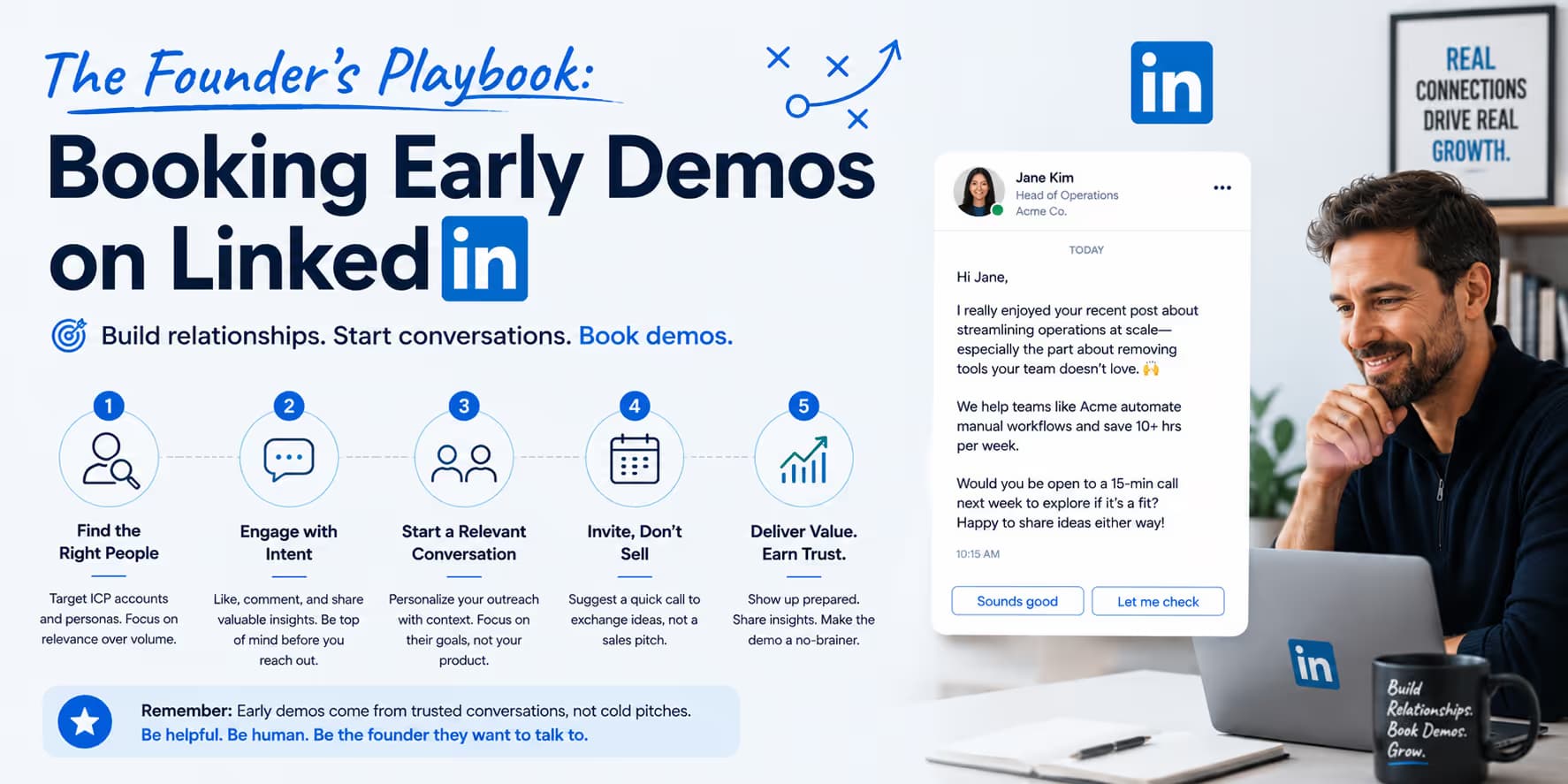
For early-stage B2B founders, booking the first 20 sales demos is an operational milestone. Those discovery meetings do more than bring early revenue. They clarify the product roadmap, refine your ideal customer profile (ICP), and test whether buyers actually care. If you can keep getting conversations with active buyers in your space, a rough prototype has a path to a business that can grow.
Many founders still struggle to get those meetings. They outsource outbound to a lead generation agency or hire an SDR too early. Before your messaging is tested and product-market fit is real, that spend is wasted capital. Direct LinkedIn outreach is still the leanest, most repeatable way for an early-stage founder to find customers. Use founder status and a feedback-first conversation, and you can fill the calendar with validation meetings worth having.
The C-suite connection: the founder's edge
Many technical founders dread outbound sales because they hate feeling "salesy." They worry about bothering prospects or being flagged as spam.
What they miss is that founders have an unfair advantage in outbound: the Founder's Edge.
VP-level and C-suite executives have a real allergy to messages from sales representatives. They know an SDR's job is to hit a meeting quota, so they delete those pitches. The same busy executives often reply to founders. They respect the work of building a company, and they will often help another builder think through a hard industry problem.
To keep that advantage, design your outreach and LinkedIn profile as a peer conversation. If your profile reads like a polished corporate sales representative, you lose it immediately. Write as an active researcher and builder trying to solve a real industry bottleneck.
The Peer Bias Rule
Never use transactional sales phrases like "schedule a demo," "our product capabilities," or "value proposition." High-value buyers spot these sales scripts instantly. Address the buyer exactly how you would discuss a growth challenge with an advisor or peer.
The peer feedback and validation strategy
The biggest mistake founders make in early outreach is trying to sell their product immediately. When you are pre-validation, pitching features and pushing for a formal demo puts the buyer on the defensive. They expect a pushy, transactional sales pitch, so they ignore your message.
To lower the temperature, change the outbound goal from selling to validation.
Instead of asking for a sales meeting, ask for their professional perspective or feedback on how they solve a specific operational pain point. This approach is disarming because it compliments their expertise and removes immediate transactional pressure. By asking a prospect to "brutally tear down our workflow blueprint" or "share their perspective on a niche problem," you open the door to a genuine peer dialogue. Once the ice is broken and they share their bottlenecks, transitioning them to a beta customer is a natural step.
3 founder outbound playbook templates
Adapt these conversational founder templates to your industry:
"Hi [FirstName], saw you manage the revenue engineering team at [CompanyName].
I am a fellow engineer building a lean, lightweight tool to automate duplicate lead cleansing safely. Since you are directly in the trenches there, I'd love to get your brutal feedback on our 2-step setup outline.
Open to checking out the 1-page playbook PDF, or are you fully sorted there?"
Why it works: COMPLIMENTARY & peer-to-peer. Asking for "brutal feedback" is a highly disarming signal that removes the fear of a slick sales presentation.
"Hi [FirstName], noticed your recent posts regarding [Topic] changes.
We are currently launching a private, free beta access cohort for a lean tool that automates [NichePainPoint] under these new parameters.
I am looking for exactly 5 revenue leaders to test-drive the workflow and share feedback. Worth a quick look?"
Why it works: High exclusivity and zero cost. Framing the offer as a "free beta cohort" for just 5 selected experts builds strong interest and drives action.
"Hi [FirstName], saw you have been scale-building [Department] at [CompanyName] for over 3 years.
I am currently mapping out a research study regarding how growth-stage SaaS companies manage hybrid cloud latency limits.
I'd love to ask you three quick questions regarding your daily workflow. Open to sharing your perspective?"
Why it works: Positioned around research and authority building. Executives enjoy sharing their professional achievements, which makes this highly effective at starting a dialogue.
How to handle the "Is this a sales pitch?" objection
When you run a validation-first outreach sequence, you will occasionally encounter prospects who are highly protective of their schedule. They are suspicious of any cold note, and they may reply with a sharp query: "Is this just a sales pitch?" or "What are you trying to sell me?"
Most founders panic when they receive this reply. They either ignore the message or double down on their product benefits, which destroys the relationship.
The way through this objection is honesty plus a conversational pivot:
| Objection type | Terrible response (avoid) | Disarming peer pivot (fix) | Tactical outcome |
|---|---|---|---|
| "Is this a sales pitch?" | "No! Omentir is an award-winning platform that increases booked demos by 30%..." | "Fair question. I do run a company, but I'm pre-revenue and genuinely want brutal feedback on our outline first. Completely up to you!" | Bypasses sales guard; demonstrates high EQ. |
| "We don't have budget." | "Our product is extremely cheap! We only charge $49/mo, which fits any budget..." | "Completely understand. We are pre-commercialization right now, so no billing exists. Genuinely just seeking process feedback." | Removes budget friction completely; invites collaboration. |
Case study: booking 24 validation demos in 30 days
A technical founder named Alex used this playbook to validate a developer tool. Alex was building a tool to monitor localized cloud latency. He spent three months on a prototype, then ran standard outbound: 50 connection requests a day with a product feature pitch and a Calendly link.
His connection acceptance rate stayed below 15%, his reply rate was zero, and he booked zero meetings in 3 weeks.
He then switched the campaign to a validation-first frame:
- Step 1: Profile audit. He updated his LinkedIn profile, changing his headline from "CEO at LatencyCheck" to "Developer building lightweight monitoring tools."
- Step 2: Narrow CRM targeting. He curated a highly specific list of 150 engineering directors in growth-stage B2B SaaS companies.
- Step 3: Disarming copywriting. He rewrote his sequence to ask for "brutal feedback from cloud experts" on his latency monitoring blueprint, utilizing Template 1.
- Step 4: The Outbound validation loop. During the discovery meetings, Alex asked open-ended questions about their daily workflows and bottlenecks. He fed their exact terminology back into his product roadmap.
The results showed up quickly. Alex's connection acceptance rate jumped to 58%, and his reply rate rose to 36%. Working within platform limits, he booked 24 validation discovery demos in 30 days. He also closed his first 4 design partners on paid beta contracts before writing a single line of enterprise code.
Keep early validation focused
Use the playbook above to validate demand before widening the campaign. Early demos are most useful when they come from buyers who closely match the problem you are testing.
Founder sales and validation FAQs
Be direct. If they ask about advanced enterprise capabilities you have not built yet, tell them: "We are pre-commercialization right now, so we are focused entirely on refining this core workflow. Since you highlighted that enterprise requirement, would you be open to test-driving the prototype as a design partner so we can build it exactly how your team needs it?" That turns early-stage status into a reason to work together, not a reason to hide.
Yes. Real validation is a financial commitment. If you offer a product free forever, people will say "yes" to be polite, then ignore it. Offer a beta discount or a low-risk pilot (for example, $100/mo) in exchange for ongoing feedback and a case study when they see results.
Keep validation calls under 20 minutes. That shows you respect their time. Spend 15 minutes on open questions about daily operational bottlenecks and a lightweight prototype. Spend the last 5 minutes asking if they want to join the free beta cohort.
Do not hire an SDR or outsource sales until you have personally booked at least 20 demos, closed 5 paying customers, and validated one outreach sequence that converts at or above 30%. Until you have that blueprint, outside help will not produce pipeline.