
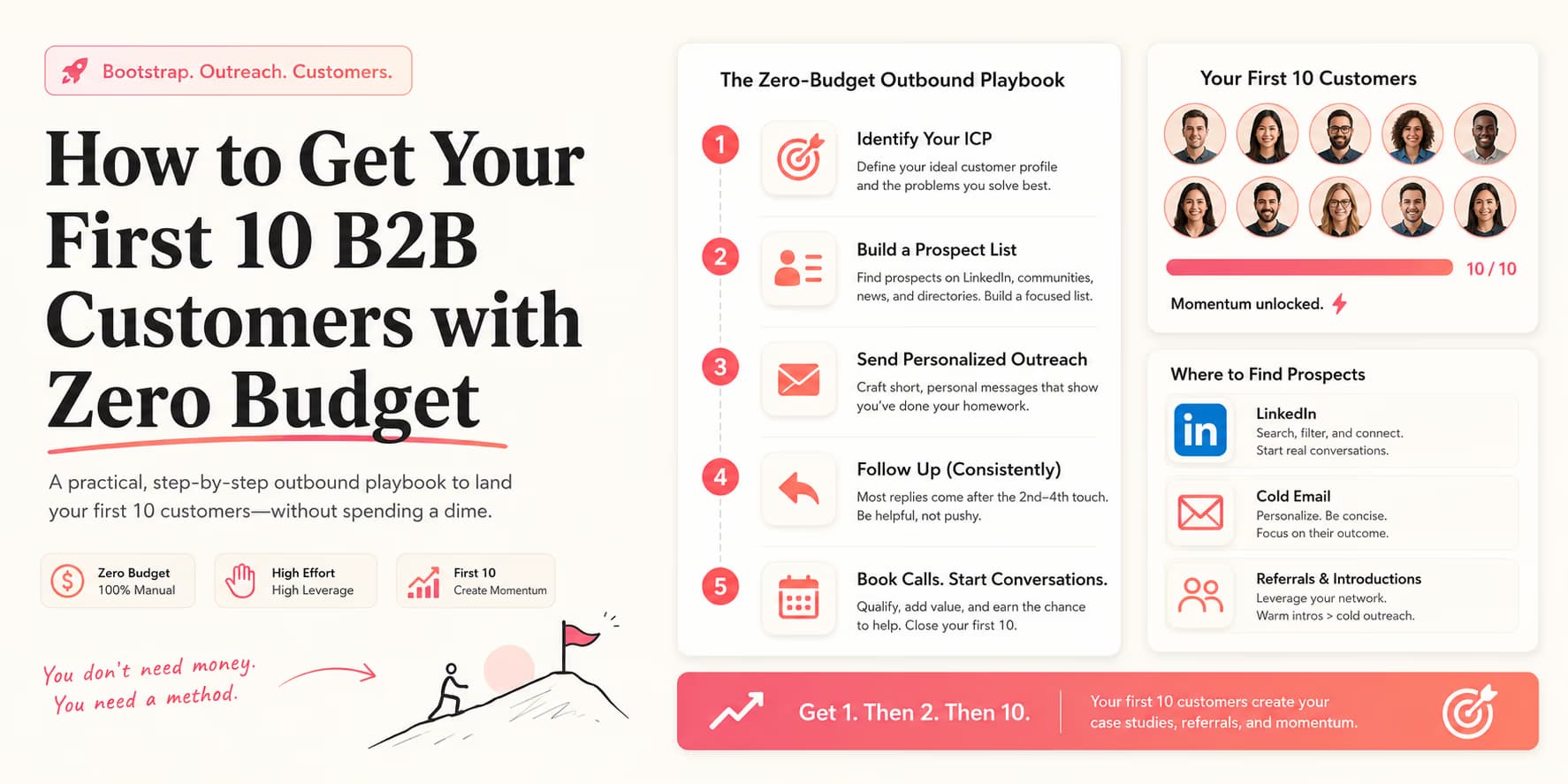
Launching a B2B startup is challenging, but getting your first customers is the most difficult stage. Senders could previously rely on venture capital to fund paid ad campaigns, purchase expensive database retainers, and hire sales agencies. For bootstrapped founders, these paths are not options.
Sourcing your first buyers requires focus. When you have no advertising budget, you must replace capital with direct outreach.
The goal is not to message thousands of prospects. Instead, focus on finding a small group of high-relevance contacts, writing custom messages, and offering design partnerships.
Zero budget does not mean zero effort. It means you spend time instead of ads, and you cannot afford to waste that time on a wide ICP.
Zero budget does not mean zero discipline. In fact, having no budget can be an advantage because it forces you to talk to real buyers before hiding behind ads, content calendars, or expensive tools. You cannot outsource the hardest question: does anyone care enough about this problem to pay?
Your first 10 customers should teach you who buys, why they buy, what words they use to describe the pain, which objections appear repeatedly, and what part of the product actually matters. The goal is not only revenue. The goal is paid learning from people who resemble the market you want to serve.
Start with one painful market
Most founders make zero-budget acquisition harder by starting too broad. They describe the product as useful for "sales teams," "founders," "agencies," or "small businesses." Those categories are too wide for manual prospecting. When you have limited time, you need a small market where the pain is visible and the buyer is reachable.
Pick one segment with three traits:
- Visible pain: You can see signs of the problem from public activity, job posts, community questions, or LinkedIn updates.
- Reachable buyer: The person who feels the problem is active online and can reasonably reply to a direct message.
- Short buying path: The buyer can test or purchase without a six-month procurement process.
For example, "B2B SaaS founders hiring their first SDR" is stronger than "companies that need leads." The founder is reachable, the hiring signal is public, and the problem is urgent: they need outbound pipeline before the new hire wastes time on messy prospecting. That is a segment you can work manually.
Write your first target statement in one sentence: "We help [specific buyer] who is dealing with [visible problem] achieve [practical outcome] without [painful alternative]." If the sentence sounds vague, your outreach will sound vague too.
Sourcing channel 1: high-relevance LinkedIn search loops
LinkedIn is the most effective channel for zero-budget B2B prospecting. Senders do not need premium subscriptions to locate target accounts.
Configure your search using standard filters:
- Job title exclusions: Filter out irrelevant roles to focus on decision makers.
- Recent activity: Target profiles that have posted or commented within the last 30 days so you are writing to people who still open LinkedIn.
- Hiring posts: Search for posts containing "we are hiring" to find companies that are growing.
Do not start by collecting hundreds of names. Start with a daily list of 10 to 20 people you would be willing to research properly. For each prospect, capture the profile link, company page, role, recent activity, visible trigger, and your reason for believing the problem is active. If you cannot fill those fields, the prospect is probably not ready for a message.
A strong LinkedIn search loop has three passes. First, search for the buyer title and market. Second, inspect the company for a trigger such as hiring, recent funding, product launch, new market focus, or active content around the problem. Third, check whether the person has posted, commented, changed roles, or engaged with relevant topics recently. This takes longer than scraping a list, but it gives you the context needed to write a message that does not feel random.
Use a simple scoring rule:
- 3 points: The buyer matches your exact role and company segment.
- 2 points: There is a current business trigger tied to your problem.
- 1 point: The buyer is active enough that a message has a realistic chance of being seen.
Only message prospects with at least five points. This keeps your outreach focused when every send matters.
For details on setup filters, see our guide to optimizing LinkedIn targeting criteria.
Sourcing channel 2: Reddit and developer Slack
Online communities are excellent sources of target buyer insights. On these platforms, operators share their operational bottlenecks and request tool recommendations.
Monitor subreddits and Slack groups relevant to your industry. Search for keywords related to the challenges your product solves (e.g. "leads list cleaning" or "email bounce limits").
When you find a user asking for help, reach out directly with a conversational message.
Communities are not lead databases. They are places where trust is visible. The fastest way to damage your reputation is to enter a group and immediately pitch every person who complains about a problem. Instead, watch the language people use, answer questions publicly when you can be useful, and only send a direct message when the context clearly supports it.
Look for problem phrases, not product phrases. Buyers rarely say, "I need an AI outbound automation platform." They say things like, "Our reps spend too much time building lists," "our LinkedIn messages feel generic," "we do not know which accounts are worth contacting," or "we booked calls but they were poor fit." Those phrases are raw customer language. Save them. They will improve your landing page, your demo, and your sales copy.
When you reply, lead with the problem, not the product:
Saw your note about reps spending hours cleaning prospect lists.
I am building a small tool around that exact workflow for early B2B teams.
Not trying to pitch a full platform here, but would it be useful if I shared
the checklist we use to decide whether a LinkedIn lead is worth contacting?
This kind of message offers help first and leaves room for a conversation. If they engage, you can ask about their workflow and decide whether a design partner conversation makes sense.
Sourcing channel 3: warm introductions and referrals
Your existing network is highly valuable during early growth. Senders often hesitate to ask for introductions, missing out on warm sales conversations.
Review your secondary connections on LinkedIn. If you find a target buyer connected to a mutual partner, ask for a brief introduction, explaining that you are looking for feedback on a new tool.
Make the introduction request easy to forward. Your contact should not have to explain your product from memory. Give them two short sentences they can paste, plus a clear reason the target person may benefit.
Hey Maya, quick ask.
I noticed you know Arjun at Northstar. I am looking for feedback from founders
who are trying to build outbound without hiring a full sales team.
Would you be comfortable introducing us if you think the context is relevant?

Forwardable line:
Vansh is building Omentir, a lightweight way for early B2B teams to find
qualified LinkedIn prospects and draft safer outbound. He is looking for
operator feedback, not a hard sell.
Warm referrals work because trust transfers, but only if you protect the person making the introduction. Be specific, respectful, and willing to accept "not a fit."
Pricing Rule: Charge Your First Users 💡
Never give away your product for free. Senders who offer free access get low user engagement because customers do not invest time to integrate the tool. Charging a discounted price verifies buying intent.
Copywriting: the conversational value pitch
Zero-budget outreach requires high personalization. Senders using generic templates will see low response rates, wasting their daily connection limits.
Write short, conversational notes that open by referencing a specific trigger and lead into a soft question. For copy blueprints, see our guide to the B2B copywriting framework.
Your first customer messages should sound more like research-backed invitations than polished sales campaigns. You are not trying to prove that your company is huge. You are trying to prove that you understand a painful workflow and are serious enough to solve it with a few early customers.
Use this structure:
- Trigger: Mention the public signal that made the person relevant.
- Pain: State the likely workflow problem carefully, without pretending you know their internal metrics.
- Build: Explain what you are building in plain language.
- Ask: Ask a question that starts a conversation, not a demand for a demo.
Hi Sam, saw you are hiring your first outbound rep.
Teams at that stage often struggle to keep lead quality high before the sales process is mature.
I am building Omentir to help founders find ICP-fit LinkedIn prospects and draft safer messages.
Are you handling prospect research manually right now?
This message is not perfect for every buyer, but it does the important things: it is specific, short, grounded in a visible trigger, and easy to answer.
Qualify before you demo
When someone replies, do not rush straight into a product tour. Your first 10 customers should be qualified carefully because early customers shape your roadmap, support load, testimonials, and positioning. A bad-fit customer can cost more than they pay.
Ask a few simple questions before offering a walkthrough:
- How are you solving this problem today?
- What happens if the problem stays the same for another quarter?
- Who owns the workflow internally?
- Have you tried another tool, spreadsheet, contractor, or manual process?
- If this worked, what would need to change for it to be worth paying for?
These questions reveal urgency. A prospect who says "interesting idea" may be curious, but a prospect who describes a painful manual process, a current workaround, and a business consequence is much closer to buying.
Nurturing leads by offering design partnerships
When launching an MVP, avoid hard sales pitches. Instead, invite prospects to join as design partners.
Explain that you have built a new tool to resolve a specific issue (e.g. automating lead qualification) and want to partner with a few select teams to refine the features in exchange for discounted rates.
This positioning lowers buyer friction and helps you land initial users faster.
A design partnership should still have structure. Define the price, length, support expectations, feedback cadence, and success outcome before the customer starts. Otherwise, "design partner" becomes a vague favor instead of a real commercial relationship.
A simple design partner offer might be: three months at a discounted rate, weekly feedback calls for the first month, priority support, and the ability to influence the roadmap around a specific workflow. In exchange, the customer agrees to use the product seriously, share honest feedback, and allow a private reference call if the outcome is strong.
Keep the offer tied to a narrow problem. "Help us shape the future of sales" is too vague. "Help us make LinkedIn prospect research faster and safer for founder-led sales teams" is much easier for the buyer to evaluate.
SOP: the daily 1-hour prospecting checklist
Implement this daily outbound routine:
- Minute 0-15: Run standard LinkedIn searches to find 10 qualified prospects.
- Minute 15-30: Review target profiles and extract specific personalization triggers.
- Minute 30-45: Write custom connection requests and follow-ups.
- Minute 45-60: Route approved drafts to Omentir's paced outbox queue.
Omentir handles delivery pacing so your profiles stay safer than a burst of manual sends.
Track the routine in a simple sheet or CRM. You only need a few fields at this stage: name, company, source, trigger, message sent, reply status, pain notes, qualification score, next step, and outcome. The notes are more important than the volume. After 50 good conversations or attempts, patterns will start to appear.
At the end of each week, review three numbers: qualified conversations started, demo-worthy prospects found, and paid commitments secured. Also review the language buyers used when they replied. If multiple prospects describe the same pain in the same words, put those words into your homepage, pitch, and future outreach.
From bootstrapping to scaling
You can get first B2B clients without a large software budget. Manual channels and design partnerships are enough to validate the product and get early traction.
Once you have repeatable signals, stronger buyer language, and a few paying design partners, you can begin automating more of the workflow. Automate the search and the first draft. Keep the "should we even send this" decision in your hands until those partners look like a pattern, not a lucky week.
Frequently Asked Questions
Use standard LinkedIn searches, monitor active job board posts, and participate in niche communities (like Slack groups or subreddits) where target buyers discuss their challenges.
A design partner is an early client who agrees to test your MVP and provide detailed feedback in exchange for discounted pricing and priority support. This helps validate features before launching broad campaigns.
Omentir offers an affordable Pro plan beginning at $49/month, providing automated discovery, prompt variables, and safe campaign pacing to help you build pipeline without high software costs.
No. Charging even a nominal fee forces real validation. Senders should offer discounted rates (such as a 50% bootstrap discount) rather than completely free access to verify buying intent.