
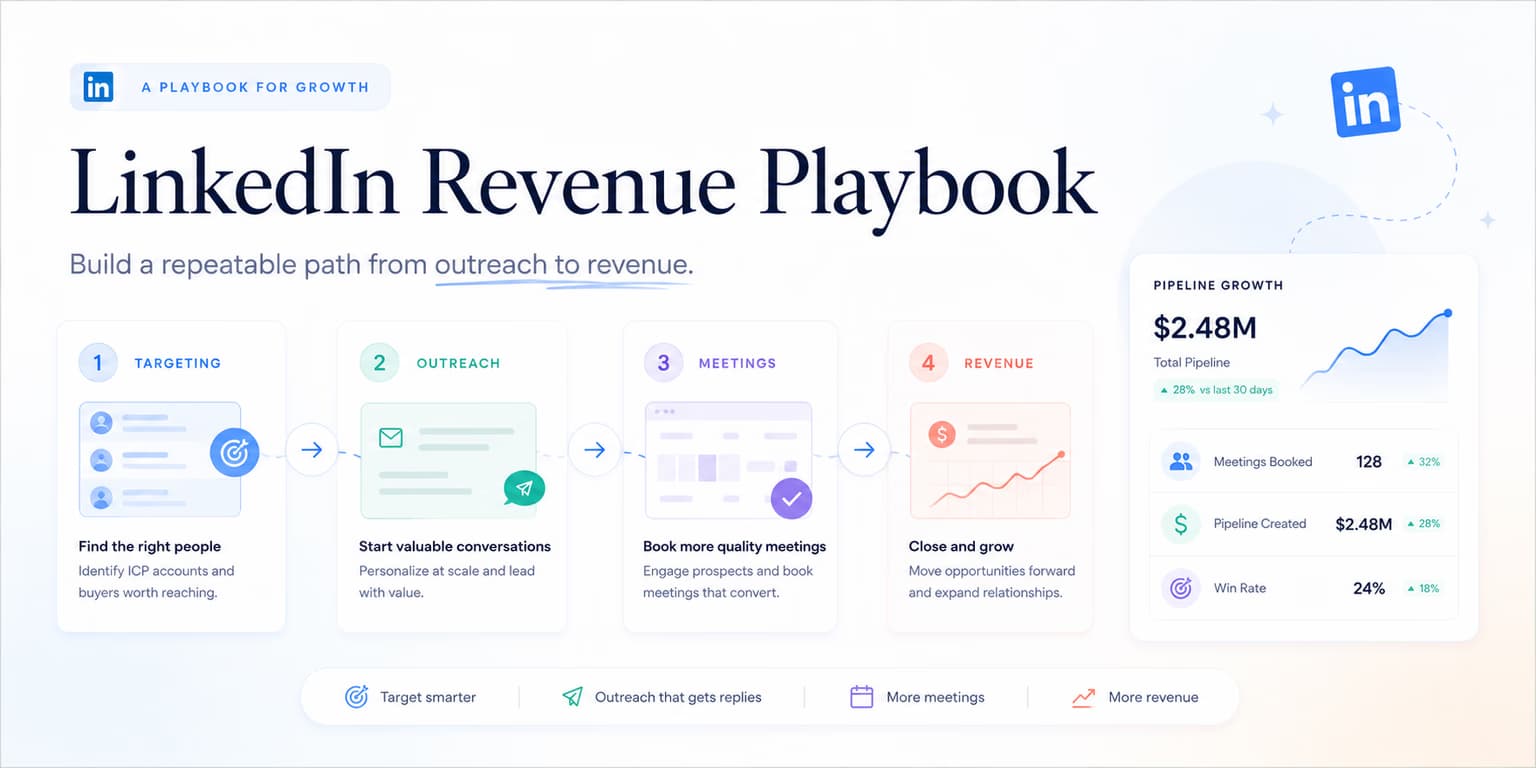
Most LinkedIn outbound reports are full of numbers that feel productive and explain very little. Connection requests sent, messages delivered, profile views, and follow-ups scheduled are easy to count. They do not tell you whether the campaign is creating revenue.
A founder can send fewer messages and still build a better pipeline if those messages reach higher-fit buyers, create clearer replies, and turn into qualified conversations. A team can also send a lot of activity and accidentally create a support burden: low-intent replies, poor-fit demos, and pressure on LinkedIn accounts that should have been protected.
The revenue playbook starts by treating LinkedIn outreach as a financial system. Every campaign should connect the account you target, the signal you use, the message you send, the conversation you create, and the revenue potential behind that conversation. If one of those links is weak, more volume usually makes the weakness louder.
Omentir helps with the execution layer: discovery agents, ICP-based lead evaluation, campaign drafts or launches, reply capture, and daily quotas. The playbook below is the operating model around that tooling: how to choose the right accounts, measure the right bottlenecks, and scale without turning LinkedIn into a blunt volume channel.
The B2B LinkedIn revenue equation
A predictable outbound machine is built on a handful of inputs. Some are conversion metrics. Some are economic constraints. You need both because a campaign can look good at the top of the funnel and still produce bad business.
- List Quality: Sourcing only verified decision-makers who match your ICP. Diluted lists lower connection request acceptance rates.
- Connection Rate: The percentage of invitations accepted. Casual, peer-to-peer opening hooks yield higher rates than sales pitches.
- Meeting Booking Rate: The percentage of connections that schedule a demo. Using low-pressure calendar offers keeps drop-offs low.
- Close Rate: The percentage of demos that close. Sifting lists for high-intent signals ensures AEs speak to active buyers.
- Average Contract Value: The revenue potential of the account if the conversation becomes a customer.
- Sales Capacity: The number of good conversations your team can handle without slow replies or sloppy follow-up.
These inputs help you diagnose the real bottleneck. If connection acceptance is low, the targeting or first touch may be wrong. If replies are high but meetings are poor, the message may be attracting curiosity instead of qualified demand. If meetings happen but deals do not progress, the ICP or offer may be too loose.
The easiest mistake is optimizing the wrong stage. A team may celebrate a high reply rate while most replies say, "not relevant." Another team may chase more meetings even though sales is already overloaded with poor-fit calls. Revenue-focused outreach asks a stricter question: which actions create qualified pipeline that the business can actually close?
Revenue Playbook Rule: Focus on LTV
Target accounts where the possible contract value justifies careful human-paced outreach. A low-fit account consumes the same sender reputation as a great account, so spend that attention where the business upside is real.
Sourcing high-LTV lead verticals
To scale revenue, start with the verticals where your product has the clearest economic value. Do not begin with "any B2B company" or "any founder." Begin with the segment where the pain is frequent, visible, expensive, and owned by a reachable buyer.
LinkedIn Sales Navigator can help define the initial universe: company size, geography, seniority, function, and industry. But filters alone are not enough. Headcount growth, hiring posts, new market launches, funding announcements, website changes, and role transitions can all help separate active opportunities from merely eligible accounts.
Enrichment tools such as Clay or databases like Apollo.io can add useful context, but they should not become a substitute for fit. The best list is not the biggest list with the most columns. It is the smallest list where each account has a credible reason to care.
A practical vertical test is simple. Write the top three business pains for the segment. Name the buyer who owns each pain. Identify one public signal that suggests the pain may be active. If you cannot complete those three lines, the segment is probably too vague for revenue-focused outbound.
Apply ICP fit scoring to pipeline velocity
ICP scoring should rank accounts by fit, signal, and economic upside. Fit is the standing match: industry, size, business model, buyer role, and problem. Signal is the timing clue: hiring, role change, public initiative, tool adoption, or website change. Economic upside is whether the account can become a customer worth pursuing.
The score should change what happens next. High-fit, high-signal accounts can enter a reviewed outreach queue. High-fit, low-signal accounts can be monitored or added to a slower nurture path. Low-fit accounts should be rejected even if they have an interesting signal. A recent job change at the wrong type of company is not a revenue opportunity.
Omentir runs discovery workflows from your ICP settings and helps surface leads that match your rules. For guidelines on list enrichment, check out our guide on LinkedIn sales lead pipelines.
Pipeline velocity improves when the team spends less time debating poor-fit accounts. A clear score gives the operator permission to say no. That restraint is what keeps a LinkedIn channel from filling the calendar with meetings that never had a chance to close.
Calculating sales operator capacity with AI
Sales operator capacity is not the number of campaigns one person can technically launch. It is the amount of qualified pipeline one person can create and manage without quality dropping. That distinction matters because AI can increase activity faster than it increases judgment.
A useful capacity model looks at four tasks: sourcing, research, drafting, and follow-up. AI can reduce manual work in each area, but the operator still needs to review the system's choices. The goal is for one person to manage a better process, not for one person to approve a flood of mediocre messages.
Track capacity with business outcomes. How many qualified accounts did the operator review? How many drafts were rejected? How many positive replies required human handling? How many meetings were accepted by the right buyer? These numbers reveal whether automation is raising output per person or simply moving busywork into a different dashboard.
For detailed founder playbooks, check our guide on founder-led demo booking.
Managing message pacing and platform safety limits
LinkedIn account health is part of revenue strategy. If a sender profile gets restricted or starts generating negative responses, the pipeline model breaks. Safe pacing is not a compliance footnote; it protects the channel you are trying to scale.
Avoid treating a single daily number as a universal answer. A newer profile, a profile with little normal activity, and a profile running multiple campaigns should all be handled more conservatively than an established account with steady manual use. The safer pattern is controlled daily budgets, natural spacing, and close attention to reply quality.
Omentir coordinates outreach through human-paced queues and daily quotas. It also captures reply conversations so the team can focus on interested buyers instead of digging through scattered message threads. For guidelines on meeting booking pacing, read our playbook on booking 5 demos weekly.
A revenue team should review pacing alongside economics. If the campaign needs unsafe volume to produce enough meetings, the answer is not to push the sender harder. The answer is to improve targeting, tighten the offer, or choose a higher-LTV segment where fewer good conversations can support the pipeline goal.
SOP: the LinkedIn revenue sourcing audit checklist
Follow this SOP to configure and audit revenue-based campaigns:
- Verify Target LTV: Confirm that the companies targeted meet your minimum contract value limits.
- Audit Sourcing Rules: Check that your discovery rules target reachable buyers, not just companies that match a broad industry filter.
- Score Signals: Separate strong timing evidence from weak personalization details.
- Review Drafts: Inspect a first batch for product accuracy, relevance, tone, and clear next steps.
- Review Pacing Quotas: Confirm daily budgets, campaign overlap, and reply stop conditions before launch.
- Track Reply Quality: Record whether replies are positive, objections, referrals, not-now responses, or poor-fit conversations.
- Connect to Revenue: Map qualified replies and booked calls back to your CRM or pipeline tracker so LinkedIn activity is judged by business outcome.
Run this audit at two levels. Before launch, use it to decide whether the campaign deserves to go live. After launch, use it to decide whether the campaign deserves more volume. A campaign that produces weak replies should not be scaled just because it is technically functioning.
The most useful review meeting is short: what segment did we target, what signal did we use, what did buyers say, and what should change? If the team cannot answer those four questions, it is managing activity rather than revenue.
Building a foundation for scalable growth
B2B outbound scales when the economics are clear. The right question is not "how many people can we message?" It is "which buyers are worth careful outreach, why now, and what revenue outcome would make the effort worthwhile?"
Use automation to remove repetitive work from sourcing, research, drafting, and follow-up. Keep human judgment on ICP, offer, account quality, and sensitive replies. That balance is how a LinkedIn channel becomes a repeatable pipeline source instead of another noisy top-of-funnel experiment.
Configure your discovery agents, review your drafts, keep pacing conservative, and connect replies back to revenue. When those pieces work together, LinkedIn becomes less about vanity metrics and more about a calm, measurable path to customer conversations.
Frequently asked questions
Vanity metrics (like raw connection request volumes) do not tell you if you are booking qualified demos or generating revenue. Connecting outreach to pipeline velocity keeps your team's energy on high-value accounts.
Sales operator capacity is how many qualified leads one sales rep can manage using AI. Automating lead discovery and copywriting drafts lets one operator cover multiple campaign channels without dropping quality.
This article treats CRM revenue tracking as an operating discipline. Omentir captures campaigns, leads, and reply conversations; your team should connect those outcomes to whatever CRM or revenue system you use.
Use conservative daily budgets, avoid stacked campaigns on the same sender, and keep outreach human-paced. The right limit depends on account history, campaign quality, and current activity.