
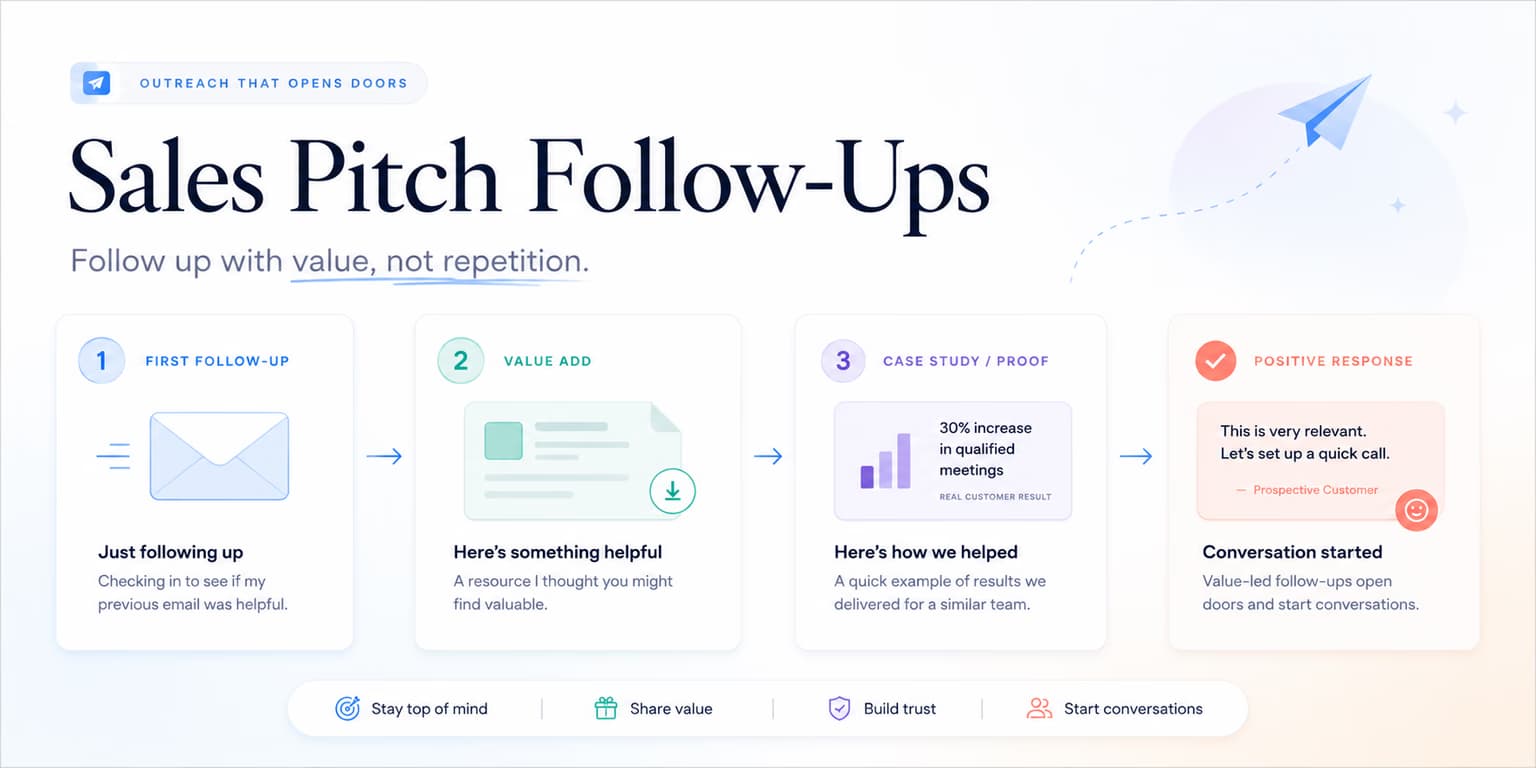
Most bad follow-ups fail for the same reason: they make the prospect do all the work. "Just bumping this" asks the buyer to remember your last message, reread it, decide whether it matters, and then rescue the conversation. That is not follow-up. That is a reminder that you want something.
Silence does not always mean rejection. The buyer may be busy, unsure, not the right owner, or interested but not ready to engage. The follow-up's job is to make the next reply easier by adding context, lowering the ask, or giving the prospect a graceful way to redirect you.
To restart stalled conversations on LinkedIn, write follow-ups that respect the thread. Each touch should do one useful thing: clarify the original reason, ask permission to share something specific, answer a likely objection, or close the loop cleanly.
Omentir helps coordinate this motion through campaign workflows, paced sending, reply conversations, and AI-drafted responses. The frameworks below are written for founders and sales operators who want follow-ups that feel like a thoughtful continuation, not a sequence trying to squeeze one more touch out of a lead.
Framework 1: the low-pressure permission bump
The biggest mistake in follow-up copy is escalating the ask when the prospect has not even acknowledged the first one. If someone did not answer a light opener, asking them to "hop on a quick call" usually increases friction rather than reducing it.
Use the permission bump instead. Acknowledge that they may be busy and ask whether they want a short, specific piece of information. The prospect can answer with one word. That matters because easy replies keep conversations alive.
Permission Bump Template
"Hey [Name], completely understand if you are busy. I put together a 2-page PDF checklist showing how we helped product teams at growth-stage startups reduce lead scoring errors. Happy to drop the link here?"
The permission bump works best when the asset is real and relevant. Do not promise a "2-page checklist" if it is just a disguised sales deck. A strong permission bump names the buyer's likely problem, offers one useful resource, and stops there.
Bad version: "Any thoughts on my last message?" Better version: "I have a short checklist for reviewing LinkedIn outreach before scaling. Useful if I send it over?" The second message does not force the prospect to reconstruct the thread. It gives them an easy decision.
For more followup strategies, read our guide to LinkedIn follow-up ideas.
Framework 2: the contextual value asset drop
The asset drop is more direct than the permission bump. Instead of asking whether to send a resource, you send a concise resource or insight that stands on its own. Use it when the prospect is a strong fit and the resource is genuinely useful without a call.
The asset should match the prospect's role and the original signal. If you target engineering directors, a resource on technical debt or developer onboarding may fit. If you target founder-led sales teams, a checklist for first outbound campaigns may fit. The more specific the asset, the less the message feels like a newsletter blast.
Value Asset Drop Template
"Hi [Name], saw your department is expanding. I thought you might find this guide on scaling development sprints without losing velocity useful. It's a quick 2-minute read: [URL]"
This message builds trust because it does not require a response or meeting booking. It gives the buyer something they can use and lets them decide whether to engage. That restraint is the point.
Keep asset drops short. A long explanation of why the resource matters becomes another pitch. One sentence of context, one link, and one optional question is enough.
For steps on automation setup, check our article on the AI follow-up playbook.
Framework 3: the collaborative clean-break CTA
Your final follow-up should not sound annoyed. The clean-break message exists to end the thread respectfully while leaving the door open. It works because it removes pressure and gives the prospect a final chance to correct your assumption.
Clean-Break Template
"Hey [Name], assuming this isn't a priority for your team right now, so I'll close the thread. If you ever look to clean up list qualification workflows down the line, feel free to reach out. Otherwise, best of luck with Q3!"
By giving the prospect a clear exit, you show respect for their time. Sometimes they reply with context: wrong timing, wrong owner, already solved, or still interested but buried. Even when they do not reply, you have ended the sequence cleanly instead of dragging it out.
Avoid manipulative breakup lines. "I guess growth is not a priority" may get attention, but it damages trust. A good clean break is calm, not accusatory.
For modular copywriting strategies, check our guide on personalized sales pitches.
Configuring follow-up cadences inside campaigns
To run these sequences, configure your campaigns with clear delays and clear stop conditions. The exact spacing depends on the relationship, the channel, and the urgency of the topic. The important thing is that the cadence feels human and gives the buyer room to respond.
A simple LinkedIn cadence might use a first message after connection, a permission bump a few business days later, a contextual asset later in the week, and a clean break after enough time has passed that the thread is clearly quiet. Do not compress all of this into two days. It will feel automated even if the copy is good.
Use prospecting databases like Apollo.io or data workflows like Clay to keep account context current, but do not let enrichment turn into noise. Follow-ups should reference only context that helps the buyer understand why you are still reaching out.
Reply detection and safety guardrails
Reply detection is the most important safety rule in any follow-up system. Once a prospect replies, the normal sequence should stop. Nothing feels more automated than receiving a scheduled follow-up after you already answered.
The next action should depend on the reply. A positive reply may need a booking message. A question needs a useful answer. A referral needs a different contact path. A negative reply needs suppression. Treat reply handling as a branch, not an interruption.
You should also protect account health with conservative sending volume, natural spacing, and campaign overlap checks. Omentir coordinates outreach through human-paced queues and helps keep reply conversations organized, but the campaign owner still needs to review quality and stop conditions.
SOP: the sales pitch follow-up audit checklist
Follow this SOP to audit your campaigns before launching:
- Verify delays: Do wait times give the prospect enough room to respond naturally?
- Check pitch copy: Does your follow-up avoid booking links and focus on value drops or permission checks?
- Check context: Does each follow-up add a new useful reason, or does it merely repeat the first pitch?
- Enforce safety pacing: Confirm connection request and message volume remain conservative.
- Verify reply pauses: Confirm that the sequence stops immediately when a lead replies.
- Review branches: Confirm positive replies, objections, referrals, and negative replies route differently.
- Test links: Check that resource and video URLs open correctly.
Review the first live replies before increasing volume. If prospects seem confused, your first message or follow-up context is weak. If they object on price before understanding the value, the asset or permission bump may be too close to a pitch.
Also match the follow-up to the state of the thread. A prospect who accepted your connection but never answered needs a different note from someone who asked a question and then went quiet. The first person may need a simpler reason to care. The second person may need a clear answer, a resource, or a smaller next step.
Use these rules when reviewing a sequence. If there has been no reply, do not act as if the prospect is in a sales cycle. If they asked a question, answer before asking for a meeting. If they referred you to someone else, do not keep following up with the original contact as though nothing changed. If they said timing is bad, pause long enough for the timing to matter.
This is where AI can help, but only with clear labels. Tag conversations as no reply, interested, objection, referral, not now, or negative. Then let each label route to a different draft path. A single universal follow-up sequence will always feel clumsy because prospects are not all quiet for the same reason.
Shift follow-ups toward long-term value
Follow-up success is driven by usefulness, not pressure. The best follow-ups make the conversation easier for the buyer: a smaller ask, a sharper resource, a clearer next step, or a respectful exit.
When in doubt, choose the follow-up that makes the prospect's next reply easiest.
Use permission bumps when you need a low-friction reply, asset drops when you have something worth sending, and clean breaks when the thread has run its course. Configure your sequences carefully, review drafts, and keep outreach paced. Omentir can help with the campaign and reply workflow; your standard should remain simple: never send a follow-up that adds no value.
Frequently asked questions
A 'just bumping this' message provides no value and places conversational work on the prospect. It signals that you only care about booking a demo, driving high archive rates.
Give the prospect enough time to respond before sending another touch. A few business days is a reasonable starting point, but adjust based on the relationship, urgency, and whether the previous message created any real value.
A clean-break follow-up is the final message in your sequence. It politely acknowledges that the timing might be off, triggers loss-aversion, and closes the thread. This clears your pipeline and often triggers late replies.
Omentir tracks reply conversations and campaign state so follow-up handling can shift once a prospect engages. Teams should review reply flows and stop conditions before launch.