
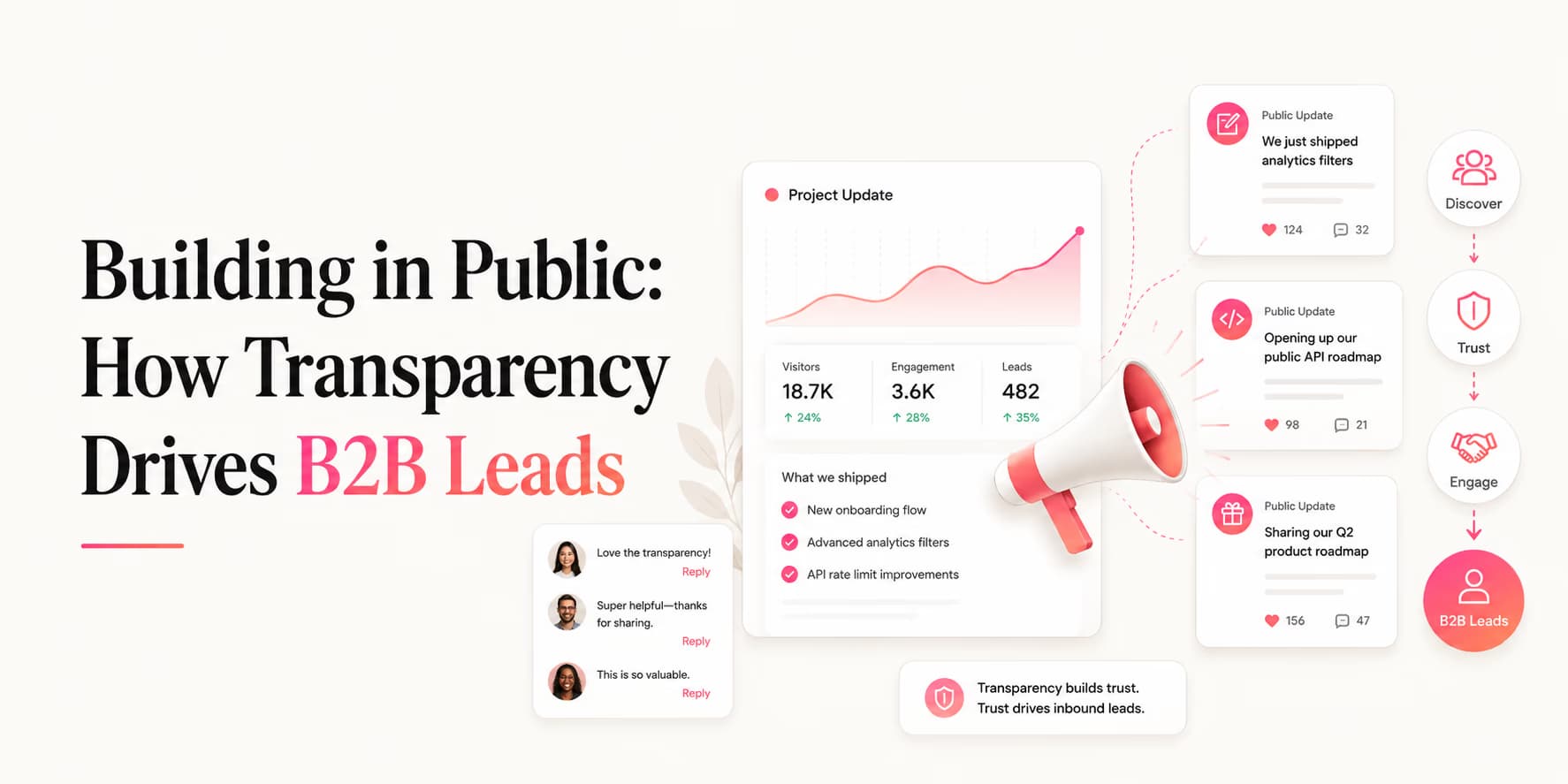
B2B marketing has long been dominated by corporate messaging. Companies publish polished press releases, generic product feature updates, and formal case studies. Senders assume that a perfect, faceless corporate image is the best way to look credible.
B2B buyers are tired of corporate messaging. They are skeptical of exaggerated sales claims and formal pitch decks.
To earn trust, show the work. Building in public (sharing revenue milestones, feature choices, bugs, and sales metrics) is a practical alternative.
That approach can build authority and bring inbound leads from people who already saw how you operate.
Building in public only produces leads when the posts teach something a buyer already wanted to know. A daily "shipped a button" update is not a demand signal.
The mistake is treating building in public like a personal diary. Buyers do not need every mood swing, every tiny feature decision, or every dramatic lesson. They need evidence that you understand the problem, are moving quickly, and are honest about what is working. The best public building creates trust before the sales conversation starts.
For B2B founders, that trust matters because most buyers are not only buying software. They are buying confidence that the vendor will stay alive, support the workflow, listen to feedback, and keep improving. A transparent operating cadence can answer those doubts long before a demo.
Why trust comes before inbound
Building in public does not automatically create leads. Visibility is only the first layer. The commercial value appears when the right people repeatedly see you solving a problem they recognize. A founder posting daily screenshots without a clear buyer problem may gain attention, but attention is not pipeline.
Useful public building has a simple loop: show the problem, show the decision you made, show the tradeoff, show the result, and invite operators who feel the same pain to compare notes. That loop turns content into a buying conversation because it lets prospects self-identify. They comment, message, or remember you when the problem becomes urgent.
This is especially powerful for early-stage B2B products. You may not have a large brand, a polished case-study library, or a sales team. But you can show your reasoning in public. You can explain why you rejected a feature, how you fixed a broken workflow, what a customer asked for, and what you learned from a failed campaign. That is the kind of proof early buyers actually inspect.
The content framework: what to share publicly
Building in public is not random posting. Senders must share structured logs that demonstrate execution and product progress.
Share three types of updates weekly:
- Revenue Milestones: Share MRR charts to demonstrate growth.
- Development Updates: Log new feature mockups, interface designs, or software bugs resolved.
- Sales Data: Publish connection rates, reply rates, and booked demo metrics.
Each update should include a lesson, not only a number. "We hit $1,000 MRR" is a milestone. "We hit $1,000 MRR after narrowing our ICP from all founders to B2B SaaS teams hiring their first SDR" is useful. The second version teaches the reader what changed and why.
Think in weekly themes instead of random posts. One week might focus on lead quality. Another might focus on onboarding friction. Another might focus on how you rewrote your positioning after three prospects misunderstood the product. This keeps your public narrative coherent, and it gives buyers a reason to follow along.
A helpful building-in-public post usually contains four pieces:
- Context: What problem, customer segment, or workflow were you working on?
- Decision: What did you change, build, test, remove, or measure?
- Evidence: What did you observe from users, outreach, product usage, or sales conversations?
- Question: What would you like operators in your market to react to?
For early founder stories, see our guide on lessons from dropping out to build SaaS.
Log 1: sharing revenue milestones and MRR charts
Revenue numbers can be compelling. When you share verified revenue growth charts, you prove that companies pay for your solution.
Log your MRR updates and pricing choices. For example, explain how Omentir's $49/month Pro plan and booking guarantee helped you onboard early users quickly.
Share revenue carefully. Revenue numbers can build trust, but only when they are presented with context. A chart without context can attract vanity engagement while teaching buyers nothing. Explain what caused the movement. Was it a new segment, a better onboarding flow, a pricing change, a founder-led outbound sprint, or one larger customer?
You do not need to reveal everything. If exact revenue feels too sensitive, share directional milestones: first paid design partner, first five paying workspaces, first month with expansion revenue, or first customer who came from a public post. The point is to prove commercial momentum without turning the company into a performance account.
A strong revenue update might read:
We signed our third paid design partner this week.
The pattern is clearer now: founder-led B2B teams care less about "AI outreach"
and more about not wasting their own LinkedIn profile on poor-fit prospects.
So we are changing onboarding to start with ICP scoring before copywriting.
This post does more than celebrate. It tells the market what you learned, who is buying, and how the product is changing because of customer evidence.
Log 2: sharing interface updates, bugs, and failures
Sharing failures builds more trust than sharing wins. When you document a software bug or campaign deliverability drop, explain how you resolved it.
For instance, post about how a pacing error triggered profile limits, and explain that you resolved the issue by implementing random outbox delays.
This level of transparency shows you take reliability seriously.
Failure posts work when they are specific and responsible. Do not dramatize the failure for engagement. Explain what happened, who was affected, what you changed, and how you will prevent the same issue from returning. This is the difference between transparency and spectacle.
For example, if a review queue was confusing, show the old decision flow, explain where users hesitated, and show the new version. If an outreach prompt produced generic copy, share the prompt constraint you added. If a crawler produced weak leads, explain the extra qualification rule you introduced. Buyers do not expect perfect software. They do expect clear ownership.
Be careful with customer examples. You can describe the workflow pattern without exposing the customer. Instead of "Acme's VP Sales complained that our lead list was bad," write "A design partner showed us that our lead scoring was over-weighting job title and under-weighting current hiring signals." The second version teaches the same lesson without making a customer feel used.
Transparency Rule: Protect Customer Data 💡
Never share private client details, profile credentials, or campaign names without explicit permission. Always blur out names and domains when publishing screenshots of your review queue or dashboards.
Log 3: sharing campaign performance and conversion data
Outbound performance data is valuable to other growth operators. Share your conversion charts weekly:
State your connection rates, reply rates, and opportunity conversion rates. For tracking ideas, see our guide on measuring early outbound success.
Sales metrics are useful when they explain a decision. Instead of posting "18% reply rate" as a trophy, explain what changed in the campaign. Did you narrow the title filter? Did you stop mentioning a vague AI benefit and start referencing a concrete operational pain? Did you discover that founders replied to workflow questions while sales leaders replied to pipeline-quality questions?
Use metrics to show the learning curve:
- Input: The segment, message angle, and signal used.
- Output: Connection acceptance, reply quality, demos booked, or qualified conversations started.
- Interpretation: What the result suggests, including what you still do not know.
- Next test: The change you will make in the next campaign.
This makes your public updates useful to other operators and credible to future buyers. It also protects you from overclaiming. You are not saying, "This always works." You are saying, "Here is what we tested, here is what happened, and here is what we are changing."
What not to share publicly
Transparency has boundaries. Some information may create trust with followers while damaging trust with customers, teammates, or prospects. A serious B2B founder should decide what stays private before posting becomes a habit.
Keep these categories out of public posts unless you have explicit permission and a strong reason:
- Customer identities: Do not reveal customers, prospects, or pipeline accounts without consent.
- Private conversations: Do not screenshot sales objections, support complaints, or user messages in a way that identifies the person.
- Security details: Do not publish implementation details that expose credentials, internal infrastructure, or abuse paths.
- Team issues: Do not use public building to vent about teammates, contractors, investors, or customers.
- Unsupported claims: Do not turn one good week of metrics into a universal promise.
The standard is simple: would this post make a serious buyer more confident in your judgment? If the answer is no, rewrite it or keep it private.
Convert social engagement into sales conversations
Building publicly generates organic views and comments. Treat those interactions as possible sales conversations, not as a vanity dashboard.
When a target buyer comments on your feature update, reach out with a direct message referencing their comment and start a conversational thread, as outlined in our guide on handling replies.
Do not treat every like as buying intent. Start with stronger signals: thoughtful comments, repeated engagement across multiple posts, questions about implementation, people who share your post with a specific opinion, or prospects who mention a similar problem in their own content. These are better reasons to start a conversation than a passive reaction.
A good follow-up sounds like a continuation of the public thread:
Hey Maya, appreciated your comment on the post about lead scoring.
You mentioned your team still reviews LinkedIn prospects manually before outreach.
Curious: is the painful part finding enough accounts, or deciding which ones are worth sending?
Notice that this message does not force a demo. It asks a diagnostic question tied to the person's own comment. If they reply with a real workflow problem, then you can offer context, a teardown, or a short walkthrough.
Keep a lightweight engagement list. Track the person, company, post topic, comment, likely pain, and whether you followed up. Building in public becomes a sales asset when engagement is connected to thoughtful conversation, not when it becomes a vanity dashboard.
Schedule campaigns safely to protect profile health
Even with high inbound interest, you must manage your outreach pacing. Random sending delays keep activity closer to natural manual behavior and reduce risky volume spikes.
Omentir handles this outbox pacing automatically. For safety guidelines, see our guide on pacing B2B outreach campaigns safely.
Public engagement can create a false sense of permission. A person who liked a post has not agreed to receive a pitch. Use the signal respectfully. If someone has engaged lightly, send a short question. If they have asked for details, offer a resource. If they have described a problem that your product solves, invite a more direct conversation.
This is where building in public and outbound should reinforce each other. Public posts create context. Outbound turns the most relevant context into one-to-one conversations. Pacing keeps that process from becoming noisy or careless.
SOP: the weekly building in public content checklist
Publish your weekly updates using these steps:
- Step 1: Record your MRR and campaign metrics from the Omentir dashboard.
- Step 2: Take screenshots of new feature mockups or dashboard updates, protecting private data.
- Step 3: Write a text update explaining one challenge you resolved.
- Step 4: Respond to all comments, starting conversational DM threads with target buyers.
A practical weekly cadence can look like this:
- Monday: Share the problem you are focusing on this week and why it matters to your target buyer.
- Wednesday: Share a product, sales, or onboarding decision with the tradeoff behind it.
- Friday: Share the result, lesson, or open question from the week.
- Weekly review: Identify which post created qualified comments, DMs, demos, or customer language worth reusing.
Do not measure only impressions. Track qualified signals: comments from target buyers, inbound messages with a real problem, referral introductions, demo requests, newsletter replies, or prospects mentioning a post during a sales call. Those are the signals that prove your public building is influencing pipeline.
Omentir handles the variable mapping and safety limits so you can keep public posting and outbound from colliding.
Build long-term trust through openness
B2B buyers care about authenticity. Sharing your development and sales journey publicly can build trust and generate qualified leads.
The winning version is not radical oversharing. It is useful transparency: clear problems, honest decisions, concrete lessons, protected customer data, and respectful follow-up with people who already showed interest in the work, not a cold list you bolted a "build in public" line onto.
Frequently Asked Questions
B2B buyers purchase from vendors they trust. Sharing your development journey, revenue metrics, and product updates shows how you actually operate.
Competitors can copy features, but they cannot copy your speed of execution, founder story, or the relationships you build with your audience.
Omentir offers a Pro plan starting at $49/month, allowing founders to run discovery, prompt campaigns, and monitor conversion metrics that they can share publicly.
Share Monthly Recurring Revenue (MRR), campaign connection acceptances, conversation reply rates, and product usage milestones.