
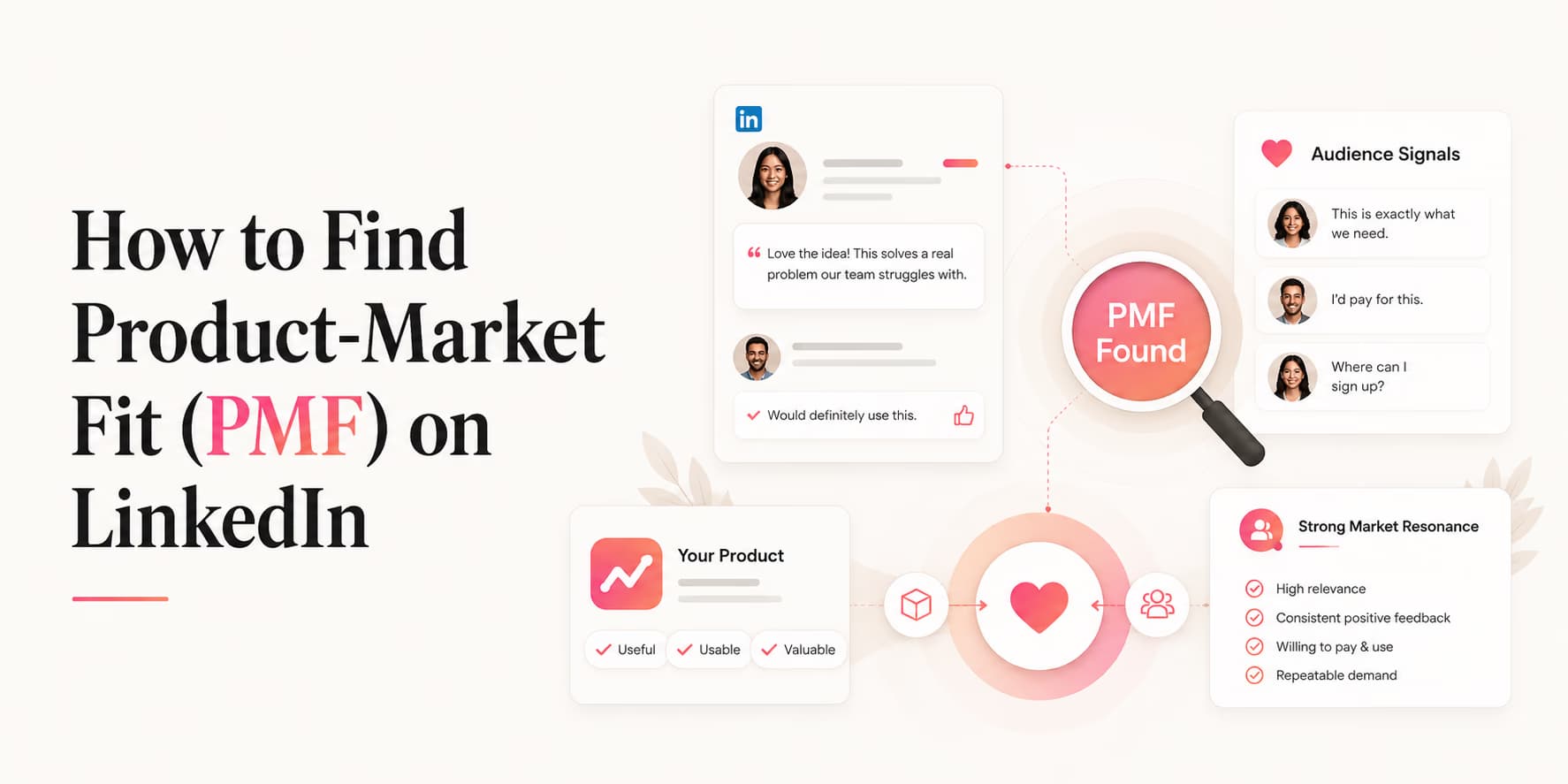
Product-market fit (PMF) is the turning point for any B2B startup. Senders often treat PMF as binary: you have it or you do not. In practice, finding PMF means testing and refining the value proposition until the same buyers keep pulling you in.
Traditional market research (surveys or customer interviews) is not enough for verifying fit. Buyers often express hypothetical interest, then never integrate your software once it is live.
To verify PMF, measure what people actually do. Targeted LinkedIn campaigns are a practical way to test value. Pitch directly to prospects and evaluate interest from connection and reply metrics.
LinkedIn can tell you whether a segment will take a meeting. It cannot tell you whether they will stay. Keep those two questions separate in the playbook below.
LinkedIn is useful for PMF because it lets you test the market one segment at a time. You can reach specific roles, observe which problems create conversations, and see whether the same buyer profile keeps pulling you toward the same product promise. That repeatability is the beginning of fit.
The danger is mistaking response for fit. A prospect can reply because the message is interesting. They can book a call because they are curious. Product-market fit requires more: buyers recognize the pain, trust your approach, activate in the product, keep using it, and tell you they would be upset if it disappeared.
MVP validation is not PMF
MVP validation asks, "Does this problem exist, and will anyone engage with a possible solution?" PMF asks a harder question: "Can we repeatedly acquire, activate, and retain a specific market with this product?" Those are different stages.
Early outreach can validate an MVP quickly, but PMF requires a loop:
- Acquisition: You can reliably find and start conversations with the same kind of buyer.
- Activation: Those buyers reach a meaningful product result without heroic support.
- Retention: They keep using the product because the workflow remains painful without it.
- Expansion or referral: They ask for more, invite teammates, or introduce similar buyers.
LinkedIn mainly helps with acquisition and market learning. To judge PMF, connect those outreach signals to what happens after the call.
The LinkedIn PMF funnel and target benchmarks
To evaluate PMF, you must track specific conversion metrics across your campaigns:
A validation funnel tracks three core conversion thresholds:
- Connection Acceptances (LinkedIn): Measures whether your sender profile, target role, and request context are credible enough to start.
- Conversation Reply Rates: Indicates whether the problem framing creates a real response from the right buyer.
- Intent Conversion: Verifies willingness to book a demo, start a trial, join a pilot, or introduce the right owner.
Do not use universal benchmarks as proof of PMF. Compare performance by segment and then inspect quality. Ten serious conversations with buyers who share the same painful workflow can be more useful than fifty polite replies from scattered audiences.
Add post-call and post-signup metrics to the funnel:
- Activation rate: Did the prospect reach the first meaningful product outcome?
- Time to value: How long did it take before they saw the workflow improve?
- Retention signal: Did they return, continue the pilot, or ask to expand?
- Pull signal: Did they ask for next steps without heavy pushing?
For details on list sourcing, see our guide on generating sales leads from LinkedIn.
Source and segment buyer verticals on LinkedIn
Your product value proposition will land differently across roles and industries. Senders who send identical messages to a broad list will see low conversion rates.
Segment your list into three distinct sub-profiles:
- Vertical A (Sales Operations): Focuses on list cleaning, API routes, and workflow efficiency.
- Vertical B (Founders): Prioritizes rapid validation, customer acquisition, and low-friction setup.
- Vertical C (Growth Marketing Agencies): Prioritizes multi-profile scaling, CRM sync, and outbox capacity.
Test your value pitch across these verticals to identify your most active buyer profile.
Each vertical test should have a different PMF hypothesis. For sales operations, the hypothesis might be that list quality and workflow reliability matter most. For founders, the hypothesis might be that speed to first customer matters most. For agencies, the hypothesis might be that account safety and repeatable delivery matter most.
Use a consistent scoring sheet:
- Pain clarity: Can the buyer describe the problem without education?
- Urgency: Is the problem active this quarter?
- Budget path: Can this person or team pay for a solution?
- Workflow fit: Does your product fit how they already work?
- Retention likelihood: Would the product become recurring behavior?
The winning vertical is the one where the sales conversation, product usage, and retention story line up, not the one that merely replies most.
Copywriting: the soft conversational discovery pitch
Validation campaigns require non-salesy copywriting. Senders who try to pitch features immediately will trigger opt-outs.
Write short, conversational notes that ask for feedback rather than meetings:
Hi {first_name}, saw {company_name} is adding outbound roles.
I am trying to understand how teams keep lead quality high before adding more volume.
Are you centralizing prospect research today, or does each rep handle it separately?
This conversational approach lowers friction and helps you get initial feedback.
That script tests a PMF-relevant question: where does the workflow live today? If the buyer says every rep handles it manually, you have a pain path to explore. If they already have a strong process, you learn what your product must beat. If they say the problem belongs to another team, you refine the buyer map.
Avoid asking "Would you use this?" Ask about behavior: what they do today, what breaks, who owns it, what they have tried, and what would make them switch. Behavior is closer to PMF than opinion.
Validation Rule: Charge Early 💡
Avoid offering free access to early users. Charging even a nominal fee forces real validation, proving that prospects experience the challenge enough to pay for a solution.
Analyze buyer objections to locate feature gaps
Active sales threads provide valuable insights for product development. When prospects explain why they cannot use your product, they share details about their workflow limits:
For example, if a prospect says "We would love to use Omentir, but we need our lead data to sync directly to our HubSpot campaigns," they are naming an integration requirement.
Use these details to prioritize your product roadmap, focusing development on features that drive conversions.
Objections become roadmap inputs only when they repeat inside the same segment. One agency asking for a niche reporting export does not prove the product needs that export. Five agencies saying they cannot onboard clients without account-level reporting is a stronger signal.
Group objections into four buckets:
- Trust gap: The buyer needs proof, security clarity, or examples.
- Workflow gap: The product does not fit their current process.
- Economic gap: The value is not clear enough to justify the price.
- Wrong segment: The buyer is not the market you should chase right now.
PMF gets closer when objections become narrow and solvable. It is a good sign when the market stops saying "why would I need this?" and starts saying "can it handle this workflow?"
Signals that PMF is getting closer
You are closer to PMF when the same pattern repeats without you forcing it. The same buyer type responds. The same pain appears. The same product moment creates excitement. The same objections are answerable. The same onboarding path works more than once.
Watch for these signs:
- Prospects describe the pain before you pitch the product.
- Buyers ask how soon they can try it, not only what it does.
- Users return to the product without constant founder reminders.
- Customers ask for expansion around the core workflow, not random features.
- Referrals mention the same use case you are trying to own.
LinkedIn can surface the first three signals through conversations, but product usage must confirm the rest. That is why PMF is not a LinkedIn metric alone. It is the connection between outbound demand and retained product behavior.
Protect account health with throttling engines
Even during early validation campaigns, you must manage your sending volume. High outreach speeds will trigger automated spam blocks on your profiles.
Omentir protects your profiles by implementing safe connection quotas (keeping connections under 20 requests per profile daily). For pacing guidelines, see our guide on pacing campaigns safely.
PMF testing does not require aggressive volume. Smaller, cleaner batches make it easier to read the market. If the segment is right, you should see stronger signals without flooding LinkedIn. If the segment is wrong, more volume only creates more noise.
SOP: the 30-day LinkedIn PMF verification loop
Implement this validation loop to test your product concept:
- Step 1: Find 100 prospects matching your target operator profile.
- Step 2: Configure Omentir to crawl their sites and draft custom discovery notes.
- Step 3: Review and approve drafts in the pacing outbox queue.
- Step 4: Track reply rates, grouping responses by category (objections, features, interest).
Expand the loop into four weeks:
- Week 1: Test two or three segments with small, high-fit lists and diagnostic messages.
- Week 2: Run calls with the strongest segment and document workflow, urgency, and buying path.
- Week 3: Push the best-fit prospects into a pilot or self-serve activation path.
- Week 4: Compare activation, retention, objections, and referrals by segment before choosing the next focus.
End the month with a PMF memo. Name the segment, the repeated pain, the core product moment, the strongest acquisition message, the biggest retention risk, and the next test. If you cannot fill those fields, you are still learning. That is fine, but it is not PMF yet.
Omentir handles the variable mapping and safety limits so you can validate the MVP without burning profile reputation.
Match product value to market demand
Building a B2B product requires market feedback. Use targeted cold outreach to validate your MVP so development time goes to buyer problems that actually show up.
Product-market fit appears when acquisition signals, product activation, and retention all point toward the same market. LinkedIn is only useful here if the people who accept also stay. Accepts from a segment that churns in a week is not fit.
Frequently Asked Questions
By running campaigns to target buyer profiles and measuring behavioral signals: connection acceptances (ICP resonance), response rates (interest), and customer objections (feature alignment).
MVP validation proves that prospects experience the challenge you target. Finding PMF proves that your solution satisfies their requirements at scale, creating a predictable acquisition engine.
Omentir offers a Pro plan starting at $49/month, allowing you to run discovery agents, automate prompt variables, and manage safe connection pacing to test ideas affordably.
Run focused cycles until patterns repeat. A 30-day cycle is useful for comparing segments, but PMF is better judged by repeated qualified demand, activation, retention, and referrals than by one fixed prospect count.