
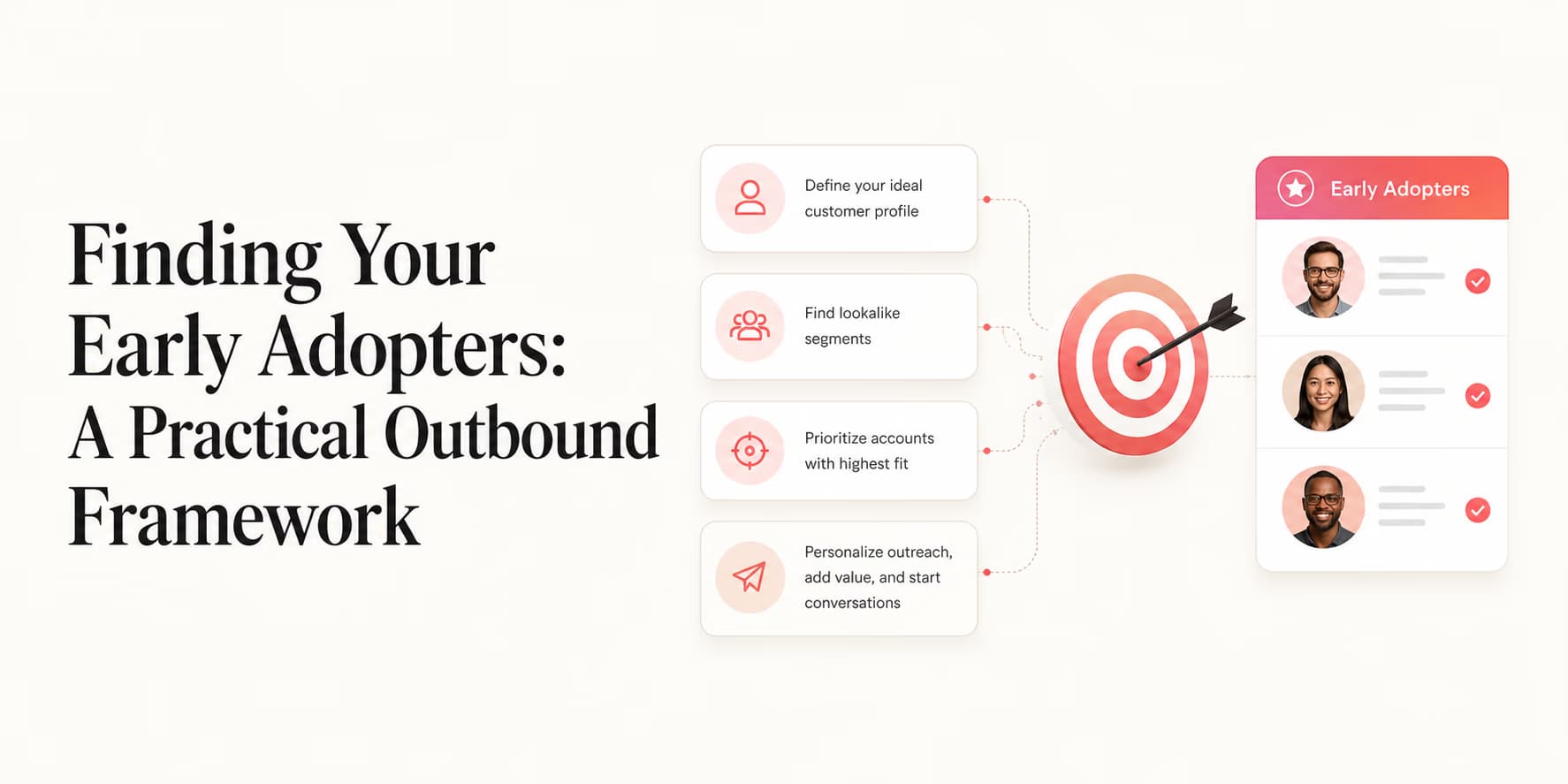
Launching a B2B startup means identifying the target audience. Founders often go after large enterprise accounts or mainstream buyers, assuming one large deal will validate the product.
Targeting mainstream buyers too early is a major mistake. Mainstream customers expect finished products with extensive feature sets, verified security compliance, and round-the-clock support. They have low tolerance for early product bugs.
To validate the product and build traction, target early adopters. These are operators who feel the problem your software solves and will use early tools to solve it.
Finding and messaging those adopters takes structure. Check technical stack maturity, read hiring posts, and write collaborative pitches. That is how you get early users without waiting for a finished enterprise suite.
Early adopters are not "anyone in the ICP." They are the people who will use an unfinished product because the pain is already expensive. Hunt those people first.
Not every small company is an early adopter
A common mistake is treating every startup as an early adopter. Many small companies are just as conservative as enterprises because they have no time, no budget, and no tolerance for workflow disruption. They may like your idea and still never use it.
A real early adopter has a painful problem, a reason to solve it now, and enough operating freedom to test a new tool. They are not buying because your product is new. They are buying because the current way is already costing them time, revenue, or focus.
Your job is to find the intersection of urgency and flexibility. Urgency without flexibility creates "sounds interesting, talk next quarter." Flexibility without urgency creates friendly feedback that never becomes usage.
What a B2B early adopter looks like
Early adopters share a few traits that separate them from slow, risk-averse buyers:
- High tech maturity: Usage of modern B2B SaaS platforms and open APIs.
- Active hiring: Expanding departments indicate willingness to evaluate new software.
- Founder-led cultures: Decision processes are managed by operators rather than complex committees.
For early founder stories, see our guide on lessons from dropping out to build SaaS.
The early adopter scorecard
Score prospects before messaging them. This prevents your "early adopter" campaign from becoming a broad startup list with nicer wording.
- Pain intensity: visible evidence that the problem is active right now.
- Decision access: the person can approve a test or influence the buyer.
- Operational flexibility: the company can try tools without a six-month procurement loop.
- Feedback likelihood: the prospect posts, comments, hires, or talks publicly about the workflow.
Give each category a 1 to 5 score. Message the people who score high on pain and decision access first. If the prospect only scores high on "interesting company," they belong in research, not outreach.
Sourcing channel: technical stack maturity
A company's software stack reveals their technical maturity.
Use website crawlers to scan prospect homepages and identify active software installations. Target companies using modern, API-first tools (like HubSpot or modern analytics platforms).
Technical maturity matters because early products often require the buyer to tolerate some setup, API connection, or workflow change. A company already using modern cloud tools is more likely to test a new workflow than a company still operating entirely from shared spreadsheets and annual procurement.
Do not overread the signal. A modern stack does not prove buying intent by itself. It simply tells you the company may be capable of adopting new software if the problem is painful enough.
This analysis is detailed in our guide to automated website analysis.
Sourcing channel: hiring signals
Active job postings are useful signals of budget and challenge relevance. If a company is hiring for "SDR Lead," they are scaling their outbound pipeline.
That signal suggests they will hit issues like list cleaning, CRM synchronization, and delivery pacing. Those are useful targets.
Hiring is strongest when the role connects directly to your problem. A company hiring SDRs may care about lead quality. A company hiring customer success managers may care about expansion signals. A company hiring RevOps may care about integrations and reporting. Match the signal to the problem you solve instead of treating all growth as equal.
Sourcing channel: public problem signals
Early adopters often reveal themselves before they buy. They ask questions in founder communities, comment on tactical posts, complain about broken workflows, or share screenshots of the manual process they are trying to fix.
Build a weekly signal search around phrases your buyer would actually use. For outbound software, that might include "our lead list is messy," "SDR hiring," "LinkedIn outreach is getting blocked," or "need better qualification before reps send." Save the people and companies behind those signals.
These public problem signals are powerful because your first message can reference the problem without guessing. You are not forcing relevance. You are continuing a conversation the prospect already started.
Targeting rule: exclude enterprise accounts
During early validation, exclude companies with more than 500 staff. Large organizations require long compliance loops that stall pre-revenue startups.
Copy: a collaborative development pitch
Early adopter outreach copy should propose collaborative problem solving rather than finished software.
Write a short message inviting the prospect to review a prototype and share feedback:
Hi {first_name}, saw you are scaling the outbound team at {company_name}.
We are building a tool to automate lead qualification and clean list noise automatically.
Are you experiencing issues with bounce rates or invalid emails in your campaigns?
Open to sharing a 1-minute prototype video to get your feedback.
For copy templates, see our guide to B2B copywriting frameworks.
The best early-adopter copy is honest about stage. Do not pretend the product is a mature enterprise suite if it is still learning from users. Say what is built, what you are trying to learn, and why you thought this person would have a useful view.
A better first ask is often feedback, not a purchase. But the feedback should still be tied to a real use case. "Can I get your thoughts?" is vague. "Can I show you how we score LinkedIn leads before reps send and see whether this matches your outbound workflow?" is concrete.
Qualify before you demo
When an early adopter replies, resist the urge to jump straight into a full demo. First, qualify the problem. Ask how they handle the workflow today, what breaks, who feels the pain, and what they have already tried.
If they cannot describe the pain clearly, they may be curious but not urgent. If they can describe the pain in detail and have already tried workarounds, they are a strong candidate for a design partnership.
The ideal design partner gives you three things: real usage, blunt feedback, and a path to paid conversion if the product solves the problem. A person who only wants to "stay in the loop" is useful for nurture but should not shape the roadmap.
Design small learning batches
Early adopter outreach should run in small batches of 20 to 30 prospects. Each batch should test one audience, one pain, and one ask. If you mix founders, RevOps leaders, and agency owners in the same batch, the reply data becomes hard to interpret.
After each batch, tag replies as urgent pain, mild interest, objection, referral, or no fit. The pattern tells you what to do next. Urgent pain means book calls. Mild interest means clarify the offer. Objections mean rewrite positioning. No fit means your scorecard is too broad.
Pace outreach to protect the profile
Even when targeting early adopters, pace the outreach. Sending high volumes of connection requests at mechanical speeds triggers automated blocks.
Omentir manages pacing limits automatically, spacing out messages to keep campaigns safe. For safety rules, see our guide on pacing LinkedIn outreach campaigns.
Early adopter lists are usually small, so protect them. Do not blast the whole market in one week. Send in batches, read every reply, and rewrite the next batch using what you learned. The market is giving you product research, not just pipeline.
Early adopter sourcing checklist
Source early adopters using these steps:
- Step 1: Define early adopter parameters (technical stack, company size under 100).
- Step 2: Crawl target company sites for active software integrations.
- Step 3: Write collaborative prompts in Omentir to generate draft messages.
- Step 4: Review drafts and launch campaigns paced safely.
- Step 5: Score replies by pain intensity, decision access, and willingness to test.
- Step 6: Invite only the strongest fits into design-partner conversations.
Omentir handles variable mapping and safety limits, so you can validate the MVP without extra admin. The founder still owns the most important decision: which early users deserve to influence the product.
Build the first user base before you scale
B2B outreach works better when it is targeted. Focus campaigns on early adopters and you avoid slow sales loops, then get early users who will guide product development.
Find a small group of urgent, flexible buyers first. Broad scale can wait until those people stay long enough to describe the product back to you in their own words.
Frequently Asked Questions
Enterprise clients require long approval loops, complete feature lists, and security reviews. Early adopters prioritize rapid problem resolution and are willing to use early products to solve pressing challenges.
Indicators include active hiring for growth or technical roles, integrations with modern developer tools, and public support of build-in-public products.
Omentir offers an affordable Pro plan beginning at $49/month, providing automated lead discovery, prompt variables, and safe campaign pacing delays.
It is an outreach message that invites the prospect to collaborate on a solution to their challenge, rather than attempting to sell a completed software suite.