
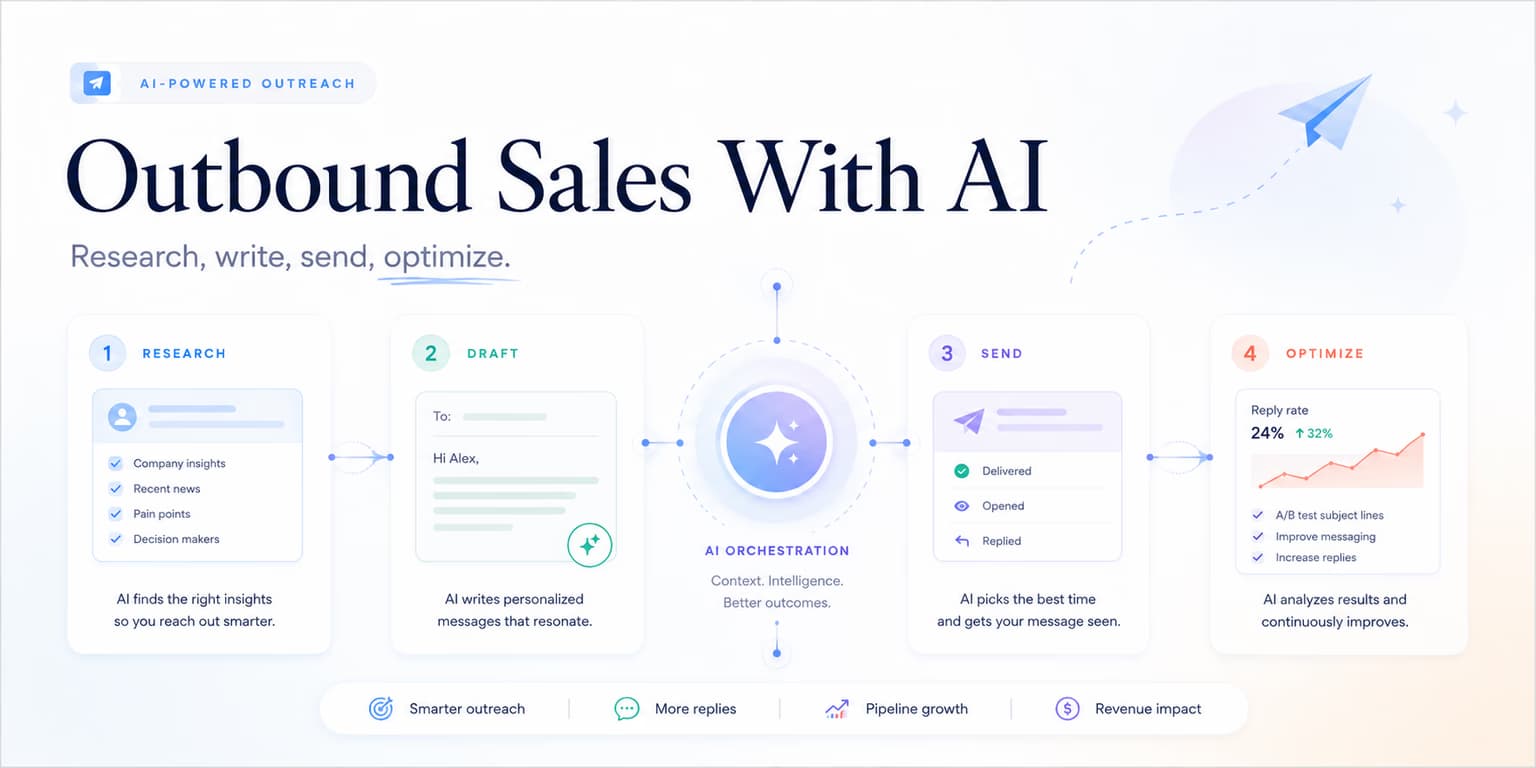
Outbound sales used to scale by adding people to repetitive work. More reps meant more list building, more profile research, more copy-pasted messages, more follow-ups, and more manual CRM updates. The operating assumption was simple: if the team produced enough activity, a predictable slice would turn into pipeline.
That model is weaker now because buyers are tired of generic outreach and platforms are less forgiving of mechanical sending. More activity is not automatically better. A team can create a bigger top of funnel while also creating more ignored messages, more low-fit demos, and more risk to sender accounts.
Outbound sales with AI changes the job design. Instead of asking humans to do every repetitive step by hand, you give agents the work they are good at: sourcing candidates, collecting context, scoring fit, drafting first passes, organizing replies, and enforcing process checks. Humans keep the judgment: ICP, offer, account quality, sensitive replies, demos, and closing.
Omentir is designed for this AI-assisted pipeline: discovery agents, lead qualification, campaign creation, draft or active campaign modes, paced LinkedIn outreach, and reply conversations in one place. The team design matters as much as the tool. If you keep the old volume-first process and simply add AI, you get faster noise. If you redesign the work, you get more output per person.
Structuring an AI-first B2B sales organization
Redesigning your team around AI agents does not mean replacing the whole sales function. It means moving repetitive execution into a controlled system and raising the standard for human review. The organization should be built around decisions, not chores.
A simple AI-first outbound team can start with two primary roles:
- AI Sales Operator: Owns ICP rules, discovery agent setup, prompt instructions, draft QA, campaign pacing, and early reply triage.
- Account Executive (AE): Owns high-intent conversations, discovery calls, demos, business cases, procurement, and closing.
In founder-led sales, the founder may play both roles at first. In a small team, one operator may support multiple AEs. In a larger team, RevOps may own the systems while sales managers own messaging standards. The exact chart can vary, but the principle stays the same: agents handle repeatable work; humans own judgment and customer trust.
The biggest mistake is treating the AI Sales Operator as a button-clicker. This role needs commercial judgment. They should know what a good account looks like, what a dangerous message sounds like, and when a reply needs a human instead of an automated draft.
Team Rule: Focus on Review, Not Writing
Give operators a daily review rhythm. Their job is not to admire AI output; it is to reject weak leads, fix risky copy, inspect replies, and improve the rules that created those drafts.
Delegating tasks: AI agents vs human operators
Outbound campaigns involve many tasks, but not every task deserves the same level of human attention. The cleanest teams write down what the agent can do, what the human must approve, and what the system should never do without escalation.
- AI Tasks: Source prospects on LinkedIn, gather public context, score ICP fit, draft connection notes, draft first messages, and organize reply conversations.
- Human Tasks: Approve ICP rules, review draft quality, handle nuanced objections, decide whether to escalate replies, run demos, and own commercial commitments.
- System Guardrails: Enforce daily quotas, stop follow-ups after replies, reject missing product context, and keep campaign activity paced.
This division prevents the two common failure modes. In the first, the team over-trusts the agent and lets it send messages that make unsupported claims. In the second, the team under-trusts the system and forces humans to redo every piece of work manually. The right middle is reviewable automation.
A useful operating rule is: let AI prepare the decision, but keep a human responsible for the decision when the stakes are high. A first-pass list can be automated. A sensitive compliance answer should not be. A routine "thanks, does next week work?" reply may be easy to draft. A pricing negotiation needs a person.
Write these boundaries into the campaign workflow before launch. For example, the agent can draft the first connection note from public context, but the operator reviews the first batch. The agent can suggest a reply to a common timing objection, but the AE handles a question about security or procurement. The agent can monitor conversations for positive intent, but the sales owner decides when to move a deal into a formal opportunity.
Clear ownership also makes coaching easier. When a campaign underperforms, you can ask whether the sourcing rule was wrong, the prompt produced weak copy, the pacing was too aggressive, or the human follow-up was slow. Without those boundaries, every issue gets blamed vaguely on "AI," which helps nobody improve the system.
For details on operational workflows, check out our guide to the AI SDR outbound playbook.
Tracking ROI and operational metrics in AI sales teams
AI-native sales teams need different metrics from traditional activity teams. Counting how many messages the system can draft is not enough. The question is whether automation creates more qualified conversations with less manual work and less account risk.
Track metrics across the whole workflow: qualified leads discovered, leads rejected, drafts approved, drafts rewritten, connection acceptance, positive replies, objection types, meetings booked, show rate, qualified opportunity rate, and time-to-first-response. The rejection metrics are especially useful. If the system approves nearly everything, your ICP rules are probably too loose.
Compare the cost of AI tools with the cost of manual research and drafting, but do not stop there. A tool that saves time but fills the calendar with poor-fit calls is not improving sales efficiency. A better ROI measure is qualified pipeline per operator hour.
Integrating enrichment waterfalls and contact cleaning
Unstructured LinkedIn profile data usually needs enrichment before outreach. A title and company name may not tell you whether the account fits your ICP, whether the buyer owns the pain, or whether there is a timely reason to contact them.
Enrichment tools like Apollo.io or workflow platforms like Clay can help add company details, role context, domains, and other public signals. Treat enrichment as evidence, not certainty. If data sources conflict, prefer recent, sourceable, account-specific context over broad database labels.
Clean data matters because AI drafts are only as good as their inputs. A wrong company, stale role, or confused domain can produce a message that looks personalized and feels careless. For sequence templates, check out our guide on B2B lead generation setups.
Protecting account health with paced delivery systems
Account health is the constraint that keeps AI outbound honest. If the system can generate thousands of messages, that does not mean the sender profile should deliver them. LinkedIn outreach has to look and feel like a real person working a focused list.
Configure campaigns around conservative daily budgets, natural spacing, reply stop conditions, and campaign overlap checks. Newer accounts, cold accounts, and accounts running multiple campaigns should be handled with extra caution. The point is not to find the highest possible number; it is to keep the channel sustainable.
Omentir manages outreach through paced queues and daily quotas, while replies are captured in a unified inbox sorted by intent. For setup details, read our playbook on outbound sales stack design.
Safety is also a quality signal. If a campaign only works when it sends aggressively, the targeting or offer is probably not strong enough. Better ICP fit and better message relevance should reduce the need for risky volume.
SOP: the AI outbound campaign checklist
Follow this SOP to audit AI-first sales operations:
- Audit Sourcing: Confirm that discovery agents target the right segment, buyer role, and buying signal.
- Review Rejections: Inspect leads the system rejected so you can improve ICP rules.
- Review Copy: Check draft queues for unsupported claims, awkward personalization, and unclear calls to action.
- Verify Pacing: Confirm daily quotas, campaign overlap, and reply stop conditions.
- Review Replies: Separate positive intent, objections, referrals, not-now replies, and negative responses.
- Connect Revenue: Map qualified conversations and booked meetings into your pipeline tracker or CRM.
- Check Redirect Links: Test calendar redirects and resources to ensure they open correctly.
Run the checklist before scaling a campaign, not after a problem appears. AI gives teams the ability to move quickly; the checklist makes sure they are moving in the right direction.
Scale without confusing volume with output
Outbound success in B2B is driven by output per person, but that is not the same as volume. The best AI sales teams use automation to improve the quality and consistency of the work humans were already trying to do: find the right buyers, understand the context, write a relevant message, follow up responsibly, and handle replies quickly.
Redesign the team before you scale the campaigns. Decide what agents own, what humans own, which metrics prove quality, and where the safety limits sit. Then use Omentir to run the repetitive pieces: discovery, drafting, campaign execution, pacing, and reply organization.
The result is not a sales team with no humans. It is a sales team where humans spend more time on judgment, conversations, and closing, and less time copying data between tabs.
Frequently asked questions
Instead of spending hours searching for leads and copy-pasting pitches, sales reps act as operators who configure search rules, review AI-drafted messages in a queue, and focus their time on closing active deals.
An AI Sales Operator is a sales team member responsible for setting up discovery agents, managing prompt instructions, reviewing campaign drafts, and auditing outbox safety limits.
Omentir coordinates campaigns around daily quotas and human-paced outreach so activity does not behave like a bulk sender. Teams should still keep campaign volume conservative and review account health.
Omentir provides REST endpoints and an MCP server for workspace context, discovery agents, searchable scored leads, activity, existing conversations, and replies. Teams can connect those outputs to their own revenue systems.