
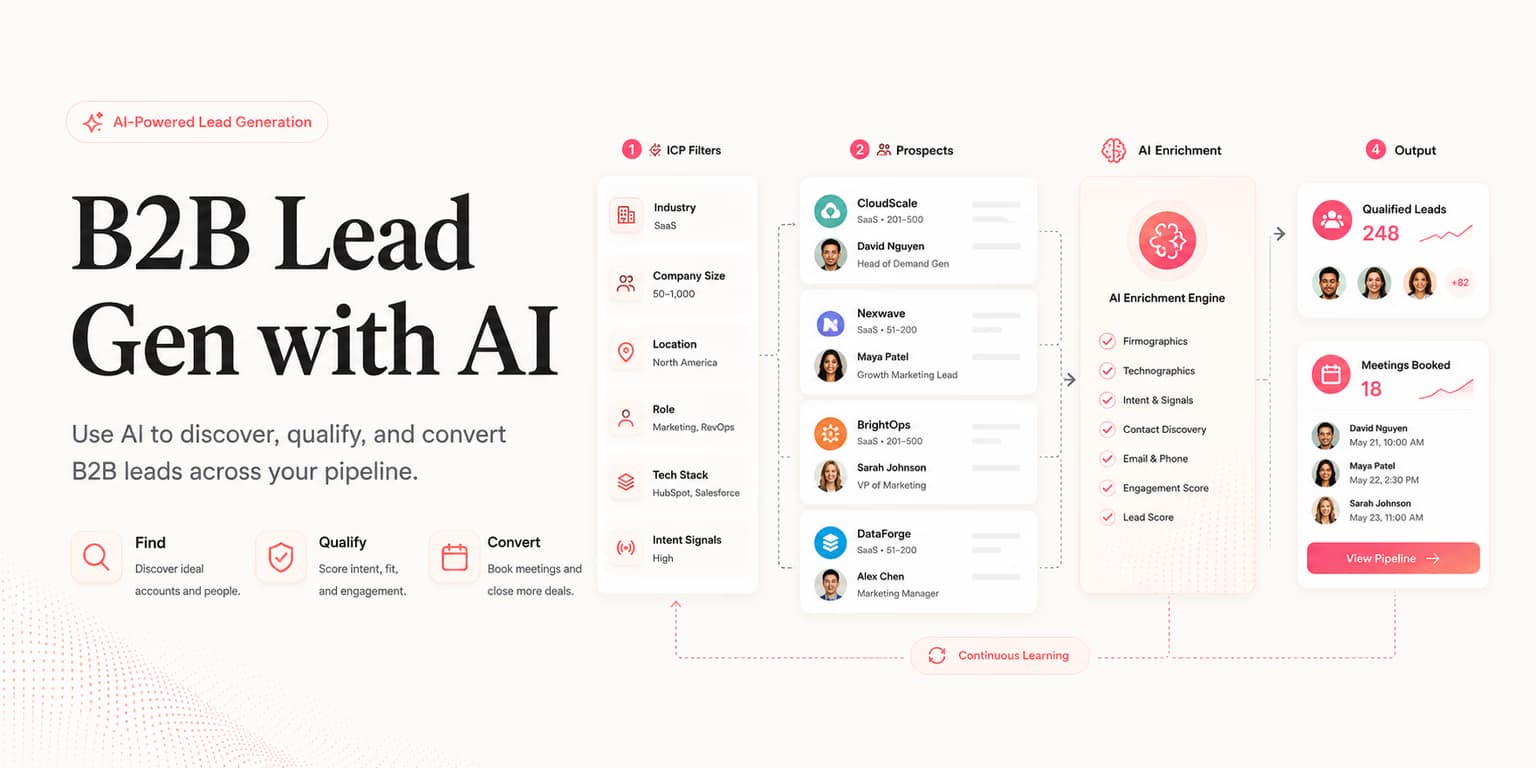
If you are still exporting list after list from static databases, cleaning them in spreadsheets, and throwing them into bulk email sequences, you are playing a losing game. In 2026, buyers are tired of generic outreach. Email providers and social platforms are clamping down on automated spam. The result is declining deliverability, restricted accounts, and reply rates that struggle to reach half a percent.
Building a modern outbound pipeline requires a change in philosophy. Instead of relying on volume, successful B2B growth teams are shifting to context-aware outbound engines. These systems combine programmatic data enrichment with real-time buying signals and generative artificial intelligence. By verifying actual customer fit before any message is sent, you can scale relevancy instead of scaling noise.
Omentir is built for this outbound model. As an AI-native sales agent for LinkedIn, it connects to your own profile to find buyers, draft relevant connection notes, and manage conversations in a unified inbox sorted by intent. Below is the architecture of an AI-powered lead generation workflow, and how to implement it.
Building the outbound data cascade
A great outbound workflow starts with data quality. The old way of prospecting involved filtering a database by industry and company headcount, then pulling contact info. The problem is that database records are static. They are often out of date by three to six months, and they tell you nothing about whether the prospect is actually facing the problem you solve today.
To fix this, we build a data cascade. A data cascade is a series of automated enrichment steps that starts with a broad list of target companies and filters them down through multiple layers of verification. You can build these waterfalls using platforms like Clay, combining databases like Apollo.io and Lusha to enrich contacts with high accuracy.
By routing data through subsequent API requests, you compile a rich set of attributes. This programmatic cascade ensures that your prospecting list contains only contacts who are actively validated. It avoids the waste of time associated with contacting invalid email addresses or dead profiles, building a strong foundation for your active campaign steps.
The Three-Step Waterfall Structure 💧
First, source company domains using basic ICP parameters. Second, query active job listings or recent press updates to find intent signals. Third, pull key decision-makers and execute a real-time validation check on their LinkedIn profiles to confirm they are still in that role.
Intent signals vs. static lists
The core difference between static lists and signal-led lists is timing. Intent signals are observable events that suggest a company has a budget, a pain point, or a strategic transition. Common B2B intent signals include hiring trends in specific departments, tech stack installations, and recent leadership changes.
For instance, if you sell an developer tooling platform, a static filter for engineering managers is highly inefficient. Instead, query active job listings for teams hiring React developers, or monitor when a competitor stack is removed. Sourcing leads based on these active triggers ensures that your value proposition is relevant to the challenges they are actively discussing.
Signal-driven lead generation also improves conversion. When a prospect gets a message that references an event they are already managing, it feels timely instead of like a cold interruption. You look like someone who noticed their current work, not a vendor blasting templates.
AI lead scoring: moving beyond job titles
Once you have a list of potential prospects, the next hurdle is qualification. In the past, this was done manually by junior sales development representatives who read through LinkedIn profiles and company websites. It is a slow, error-prone process that limits the speed of your outbound motion.
AI lead scoring solves this by programmatically evaluating each lead against a detailed ideal customer profile. An LLM (Large Language Model) can read a company description, website copy, and individual profile highlights to make a qualitative judgment about whether they match your target buyer criteria.
The key to successful AI qualification is transparency. If your system flags a lead as a good fit, it must explain why. This prevents black-box decisions where you blast messages to prospects without knowing the underlying reason for their inclusion.
If an agent approves a lead, it should generate an explanation of how the target ICP matches the prospect's profile. That log gives SDRs the context they need to personalize pitches. For more on scoring systems, read our guide on LinkedIn lead scoring models.
Implementing custom scoring rules
To make AI qualification work, you need to define explicit scoring rubrics. Instead of asking a general question like "Is this a good lead?", break the evaluation down into specific criteria:
- Role fit: Does the prospect actually manage the budget or the team affected by the problem?
- Company profile: Does the organization sell B2B, and does their product size justify the integration overhead?
- Contextual signal: Is there active evidence (e.g., job postings, software keywords) showing they need a solution?
Omentir integrates this scoring logic directly into its lead discovery engine. When you set up a discovery agent, it retrieves profiles matching your input criteria and runs them through a context-aware grading prompt. The agent scores each prospect from one to ten, providing a detailed explanation of its reasoning so you can audit the results before launching outreach. You can see how this fits into our broader framework in the AI lead qualification playbook.
Safe LinkedIn execution: pacing and consent
Having a highly qualified lead list is meaningless if your outreach methods get your accounts restricted. Many sales automation platforms scrape data aggressively or send hundreds of messages in bursts. LinkedIn's detection algorithms quickly flag this behavior, leading to account restrictions or permanent bans.
outbound outreach must stay human-paced. This means replicating the natural pacing of a human user: spacing requests throughout the day, limiting the number of weekly invitations, and letting campaigns run gradually. A safe benchmark for most active accounts is between 100 and 150 connection requests per week.
Omentir protects your account health by using native API wrappers via Unipile, which manages secure and encrypted access without violating platform terms. Omentir enforces strict daily send quotas and spaces messages naturally. Rather than fully automating the initial connection note, it lets you choose between auto-approval modes and human-in-the-loop validation, ensuring that you maintain full creative control.
Safety throttles matter for brand reputation. Unsolicited pitches at scale create negative impressions. Throttles let you build connections with actual buyers while keeping the social account active. Check our detailed guide on cold LinkedIn outreach workflows for specific safety parameters.
The Human-in-the-Loop Safeguard 🛡️
By default, Omentir queues your generated sales drafts in a pending folder. You can read, tweak, and approve the copy with one click, giving you the speed of AI drafting without the risk of embarrassing typos or irrelevant pitches reaching high-value buyers.
Connecting AI agents via MCP
The bigger change in B2B lead generation is autonomous AI workers. Instead of running search queries and copy-pasting pitches by hand, you can connect existing AI agents to the sales workflow.
This is made possible through the Model Context Protocol, an open standard that allows models like Claude and ChatGPT to interact with local and hosted databases, tools, and SaaS APIs. By shipping a hosted MCP server, Omentir enables agents to run your entire outbound sequence autonomously.
Your agent can query workspace context using tools like omentir_get_context, update product profiles, create new target lead groups, and review campaign performance. This keeps your GTM pipeline active in the background: your agent discovers the leads, scores them, writes the personalized copy, and puts them into campaigns, leaving you to join only when a prospect sends a warm reply. Read more in our MCP LinkedIn outreach guide.
By giving your AI tools direct API access under your strict guidelines, you transition from slow manual prospecting to continuous market discovery. The agent tracks response signals, reports which outreach angles are converting, and flags opportunities without requiring you to handle data formatting or sequence triggering.
Step-by-step GTM outbound blueprint
If you want to set up an AI-driven B2B lead generation engine from scratch, follow this blueprint:
- Step 1: Define your Target ICP: Write down your ideal customer profile, including company tags, funding status, role challenges, and specific technology signals.
- Step 2: Connect Omentir: Link your LinkedIn profile and navigate to Settings to generate a workspace token. Configure your product description and main value proposition.
- Step 3: Setup Discovery: Initialize an automated search agent in Omentir. Use plain-English filters to target prospects matching your ICP, and let the scoring algorithm grade candidates.
- Step 4: Draft Campaigns: Create an outreach sequence consisting of a connection request note, a follow-up three days later, and a final value-add message five days after. Enforce soft value offers instead of direct product pitches.
- Step 5: Review and Scale: Spend 5 minutes every morning checking your pending queue. Approve qualified leads to put them in the live pipeline. Track reply intent flags in your inbox to prioritize bookable demos.
This structured process keeps your outreach highly targeted. Since you are validating fit before executing, you save credits and protect your sender reputation while maintaining a steady flow of sales opportunities.
What actually changed in B2B outreach
The era of mindless outbound volume is over. Buyers are sharper, spam filters are tighter, and generic sales copy gets ignored. Teams that grow here prioritize context, precision, and safe delivery.
Combine AI-driven data waterfalls, qualitative scoring rubrics, and a secure LinkedIn execution layer like Omentir, and you can scale without turning every message into noise. Start small, verify every signal, and let the agent handle the repetitive work while you stay on the conversations that matter.
Frequently asked questions
Traditional prospecting relies on static database filters like company size and job title. AI lead generation evaluates qualitative, real-time context (such as website copy, job openings, and product listings) to determine if a company actually faces the specific problem you solve.
The most effective signals are hiring patterns in relevant departments, software stack additions or removals, recent leadership changes, and specific product-expansion announcements. These events represent timing advantages that make your outreach highly relevant.
Yes, but only if it respects natural, human-paced sending limits and leaves the final approval in your hands. Omentir enforces strict daily quotas and coordinates message actions via secure APIs like Unipile, avoiding the spam tactics that lead to restricted accounts.
Ground your AI drafting in a detailed product profile and verified prospect evidence. Instead of letting the AI invent facts or use standard introductory formulas, feed it the specific intent signal or profile context that earned the prospect a high score.