
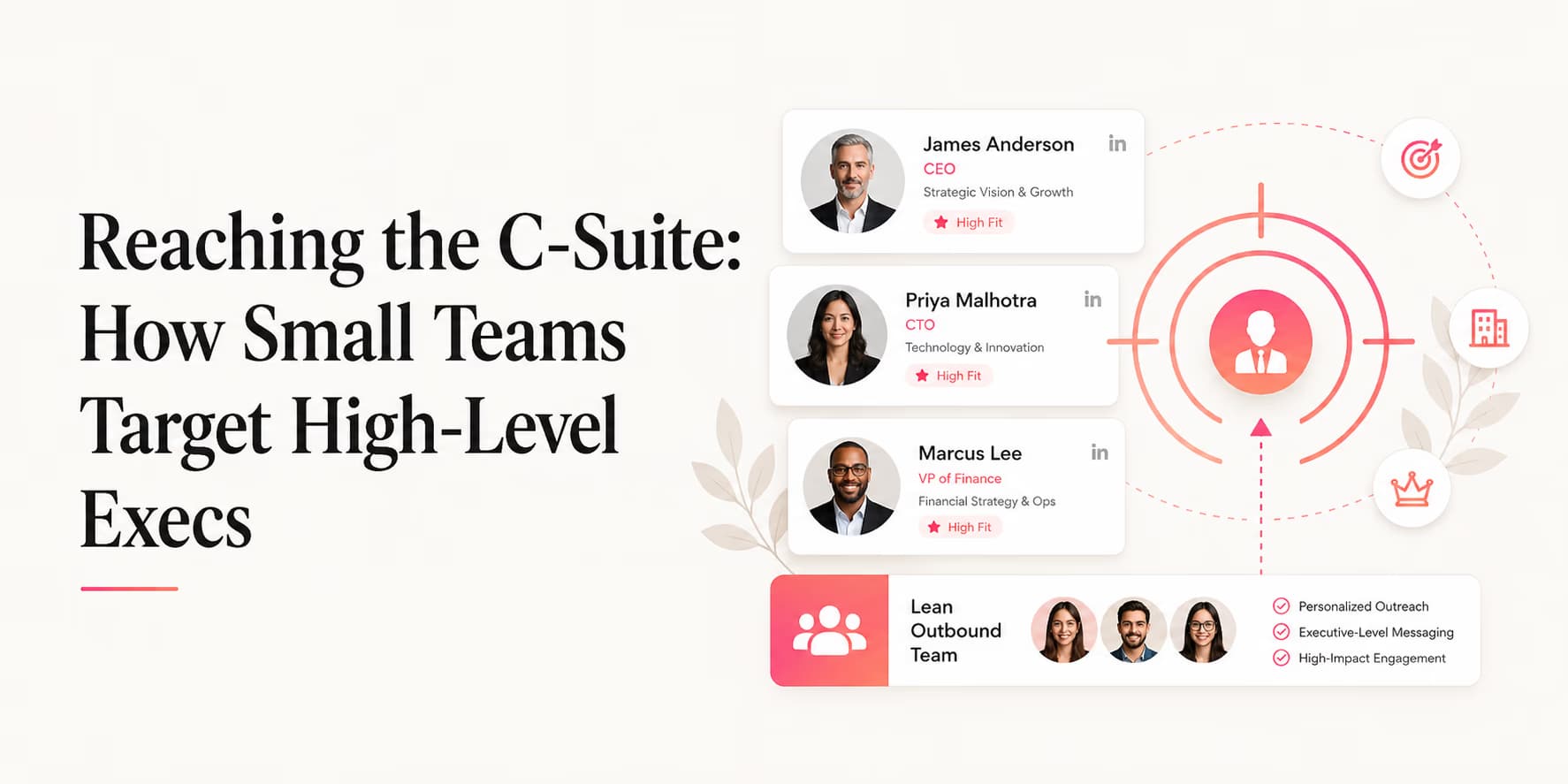
Outbound pipeline generation often targets mid-level managers. Senders focus on managers or coordinators because they are easier to contact and have higher acceptance rates. However, mid-level staff rarely hold budget authority, resulting in long sales cycles that stall during approval processes.
To accelerate sales, you must target the C-suite. Reaching high-level executives (such as CEOs, CFOs, or CTOs) allows you to start sales conversations with the decision makers who hold budget ownership.
Targeting the C-suite requires a different copywriting approach. Busy executives will delete long pitches, generic greetings, or aggressive call requests.
To get executive replies, your messages must be short, direct, and grounded in real business outcomes.
Executive outbound fails when the note could have been sent to any VP. The rest of this piece is about finding a moment they already care about, then asking for one small next step.
The mistake most small teams make is treating executive outreach as a louder version of normal SDR outreach. They take a message written for a manager, swap the title field to CEO or CTO, and assume seniority alone will make the pitch more urgent. That usually creates the opposite effect. Executives notice when a message is really meant for someone two levels below them.
A better executive campaign starts with one question: what business decision is this person already responsible for? If your message does not connect to revenue, cost, risk, hiring, margin, customer retention, or strategic speed, it is probably not a C-suite message yet. It may still be useful, but it belongs with a director, head of department, or operations owner.
Which executive should you target?
"The C-suite" is not one persona. A CEO, CFO, COO, CTO, CRO, and CMO all care about different tradeoffs. Sending one generic executive pitch to all of them weakens your campaign because the proof, trigger, and ask should change by role.
Use this simple mapping before writing:
- CEO: Speak to growth constraints, strategic execution, market timing, and bottlenecks that prevent the company from moving faster.
- CRO or VP Sales: Focus on pipeline quality, rep productivity, slow prospecting workflows, low reply rates, and wasted selling time.
- CMO: Connect the message to demand generation efficiency, audience quality, content-to-pipeline conversion, and campaign learning loops.
- COO: Lead with process consistency, handoff failures, manual work, team throughput, or operational risk.
- CTO: Reference integration complexity, technical reliability, data flow, security posture, or engineering time saved.
- CFO: Keep the argument tied to cost control, payback period, forecasting confidence, or reducing spend on underperforming tools.
This does not mean you need six completely different campaigns. You need one core offer with role-specific framing. For Omentir, a CRO might care that autonomous prospecting protects sellers from low-quality list building. A CEO might care that the same system helps the company find design partners without hiring a large sales team. The product is the same. The business problem is different.
If you cannot write the executive's likely priority in one sentence, pause the campaign. It is better to send 40 precise messages to the right senior buyers than 400 messages that merely contain senior job titles.
The writing rules of C-suite outreach
C-suite executives evaluate messages in seconds. If the first line does not show why it matters, it is ignored.
Enforce these writing constraints across your campaigns:
- Extreme brevity: Keep copy under 50 to 60 words. Short messages fit on mobile screens without scrolling.
- No buzzwords: Cut vague phrases. If a sentence could be "synergies" or "digitally transform," rewrite it in plain English.
- Direct openings: Skip introductory greetings like "I hope this email finds you well" and state your value proposition in the first sentence.
The strongest executive messages usually have four parts: a relevant trigger, a business interpretation of that trigger, one credible way you can help, and a low-pressure question. The trigger proves the message is not random. The interpretation proves you understand why the trigger matters. The offer explains the connection to your product. The question lets the executive reply without committing to a sales call immediately.
Avoid praise-only personalization. "Congrats on the funding" or "loved your post" can be a useful opener, but it is not enough by itself. Executives see that pattern constantly. The line that matters is what you infer from the signal: "That funding usually creates pressure to turn founder-led pipeline into a repeatable motion" is stronger than "Congrats on the Series A."
Also avoid junior language. Phrases like "I wanted to pick your brain," "just checking if you are the right person," or "would you be willing to hop on" make the sender sound uncertain. A senior buyer does not need theatrical confidence, but they do need a clear reason to care.
For details on copywriting prompt rules, see our guide on prompting LLMs for human outreach.
Sourcing executive buying signals
Executives respond to messages that reference their active initiatives.
Instruct your discovery agents to look for high-level buying signals:
- Department growth: Senders search for active job postings indicating department expansions.
- Technology changes: Verify competitor technology installations using website crawlers, as detailed in our guide on how AI crawlers extract signals.
- Public milestones: Reference active company updates or career transitions.
A useful executive signal should pass two tests. First, it should be visible enough that referencing it feels fair. Public hiring, website changes, product launches, market expansion, executive appointments, funding announcements, and new compliance pages are all fair game. Second, it should imply a business problem your offer can plausibly help with.
For example, a company hiring five account executives is not just "growing." It may need cleaner prospect lists, faster account research, better territory coverage, safer LinkedIn workflows, or a way to keep reps from spending half their week on manual sourcing. A company adding an enterprise security page may be moving upmarket, which can imply longer buying committees, stricter procurement, and a need for more precise account selection.
Do not overstate the signal. "I saw you are hiring SDRs, so you must be struggling with pipeline" is too assumptive. "Saw you are hiring SDRs; teams at that stage often start tightening lead quality before adding more outbound volume" is more credible. It connects the trigger to a problem without pretending you know the executive's internal situation.
In Omentir, this is where lead discovery and message generation should work together. The crawler should not only collect a company fact. It should attach the reason that fact matters for the role you are targeting. That gives the copywriter, human or AI, enough context to write like a business peer instead of a template engine.
The executive messaging template blueprint
Use the template below to draft direct, outcome-focused copy for busy executives:
Hi {first_name}, saw you are hiring for the sales team at {company_name}.
That usually creates pressure to keep prospect quality high while reps ramp.
Omentir helps small teams find ICP-fit LinkedIn leads, draft grounded messages,
and pace outreach safely from one workflow.
Worth comparing notes on how you are handling prospecting quality this quarter?
This copy states the trigger, presents the outcome, and asks a low-friction question.
Notice what the template does not do. It does not claim secret knowledge about the company. It does not ask for 30 minutes. It does not list every feature. It gives the executive a quick reason to believe the sender understands the operating moment, then invites a practical conversation.
If you use AI to draft this message, give the model strict inputs: the executive role, the public trigger, the business interpretation, the product outcome, the banned claims, and the maximum word count. Do not ask it to "make this exciting." Ask it to make the message specific, restrained, and easy to answer.
Before and after: executive message rewrite
Here is the kind of message small teams often send when they want to reach senior buyers:
Hi Priya, I hope you are doing well.
I wanted to introduce Omentir, an AI sales platform that can transform your outbound.
We have many features including lead scraping, personalization, and automated outreach.
Would you be open to a 30-minute demo next week?
The problem is not that the message is rude. The problem is that it asks the executive to do all the work. They must figure out why this matters, whether it relates to a current priority, and why a demo is worth their time.
A stronger version would look like this:
Priya, saw your team is adding two outbound roles this month.
That usually makes lead quality and rep focus harder to control early.
Omentir helps founders test ICP-fit LinkedIn outreach before building a bigger motion.
Are you centralizing prospect research yet, or still letting each rep handle it?
The second message is still a sales message, but it behaves differently. It uses a visible trigger, connects that trigger to an executive concern, narrows the product outcome, and ends with a question the buyer can answer in one sentence. That is the level of friction you are trying to create: low enough to reply, specific enough to qualify.
Outreach Rule: Peer-to-Peer Positioning 💡
Write messages that sound like they come from an equal business leader. Do not use overly deferential language or ask for "favors," as this reduces your professional credibility.
Orchestrating LinkedIn and email outreach loops
C-suite campaigns are most effective when coordinated across multiple channels. If an executive ignores your LinkedIn request, follow up via email after a few days.
Ensure your messaging across channels references the same business trigger.
Multi-channel does not mean repeating the same pitch everywhere. It means each channel carries one small part of the same argument. LinkedIn can be used for a short connection request tied to a public signal. Email can carry the slightly fuller business context. A later LinkedIn follow-up can reference a useful asset, customer story, or observation without demanding a meeting.
A simple executive sequence might look like this:
- Day 1 LinkedIn request: One sentence referencing the public trigger and the reason you wanted to connect.
- Day 3 email: A concise version of the business problem, the outcome you help with, and a question about current process.
- Day 7 follow-up: Add one new useful point, such as a short teardown, relevant example, or specific risk you noticed.
- Day 12 final note: Close the loop politely and offer to send context to the right owner if someone else handles the workflow.
Keep the thread consistent. If the LinkedIn request talks about hiring and the email talks about generic AI automation, the buyer feels the handoff. The campaign should read like one coherent conversation, even when it crosses channels.
Follow-up boundaries for senior buyers
Executives are worth following up with, but they are not worth chasing indefinitely. The goal is to be present, clear, and useful without turning the campaign into pressure. Two follow-ups are usually enough for a cold executive sequence unless the buyer engages.
Each follow-up should earn its place. Do not send "bumping this" as the entire message. Add a sharper point: a pattern you see in their market, a relevant operational question, or a short resource that helps them think about the problem. If you have nothing new to say, wait.
A useful final note can be simple: "I may be early here. If prospecting quality is owned by someone else, happy to send a short note their way." This gives the executive an easy referral path and avoids making silence feel awkward.
Pacing campaign activity to protect profiles
Even with highly personalized copy, you must manage campaign pacing. High outreach speeds will result in profile restrictions.
Omentir paces connection requests and messages automatically. For pacing guidelines, see our guide on pacing LinkedIn outreach campaigns.
Senior campaigns should be smaller than manager campaigns. A founder or sales lead sending executive outreach should care more about account quality than daily volume. Start with narrow account batches, review every drafted message, and watch for negative signals such as ignored connection requests, profile warnings, or repeated objections that the message is irrelevant.
Pacing also protects your judgment. When you send too many executive messages at once, you cannot learn which signals are working. Smaller batches let you compare triggers, roles, industries, and questions. If CFOs ignore a cost-savings angle but COOs reply to a process bottleneck angle, that is a strategic learning. Bulk sending hides that information.
SOP: the C-suite outreach campaign checklist
Launch your C-suite campaigns using these steps:
- Step 1: Identify target C-suite profiles matching your ICP criteria.
- Step 2: Configure Omentir to crawl company domains for active signals.
- Step 3: Write concise copywriting prompts limiting length under 60 words.
- Step 4: Review drafts and launch campaigns paced safely.
Add a human review step before launch. For each message, ask:
- Is the trigger public, current, and relevant to this specific executive?
- Does the first line make sense without reading the rest of the message?
- Would the executive understand the business outcome in under ten seconds?
- Does the message avoid unverifiable claims, exaggerated savings, and fake familiarity?
- Is the ask easy to answer without booking a call immediately?
This review takes time, but it is the work that separates executive outreach from automated noise. The point of automation is to remove repetitive research, mapping, pacing, and drafting work. It should not remove the judgment required to decide whether a senior buyer deserves a message in the first place.
Omentir handles the variable mapping and safety limits, allowing you to manage campaigns efficiently.
Connecting with high-level B2B decision makers
Reaching C-suite executives requires precision and brevity. By using short, trigger-grounded messages and pacing campaigns safely, small sales teams can build pipeline with enterprise decision makers.
The best campaigns do not flatter executives or overload them with features. They show that you understand a visible business moment, explain why that moment creates pressure, and offer one practical next step. If you cannot name the moment in one clause, do not send the note.
Frequently Asked Questions
Executives receive dozens of messages daily. Long paragraphs, vague value claims, and requests for 30-minute meetings are ignored. Senders must keep copy under 50 words and focus on business outcomes.
Look for high-level organizational signals, such as department expansions, executive hiring posts, or shifts in competitor technology stacks.
Omentir automates lead discovery based on targeting filters, runs prompts grounded in your product specs, and enforces random pacing delays to protect sending safety.
Yes. Senders should send 1 to 2 paced follow-ups spaced 3 to 5 days apart, sharing a brief resource (like a case study link) rather than asking for a call again.