
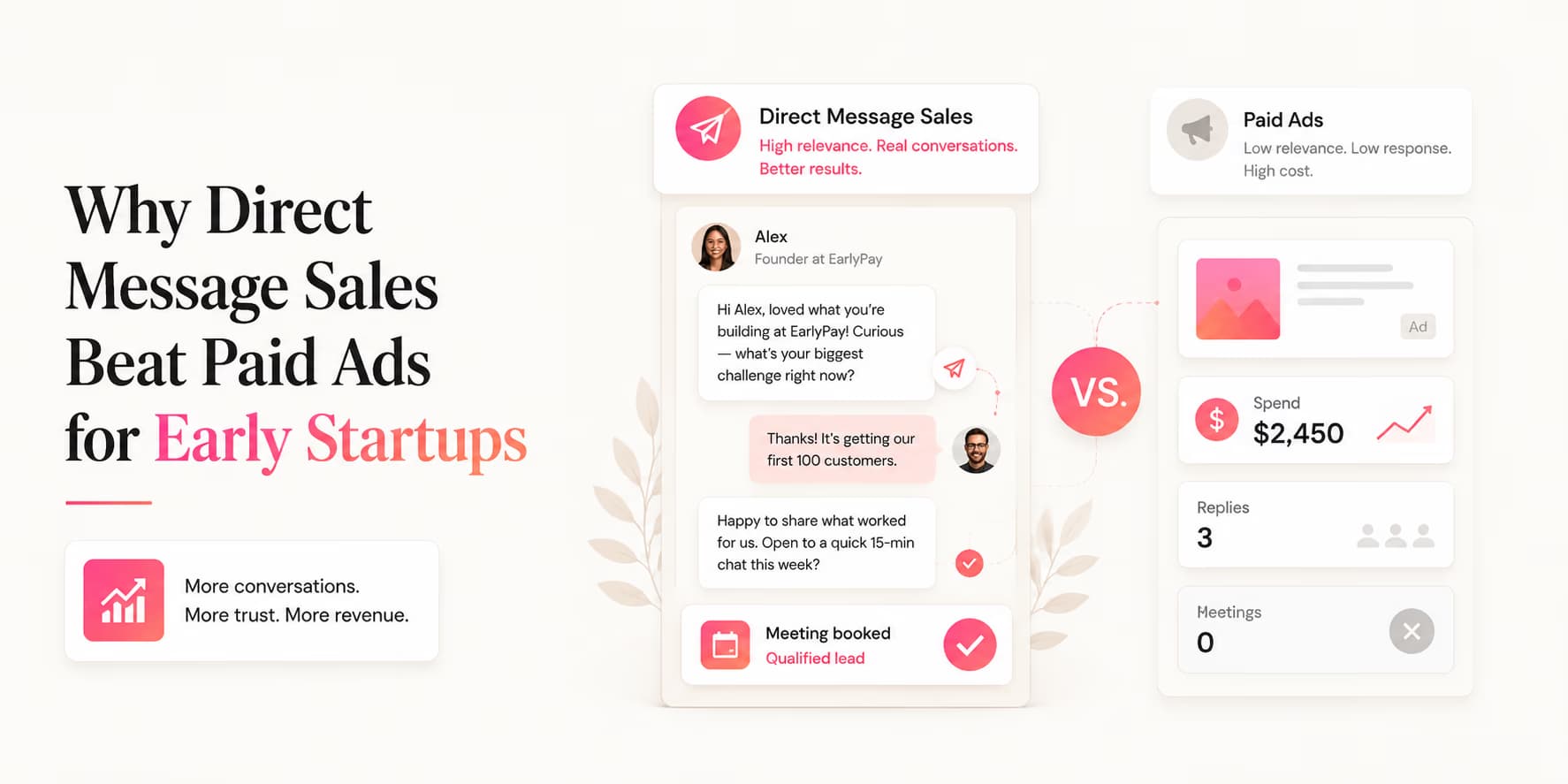
Building a predictable customer acquisition loop is a core milestone for B2B SaaS startups. Founders often turn to paid ads (Google Ads, LinkedIn Campaign Manager, or Facebook Ads) to drive traffic. The assumption is that paying for clicks is the fastest way to scale.
For early-stage startups, paid ads often burn cash. Advertising networks are competitive, and CPC rates sit at historical highs. If the landing page positioning is unvalidated, you pay for visitors who leave immediately.
Direct message (DM) sales are far more effective for early validation. By messaging target prospects over LinkedIn or email, you build relationships and gather qualitative feedback at a fraction of the cost.
Paid ads buy attention you have not earned. A DM asks for two minutes from one person. The rest of this piece is about when that trade is worth it, and when it is just unpaid spam.
The important phrase is "early validation." Paid ads can work once you know the buyer, message, offer, landing page, and conversion path. They are much weaker when those pieces are still guesses. At the beginning, the most valuable thing is not traffic. It is conversation.
Direct messages give you a feedback loop ads cannot easily provide. You can ask why someone is not interested, learn what they use today, hear the exact words they use for the pain, and adjust the next message. That learning compounds quickly when you are still shaping the product and positioning.
When paid ads still make sense
Paid ads are not useless. They are just usually the wrong first move for a B2B startup that has not validated its market. Ads can be useful when you already know which segment converts, the landing page explains the offer clearly, and you can afford enough traffic to learn without threatening runway.
Ads can also help with retargeting. If a prospect visits your site after a sales conversation, seeing a relevant ad later may reinforce the category or remind them to return. Ads can support a motion that is already working. They are rarely the best way to discover the motion from scratch.
Use this decision rule: if you cannot confidently name the buyer, pain, trigger, offer, objection, and proof point, direct conversations should come before paid traffic. If those pieces are already clear and you need distribution, ads may deserve a test.
Why direct message outbound sales perform better
Direct message outreach beats search or social ads for early B2B validation in a few practical ways:
A DM campaign is built around specific people and a conversation, not a click:
- Feedback density: Gather detailed text responses instead of anonymous click statistics.
- Low software fees: Start outreach loops with a monthly budget under $100.
- Micro-targeting: Send messages directly to decision makers, bypassing general company filters.
DMs also force clarity. You cannot hide a vague offer behind a beautiful landing page when you are writing to one person. The message either connects to their world or it does not. That pressure is useful for founders because it exposes weak positioning quickly.
A good DM campaign gives you four assets:
- Buyer language: The exact phrases prospects use to describe the problem.
- Objection patterns: The reasons prospects do not move forward.
- Segment evidence: Which titles, company stages, or triggers respond with real intent.
- Offer feedback: Whether the next step feels clear, useful, and low-risk.
Those assets improve everything else: your homepage, demo, onboarding, pricing page, and eventually your ads. Direct sales is not only an acquisition channel. It is research with revenue attached.
For early setup validation templates, check out our guide to validating B2B MVPs via cold outreach.
Feedback density: gathering insights vs. anonymous clicks
The primary limitation of paid advertising is the lack of qualitative data. When an ad campaign fails, you get basic numbers: a 1.2% click-through rate and a high bounce rate. These metrics do not explain why visitors left.
Direct messages generate rich conversations. When a prospect declines your offer, they often explain why:
- "We use a competitor tool because we need HubSpot integrations."
- "Our team is currently focused on list cleansing issues."
- "We do not have the budget for another paid tool right now."
Those replies tell you which features matter and where the copy is off.
The best replies are not always positive. A thoughtful rejection can be more useful than a vague "sounds interesting." If five target buyers say they already solved the problem internally, your product may need a sharper angle. If several say the problem belongs to a different role, your targeting needs to change. If they all ask whether you integrate with a certain tool, that integration may matter more than your current roadmap suggests.
Capture replies in a simple taxonomy:
- Problem confirmed: The prospect says the pain exists or describes a related workflow.
- Wrong owner: The prospect points to another role or team.
- Timing issue: The prospect cares but not now.
- Proof issue: The prospect needs examples, security detail, or customer evidence.
- Poor fit: The prospect's company does not match the market you should pursue.
This turns DMs into a market-learning system. Ads can tell you where people clicked. DMs can tell you why they care or why they do not.
Economics: comparing outbound CAC and ads budgets
The economics of early B2B ads compare poorly to targeted outreach campaigns:
Paid advertising: Senders often need a meaningful monthly test budget to gather enough data. If your conversions are low, your Customer Acquisition Cost (CAC) can exceed your product pricing before you learn whether the segment is right.
DM Outreach: Pro is $49/month, with a minimum of three bookings per week or you pay nothing. Enterprise includes unlimited users, unlimited LinkedIn accounts, SSO, dedicated onboarding, and priority support.
This self-serve pricing lets bootstrapped teams validate campaigns without risking their runway.
The economic difference is not only cash. It is also learning cost. With ads, you may pay for impressions, clicks, landing page visits, and form fills before you reach a human conversation. With DMs, the first useful event can be a reply from the exact buyer you want to understand.
That does not make DMs free. Founder time is expensive. List building, research, message review, reply handling, and demos all require effort. But in the earliest stage, that effort is usually the work you need to do anyway. You are not only selling; you are learning the market.
Track CAC for DMs honestly:
DM CAC =
(software + data + contractor spend + estimated founder time)
/ new customers acquired
Also track cost per qualified conversation. That metric helps before you have enough customers for a stable CAC calculation.
Targeting rule: clean your lists
Ensure your DM lists are verified before launching campaigns. Messaging invalid accounts or out-of-market profiles wastes your daily connection limits, slowing down validation.
Micro-targeting: reaching specific roles directly
Paid ads target audiences based on broad behaviors. Direct message outreach targets specific operators based on their live career changes and updates.
Omentir's crawlers check prospect profiles, verifying titles like "SDR Lead" or "VP of Sales" to ensure messages are relevant, as detailed in our guide to optimizing LinkedIn targeting.
Micro-targeting is where DMs are strongest. Instead of saying "show this ad to people interested in sales software," you can choose 100 people who match a very specific moment: founders hiring their first sales rep, revenue leaders expanding outbound, agencies managing multiple client accounts, or operators complaining publicly about lead quality.
This allows smaller, sharper tests. For example, send 30 messages to founders hiring SDRs and 30 messages to heads of growth at similar companies. Keep the offer similar, but change the opening trigger and diagnostic question. After the replies, you will know which role feels the pain more clearly. That is difficult to learn from broad ad targeting.
A DM framework that does not feel like spam
Direct messages beat ads only when they are written with care. Bad DMs are worse than bad ads because they arrive in a personal inbox. The goal is to start a relevant business conversation, not to paste a pitch into someone's day.
Use this four-line structure:
- Trigger: Why this person, now?
- Observation: What business problem might that trigger create?
- Context: What are you building or offering in plain language?
- Question: What can they answer without booking a call immediately?
Hi Maya, saw you are hiring your first SDR.
Teams at that stage often find that lead quality becomes the bottleneck before volume.
I am building Omentir to help founders find ICP-fit LinkedIn prospects and review safer messages.
Are you centralizing prospect research yet, or still doing it manually?
This message is not magic. It is useful because it is specific, respectful, and easy to answer. If the prospect replies, the next step should be a conversation, not an instant demo push.
Pacing campaign activity safely to protect accounts
Outbound campaigns must prioritize safety boundaries. Pacing connection requests protects your profiles from automated restriction filters.
Omentir manages this pacing automatically, spacing requests out with random human-like delays. For pacing guidelines, see our guide on pacing LinkedIn outreach campaigns.
Safety also means social safety. Do not message every person who likes a post. Do not follow up endlessly. Do not pretend a weak signal is personal research. DMs work because they are direct; that same directness makes poor outreach more damaging to your reputation.
Start with small batches, review every draft, and read every reply. If the replies are confused, your message is unclear. If the replies are annoyed, your targeting or tone is wrong. If replies are positive but unqualified, your hook may be too broad.
SOP: the bootstrap outbound transition checklist
Transition your customer acquisition from paid ads to DM outreach using these steps:
- Step 1: Pause unvalidated paid advertising campaigns.
- Step 2: Build a micro-targeted list of 100 decision makers on LinkedIn.
- Step 3: Configure Omentir prompts to write personalized connection notes.
- Step 4: Review drafts and launch campaigns paced safely.
Add a weekly learning review:
- Segment: Which buyer group replied with the clearest pain?
- Message: Which trigger produced the best conversations?
- Offer: Which next step felt easiest for prospects to accept?
- Objection: What repeated concern should shape your product, proof, or positioning?
Once those answers become consistent, you can decide whether ads should re-enter the mix. At that point, ads can amplify a message the market already helped you write.
Omentir handles variable mapping and safety limits so you can run campaigns without babysitting every send.
Prioritizing relationships over clicks
Outbound works when it is a conversation, not a click. Paid ads without product validation usually mean high CAC and thin feedback.
By focusing on direct message sales campaigns, you build relationships while gathering real market insights. The insight is the point. If you cannot write down what the last five conversations taught you, you are running a send metric, not a sales motion.
Frequently Asked Questions
Early-stage startups lack clear positioning and verified client profiles. Running ads drives anonymous clicks rather than conversations, wasting budget on unqualified visitors.
Feedback density is the volume of qualitative insights you gather from prospect interactions. Direct messages generate detailed text replies (objections, questions), whereas ads only provide quantitative data (clicks, impressions).
Omentir starts at $49/month, allowing you to run discovery, personalize prompts, and pace campaigns without committing to large ad tests before your positioning is validated.
You can shift early validation toward direct messages, but ads may still be useful later for retargeting, brand capture, or proven segments. The right mix depends on your stage and evidence.