
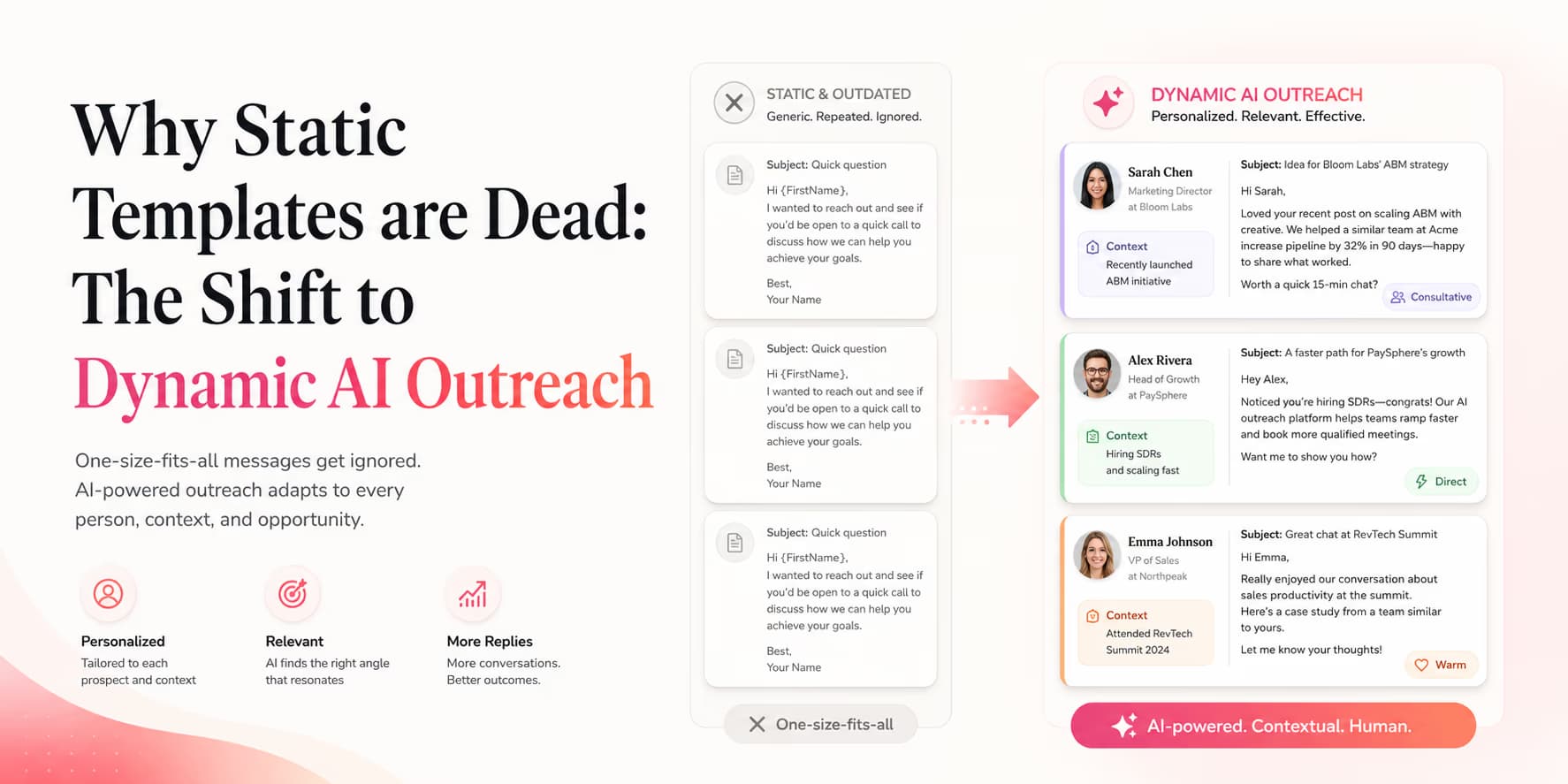
Static templates are not dead because every template is useless. They are dead as the center of a modern outbound motion. The old model was simple: build a broad list, write a five-step sequence, fill in first name and company name, then send enough volume that a few meetings appear at the bottom.
That model worked best when inboxes were less crowded and buyers had not seen the same patterns thousands of times. Now a generic opener is recognized instantly. "Noticed you're growing," "quick question," "helping companies like yours," and "worth a chat?" all blur together when the prospect receives them from multiple sellers every week.
Deliverability is part of the problem, but buyer attention is the deeper issue. Platforms can notice repeated text and unnatural activity. Buyers notice something even faster: whether the message has a real reason to exist. If it could have been sent to any person with the same title, it usually feels like noise.
Dynamic outreach is the replacement. Instead of writing one message and stamping it across a list, you build a system that assembles each message from verified context: who the buyer is, what their company is doing, what signal made the account relevant, and what next step makes sense.
Omentir sits in that practical middle ground: discovery, scoring, draft generation, reply collection, and human-paced delivery. The goal is not to make every sentence wildly unique. The goal is to make every message specific enough that a real buyer can see why it reached them.
Anatomy of a dynamic AI outreach campaign
A dynamic outbound campaign still needs structure. Without structure, AI output becomes inconsistent and hard to review. The difference is that the structure is a decision system, not a fixed paragraph.
A good campaign decides which account should be contacted, which signal deserves mention, which offer angle fits the buyer, and which call to action is appropriate for the relationship stage. The message is compiled from those decisions.
- Dynamic opener: References a verified signal (such as a career transition or company update), replacing generic greetings.
- Contextual value card: Outlines how your software solves a specific challenge relevant to their role.
- Low-friction CTA: Asks a simple, conversation-starting question rather than booking a meeting immediately.
The key word is "verified." Dynamic does not mean the AI gets to invent a clever reason to reach out. The opener should come from public profile context, company website context, a hiring signal, a role-based pain, or another source your team can inspect. If the system cannot explain why the account was selected, it should not create a confident personalized message.
For example, a static template says: "We help B2B teams book more meetings with AI." A dynamic version might say: "Saw your team is hiring for someone to own LinkedIn prospecting and pipeline reporting. Are you trying to make that workflow more repeatable before the new hire ramps?" The second message works better because it is tied to a specific operational moment.
The best dynamic campaigns also include fallback paths. If a hiring signal is missing, the message can use a role-based problem. If the role is unclear, the message can ask a diagnostic question. If the account is a weak fit, the system can reject it instead of forcing a bland opener.
For details on how to write B2B openers, read our guide on writing high-converting LinkedIn message hooks.
Adapting message context based on reply intent
Static sequences are especially weak after the first reply. They assume the prospect will follow a neat path: receive message, ignore message, receive follow-up, book meeting. Real conversations are messier. Prospects ask for pricing, refer you to a colleague, say timing is bad, ask what you actually do, or respond with one ambiguous word.
Dynamic outreach adapts based on reply intent. When a prospect replies, the system should classify the response before suggesting the next action:
- Interested: Draft a concise response that offers the right next step without overexplaining.
- Objection: Identify the actual concern before responding; budget, timing, trust, and relevance are different problems.
- Referral: Capture the referred person and draft a respectful message that keeps context intact.
- Not now: Stop the current sequence and create a later reminder if the prospect gave a real timeline.
- Negative: Suppress follow-ups and avoid turning a clear no into another automated touch.
This is where AI can help a small team behave like a careful sales team. It can summarize the conversation, suggest a response, and keep the rep from missing intent. But sensitive replies still deserve human review. Pricing, security, compliance, legal concerns, and angry responses should not be handled by autopilot.
This conversational adaptation is outlined in our playbook for AI reply-handling systems.
How text variance reduces repetition risk
Text variance is not a magic shield. It will not save a campaign that targets the wrong buyers, sends too fast, or makes weak offers. But repetition is one of the easiest signs that a campaign is automated, and static templates create repetition by design.
A dynamic system reduces that problem by changing the message for a real reason. The opener changes because the signal changes. The pitch angle changes because the role changes. The question changes because the prospect's context changes. That kind of variance is healthier than simply asking a model to rewrite the same generic paragraph one hundred ways.
Quality matters more than novelty. If every message is unique but every message is vague, buyers still ignore it. Your QA process should compare drafts side by side and ask whether each one contains a distinct, truthful reason for the prospect to care.
Safety warning: sending pacing
Even strong personalization needs conservative pacing. Treat connection requests and follow-ups as account-health decisions, not only conversion decisions. If a campaign needs unsafe volume to work, the targeting or offer is probably too weak.
Protecting account health with pacing engines
Dynamic copy solves only one part of the outbound problem. Account health still depends on volume, timing, campaign overlap, reply handling, and the history of the sender profile. A thoughtful message can still create risk if it is sent as part of an aggressive batch.
A pacing system should spread activity naturally, enforce daily budgets, stop follow-ups when prospects reply, and avoid stacking multiple campaigns on the same sender at once. It should also make it easy to pause campaigns if replies are poor or if the sender account begins to show warning signs.
Omentir is built around human-paced LinkedIn outreach rather than bulk blasting. For pacing principles, see our guide to pacing LinkedIn outreach campaigns.
The practical rule is simple: personalization should raise the quality bar, not justify reckless sending. If a human seller would not manually send that many messages from that profile in that time window, the automated system should not either.
Performance comparison: static vs. dynamic outreach
Static and dynamic outreach should be judged by more than reply rate. A static campaign can produce replies if the list is big enough. The better question is whether those replies are from the right buyers, with enough intent to justify the time your team spends.
- Static campaign health: Often measured by send volume, open activity, and total replies, even when many replies are low intent.
- Dynamic campaign health: Better measured by accepted conversations, qualified replies, objections with useful information, and meetings that match the ICP.
- Static failure mode: The team keeps increasing volume to compensate for weak relevance.
- Dynamic failure mode: The team lets AI produce overly clever personalization without enough evidence or QA.
If you are comparing the two, run a clean test. Use the same ICP, similar sender profiles, similar pacing, and the same offer. Compare not only reply rate, but also how many replies came from buyers you would actually sell to. A lower-volume dynamic campaign can be healthier if it creates fewer junk conversations and more qualified ones.
By focusing on relevance rather than volume, you give the sales team a better chance of starting conversations that deserve follow-up. That is the real performance difference.
SOP: migrating to dynamic outreach workflows
Do not migrate by asking AI to rewrite your old templates. That usually creates prettier versions of the same generic campaign. Migrate by changing the workflow underneath the copy.
- Step 1: Define the ICP tightly enough that the system knows which accounts to reject.
- Step 2: List the buying signals that should change the opener, offer angle, or follow-up path.
- Step 3: Build prompt-based message blocks with approved product context and disallowed claims.
- Step 4: Add fallback logic for missing posts, weak company data, unclear job titles, and stale signals.
- Step 5: Review a small draft batch before launch and fix the worst cases first.
- Step 6: Launch with conservative pacing, then inspect replies before increasing volume.
A good migration feels less like installing a writing tool and more like installing a better sales judgment loop. The system should help your team decide who is worth contacting, why now, what to say, and when to stop.
Omentir helps automate the repetitive parts of that loop: prospect discovery, context collection, draft creation, reply organization, and paced outreach. Your team still owns the offer, the ICP, and the standard for what deserves to be sent.
Building a conversational sales engine
Static templates are too blunt for the way buyers evaluate outreach now. They may still provide a starting structure, but they should not be the final message, the targeting logic, or the follow-up strategy.
Dynamic AI outreach works when it is grounded in evidence, constrained by product truth, reviewed for quality, and delivered at a human pace. The best systems do not merely generate more copy. They help sales teams make better decisions about context.
Start small: one ICP, one offer, one set of signals, and one reviewed campaign. Once the messages consistently sound like a careful rep wrote them for a real reason, you can scale the workflow without sliding back into template spam.
Frequently Asked Questions
Repeated text, high send volume, and unnatural timing can make a campaign look automated. Static templates are especially risky when teams send the same message to broad lists without enough relevance or pacing.
It is the practice of using AI agents to write unique message variations for every recipient based on their public profile details, career signals, and company website context.
Omentir helps teams work from prospect context, review drafts, manage replies in one inbox, and keep outbound activity paced instead of blasting static sequences.
Begin by replacing your generic outreach templates with variable-based prompts, setting up real-time web enrichment, and implementing a human-in-the-loop review queue.