
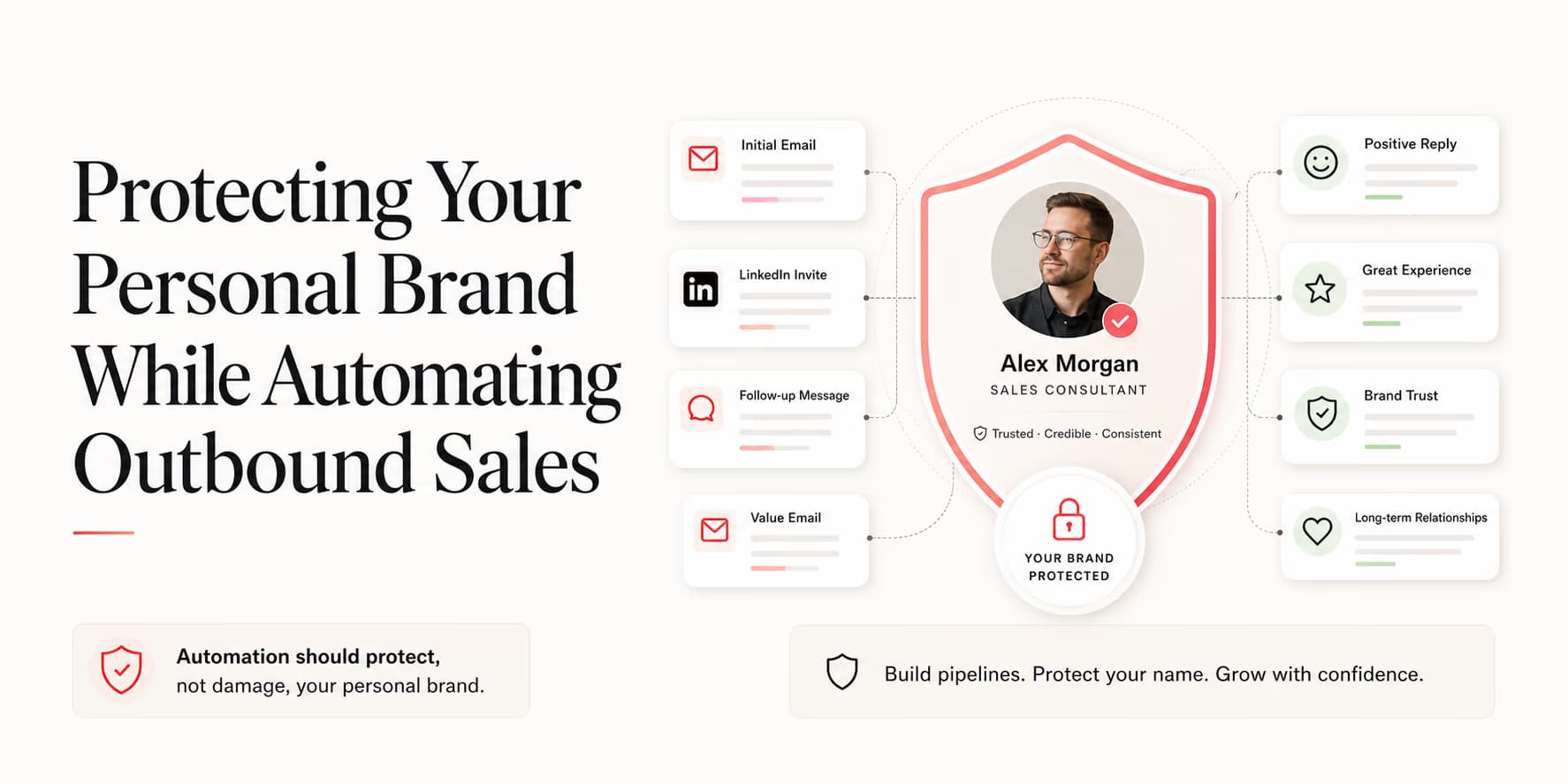
Social selling and LinkedIn prospecting can work well for B2B. Senders build lists in databases, connect their profiles to automation scripts, and send pitches to hundreds of decision makers. The assumption is that if you increase outreach volume, you will book enough meetings to hit your targets.
For busy executives, these high-volume campaigns look like spam. When prospects receive generic messages containing formatting errors or irrelevant value claims, they ignore them and flag the sender profile.
Receiving spam reports damages your personal brand. If you use your personal profile to send unverified templates, you risk burning your reputation with key industry buyers.
To automate sales development without damaging your brand, prioritize quality. Route messages to a human review queue, ground prompts in verified signals, and pace outbox delivery.
Your LinkedIn profile is the landing page for every invite. If the note and the headline disagree, the reader does not give you the benefit of the doubt. They hit ignore.
Personal-brand risk is different from deliverability risk. If an email domain gets noisy, you can repair reputation over time or move to a different sending setup. If your own LinkedIn profile becomes associated with lazy automation, the damage follows you into future sales calls, partnerships, hiring conversations, and investor introductions. Buyers remember people who wasted their time.
That does not mean automation is the enemy. It means automation should remove repetitive work while preserving human judgment. The safest outbound systems help you research faster, draft faster, and pace activity more consistently. They should not turn your profile into an unattended broadcast channel.
Why brand risk compounds
A single awkward message is usually survivable. The problem is repetition. If dozens of prospects in the same market receive the same thin pitch, the campaign can make your company look careless before a buyer ever sees your product. This is especially dangerous in niche B2B categories where founders, operators, and investors talk to each other.
Reputation-safe outbound starts with the assumption that every message may be screenshot, forwarded, or remembered. That assumption changes the standard. The message no longer needs to be merely "not spam." It needs to be something you would be comfortable defending if a prospect asked, "Why did you send this to me?"
A brand-safe message has a clear answer: because the prospect matches your market, the trigger was relevant, the problem was plausible, and the note was written with enough care to respect their time.
The core pillars of reputation-safe outbound
A reputation-safe outbound campaign prioritizes copy relevance and pacing safety over brute volume.
A brand-safe sales pipeline relies on three pillars:
- Review Loops: A human audits every draft before delivery to verify spelling and context.
- Prompt Grounding: LLM generation boundaries restrict buzzwords and ensure accuracy.
- Pacing Controls: Random outbox delays keep campaign activity closer to normal human behavior and reduce risky spikes.
Add a fourth operating principle: intentional audience design. The best copy cannot protect your brand if it goes to the wrong people. Reputation-safe outbound starts before writing. It starts when you decide who deserves to receive a message from your profile.
For each campaign, define a "why this person" standard. A prospect should enter the queue only when there is a clear match between role, company, signal, and offer. If the only reason is "they have the right title," the campaign is still too loose.
For details on setup configurations, see our guide on maintaining LinkedIn account health.
Pillar 1: enforcing the human-in-the-loop review queue
The most reliable way to protect your brand is to keep a human in the loop. Do not allow automation scripts to send generated text directly to prospects.
Omentir's review queue compiles lead data and drafts custom copy based on target signals, placing drafts in a queue. Senders log in weekly, audit drafts for casing mistakes, and click approve.
This review step eliminates formatting errors (like "Hi JOHN") and ensures copy reads naturally.
The review queue should show more than the message. A reviewer needs the prospect's role, company, source, public trigger, ICP reason, and any risk flags. Without that context, the human is only proofreading. With that context, the human can judge whether the message should exist at all.
Use four review decisions:
- Approve: The prospect is a clear fit and the message is specific, accurate, and restrained.
- Edit: The prospect is worth contacting, but the draft needs a stronger trigger, cleaner ask, or less generic wording.
- Skip: The prospect is not relevant enough to justify using your profile.
- Fix system: The mistake will repeat unless you update targeting, prompt rules, or banned phrases.
The last decision is the one teams ignore. If every third draft needs the same correction, do not keep editing manually. Fix the campaign input. Brand safety improves when the system learns from review, not when a person endlessly cleans up the same avoidable mistakes.
Pillar 2: grounding LLM prompts in verified signals
To write relevant copy, ground your prompts in verified details. Senders pull triggers from websites and career listings, as detailed in our guide to how AI crawlers analyze B2B websites.
This context ensures your messages address the prospect's active operational needs, preventing generic sales pitches.
Grounding does not mean stuffing the message with every fact the system finds. A grounded prompt should choose one useful signal and connect it to one relevant business problem. Too much personalization can feel just as unnatural as too little, especially when it references minor details that do not belong in a sales note.
Give the model a strict claim policy:
Approved:
- We help teams find ICP-fit LinkedIn prospects.
- We help draft grounded outreach for human review.
- We pace sending to avoid risky volume spikes.

Not approved:
- Do not claim guaranteed meetings.
- Do not invent customer results.
- Do not mention private or sensitive personal details.
- Do not imply we know internal metrics unless the prospect shared them publicly.
This is where brand protection and legal caution overlap. Unsupported performance claims may get replies in the short term, but they train prospects to distrust the sender. A restrained message that makes one accurate promise is more valuable than an impressive-sounding note that cannot be defended.
Branding rule: use deferential tone sparingly
Write messages that sound like they come from an equal business leader. Do not use overly formal or apologetic phrasing, as this reduces your professional authority.
Pillar 3: restricting campaign volume and sending speed
Outbound safety depends on pacing. Senders must manage daily limits to protect profile health.
Omentir enforces workspace daily connection limits and spaces out requests automatically. For pacing guidelines, see our guide on pacing LinkedIn outreach campaigns.
Volume creates two kinds of risk. The first is platform risk: too much repetitive activity can trigger restrictions. The second is market risk: too many mediocre messages can make your name familiar for the wrong reason. Both matter. A campaign that technically avoids restrictions can still harm your reputation if the audience quality is poor.
Start with small daily batches and inspect the results. Are prospects accepting? Are replies relevant? Are people objecting to the same claim? Are you seeing signs that the targeting is too broad? The safest pacing system is not only slower. It is responsive to what the market is telling you.
Copywriting: the peer-to-peer discovery pitch
Reputation-safe copy uses short, conversational scripts that open by referencing a specific trigger and lead into a soft question. For copy blueprints, see our guide to the B2B copywriting framework.
Peer-to-peer copy sounds like one operator speaking to another. It is direct, specific, and calm. It avoids exaggerated urgency, fake familiarity, and the kind of over-polished language that makes a message feel generated.
Compare these two openers:
Weak:
Hi Alex, hope you are well. I wanted to introduce our revolutionary AI platform
that helps businesses transform outbound and book more meetings.

Stronger:
Alex, saw your team is hiring SDRs in Austin.
Teams at that stage often tighten prospect quality before adding more outbound volume.
Are you centralizing lead research yet, or is each rep still building lists manually?
The stronger message protects the sender because it is easy to justify. It references a visible business signal, makes a reasonable observation, and asks a practical question. Even if the prospect says no, the note does not feel careless.
Handling replies without sounding automated
Brand risk does not stop after the first message. Many teams use decent first-touch copy and then lose trust with robotic replies. If a prospect asks a specific question, answer that question first. Do not jump into a canned demo pitch.
AI can help draft reply options, but the sender should choose and edit the final response. Replies contain more nuance than first-touch messages: objections, buying context, timing, internal politics, and tone. A prospect who says "not now" may need a different response from a prospect who says "we tried this and it failed."
Use this reply review checklist:
- Does the first sentence answer the prospect's actual message?
- Does the reply avoid pretending to know facts that were not shared?
- Is the next step proportional to the interest level?
- Would this still sound normal if the prospect forwarded it to a colleague?
SOP: the reputation-safe campaign audit checklist
Audit your campaign reputation using these steps:
- Step 1: Access your campaign dashboard and verify that the review queue setting is active.
- Step 2: Audit drafted connection requests, correcting name casing and company abbreviations.
- Step 3: Track acceptance and reply quality so drops in relevance are visible early.
- Step 4: Check campaign pacing and outbox delay settings in Omentir.
Add these audit questions before every campaign launch:
- Would I be comfortable sending this message manually from my own profile?
- Can I explain why this person is on the list in one sentence?
- Does the message contain any unsupported outcome claim?
- Does the copy sound like our actual company voice?
- Is the campaign small enough that we can learn from responses?
Omentir handles the variable mapping and safety limits, allowing you to validate your campaigns.
Grow outreach without burning the profile
Outbound works best when it is relationship-focused. Senders who ignore safety boundaries will struggle with frequent restrictions and bans.
By reviewing messages, grounding claims, watching pacing, and treating replies with care, you protect your profile assets while still building pipeline. A personal brand is just the residue of those four habits. One sloppy week undoes a month of careful notes.
Frequently Asked Questions
Sending high-volume generic templates with name formatting errors (like "Hi JOHN") makes automation obvious, signaling to buyers that you do not respect their time.
It is a workspace setting where your AI agent drafts personalized messages based on prospect details, but holds them in a drafts queue for a human to edit or approve before sending.
Omentir coordinates campaigns via a built-in review queue. Senders can audit every drafted connection request, verify casing, and ensure variables match prospect contexts.
No. While AI can draft reply options, an operator should always review and click send manually to ensure replies address the prospect's specific questions.