
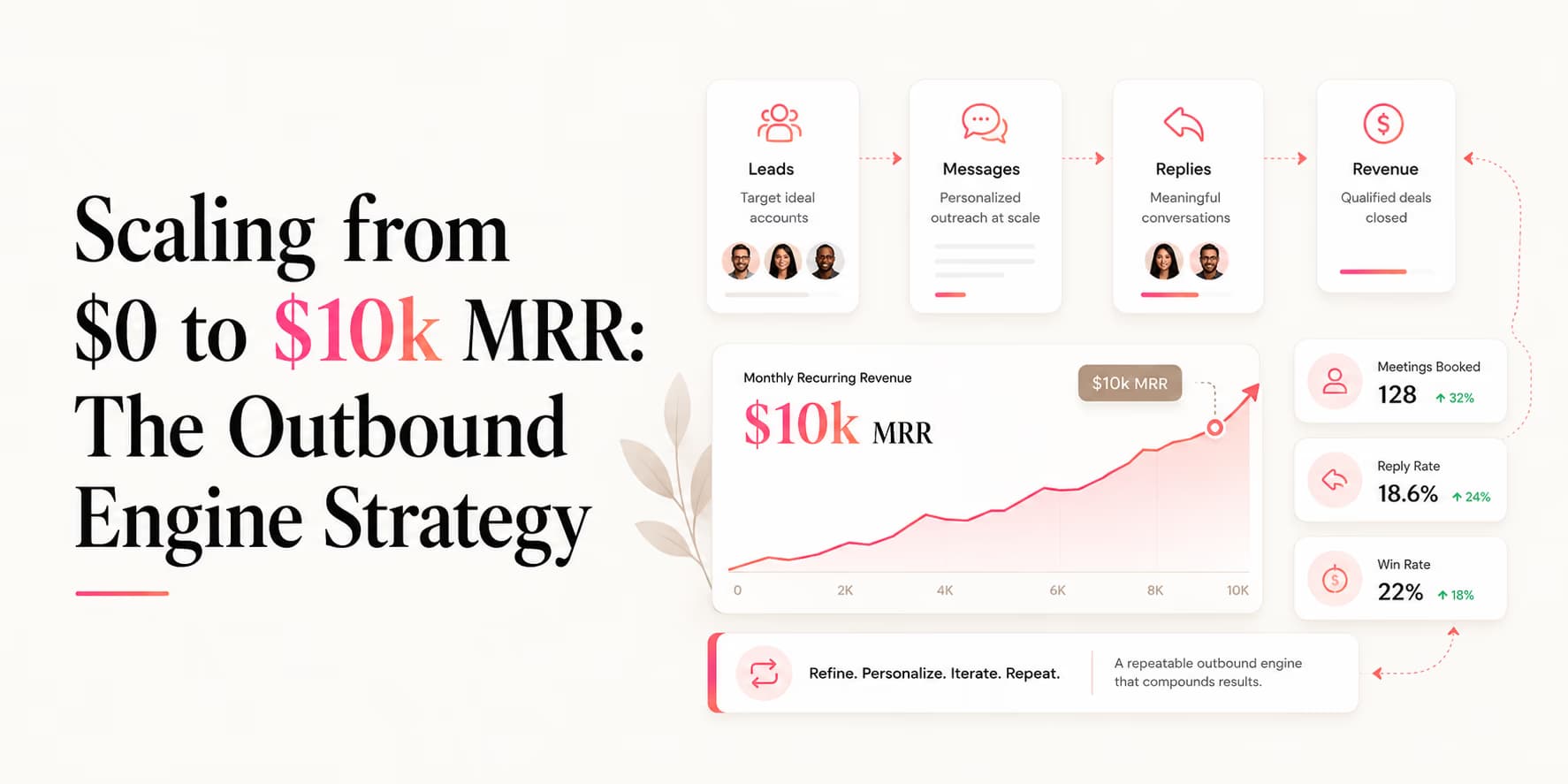
$10,000 in monthly recurring revenue (MRR) is a useful checkpoint for B2B SaaS startups. At that level, paying customers can cover basic operating costs, and there is often enough cash to hire early staff.
Most founders treat sales scaling as an art. They assume hitting MRR targets means hiring expensive sales reps, hosting large marketing events, or waiting for inbound page signups.
Sales development is a mathematical process. If you understand your conversion metrics, you can calculate the outreach volume required to hit your MRR goals.
One practical way to reach $10k MRR is an outbound engine you can measure. Manage multi-profile campaigns, personalize copy from buying triggers, and pace outbox delivery so you can count on a steady flow of B2B conversations.
Omentir is the infrastructure for these engines, with a Pro plan starting at $49/month. Here is the scaling strategy.
The danger is making the math look cleaner than reality. A spreadsheet can say you need a certain number of conversations, demos, and closes. The market will add friction: no-shows, poor-fit buyers, slow onboarding, churn, pricing objections, and segments that look good on paper but do not feel urgent. The purpose of pipeline math is not to predict the future perfectly. It is to reveal which assumptions must become true for $10k MRR to happen.
The path from zero to $10k MRR usually has three phases. First, prove that a specific buyer cares enough to talk. Second, prove that some of those buyers will pay and stay. Third, scale the outreach motion that produced those customers without lowering quality. Skipping any of those phases turns outbound into noise.
Start with the right ACV target
Your monthly price changes the entire growth plan. If customers pay $50/month, $10k MRR means 200 active customers. If they pay $500/month, it means 20 active customers. If they pay $1,000/month, it means 10 active customers. None of these paths is automatically better; each has different acquisition, support, and retention demands.
Lower-priced products need a much smoother self-serve motion because the team cannot spend hours selling each account. Higher-priced products can justify more founder time, deeper discovery, and more hands-on onboarding. The outbound strategy should match the price point.
Before scaling outreach, build a simple scenario table:
- $100/month: Requires many customers, strong onboarding, and low support burden.
- $250/month: Requires fewer customers, but still needs repeatable demos and clear activation.
- $500/month: Requires a narrower buyer with a painful enough problem to justify a real sales process.
- $1,000+/month: Requires stronger proof, clearer ROI, and usually more hands-on sales and support.
This decision shapes everything: who you target, how much research each prospect deserves, how personalized your outreach should be, and what kind of pilot or offer makes sense.
Scale safely with multi-profile outbox rotation
Outbound campaigns must prioritize account safety. If you send too many connection requests or messages from a single profile, social platforms will restrict your account.
To scale volume safely, you must distribute campaigns across multiple sending profiles.
Omentir offers Pro for self-serve teams and Enterprise for teams that need SSO, dedicated onboarding, and priority support:
- Pro ($49/month): Includes one user, one LinkedIn account, unlimited AI agents, leads, campaigns, AI automated campaigns, API access, email customer support, and a minimum of three bookings per week or you pay nothing.
- Enterprise: Includes unlimited users, unlimited LinkedIn accounts, all Pro features, plus SSO, dedicated onboarding, and priority support. Book a call to discuss your setup.
Rotating campaigns across multiple accounts allows you to increase outreach volume while keeping individual profile activity within safe limits.
Multi-profile scaling should come after message-market fit, not before it. If one profile cannot produce relevant conversations from a narrow audience, adding more profiles only multiplies the wrong motion. Use the first profile to validate the segment, offer, and reply path. Add capacity only when the bottleneck is genuinely volume rather than relevance.
A safer scaling sequence is:
- Profile 1: Founder-led validation with careful review of every lead and message.
- Profiles 2-3: Segment expansion after the first segment produces qualified demos.
- Team scale: More senders only after onboarding, response handling, and CRM follow-up are reliable.
This keeps scaling tied to evidence. Volume is useful only when the operating system behind it is already producing the right conversations.
Source and prioritize active buying signals
To maintain high conversion rates during scaling, your campaigns must target qualified buyers.
Configure discovery agents to monitor active organizational signals:
- Hiring Posts: Companies looking for new sales reps have budget for software tools.
- Tech Installs: Identify prospects using compatible CRM setups or competitor tools, as detailed in our guide to automated website analysis.
- Career Updates: Congratulate newly promoted executives to start warm conversations.
Treat buying signals as prioritization inputs, not proof that someone will buy. A company hiring sales reps might need prospecting help, but it might also already have a strong system. A newly promoted executive may be open to new ideas, but they may not own budget yet. The signal gives you a reason to research and write a relevant opener. It does not replace qualification.
For the $10k MRR journey, prioritize signals that indicate urgency and budget. Hiring is useful. A public complaint about the exact problem is stronger. A company expanding into a market where your product solves a bottleneck is stronger still. The best signals connect directly to a business cost: wasted rep time, low lead quality, slow follow-up, broken handoffs, or manual work that blocks growth.
Keep a signal score on every account:
- 1 point: The company fits the broad segment.
- 2 points: The buyer role likely owns or feels the problem.
- 3 points: A current public trigger suggests the problem may be active now.
Spend your deepest personalization on the highest-scoring accounts. This protects quality as you grow.
Copywriting: write high-relevance conversion prompts
Outbound copywriting must stay concise. Senders who send long pitches to busy operators see low response rates, wasting their daily connection quotas.
Enforce prompt settings to keep messages under 75 words and avoid buzzwords. For copywriting templates, see our guide on outbound copywriting prompts.
Scaling copy does not mean writing one template and sending it everywhere. It means creating a repeatable structure that can adapt to real account context. The prompt should force the system to include the buyer role, the trigger, the likely business pain, the product outcome, and a low-pressure question.
A useful scaled prompt contract looks like this:
Write one LinkedIn message under 70 words.
Use only the verified trigger and approved product claims.
Open with the trigger, connect it to one likely business pain,
and end with a question about the current workflow.
Do not mention guaranteed results, fake familiarity, or generic AI benefits.
This protects the campaign from the two most common scaling failures: generic copy and invented claims. Review the first drafts from every new segment manually. If the drafts sound thin, the problem is usually missing context, not the model.
Scaling Rule: Never Bypass Review Queues 💡
Even when scaling to high volume, keep a review queue active. Reviewing drafts for name casing errors or weird phrasing prevents spam reports and protects your outbox reputation.
Handle the demo call and close contracts
Outbound math depends on your demo close rate. If your close rate is low, you will require too much outbox volume to reach your MRR goals.
Structure your demo calls around active discovery: focus on uncovering their manual bottlenecks, and map the product walkthrough directly to those challenges, as outlined in our guide on handling sales demos.
At this stage, every demo should teach you something even if it does not close. Track why the prospect booked, what pain they described, what part of the product created interest, what objection blocked purchase, and whether the company matches the segment you want more of. Treat the demo as research for the next campaign.
Do not optimize only for booked demos. A calendar full of poor-fit calls can make the funnel look healthy while delaying revenue. Qualify before the demo with a few direct questions: how are they solving the problem today, who owns the workflow, what happens if nothing changes, and what would make a solution worth paying for?
Retention before more volume
$10k MRR is not only an acquisition target. It is a retention target. If customers churn quickly, you are filling a leaking bucket. Before increasing outbound volume, inspect whether the first customers activate, use the product, and keep paying.
Watch for three retention signals:
- Activation: Did the customer reach the first meaningful outcome quickly?
- Habit: Is the product part of a recurring workflow, or was it a one-time experiment?
- Expansion pull: Does the customer ask for more seats, more accounts, more volume, or deeper workflow support?
If activation is weak, improve onboarding before adding more leads. If customers use the product once and disappear, the problem may not be painful enough or the product may not be embedded deeply enough. If the right customers ask for more, that is a strong signal that your outbound segment deserves more attention.
Enforce pacing limits to protect outbox reputation
Campaign pacing protects outbox health. Sending requests at mechanical speed triggers platform bans.
Omentir's dedicated Throttling Engine spaces connection requests automatically. For pacing details, see our guide on pacing B2B outreach campaigns safely.
As you scale, review safety and quality together. If daily volume rises but reply quality falls, the campaign is not scaling; it is diluting. If more profiles create more manual review than the team can handle, quality will slip. If follow-ups are delayed because inboxes are messy, booked demos will suffer even if sourcing improves.
A real revenue engine has constraints by design: daily send limits, draft review, lead scoring, reply routing, and weekly metric review. Those constraints slow down reckless sending, but they speed up learning.
SOP: the $10k MRR weekly pipeline checklist
Manage your sales scaling pipeline weekly using these steps:
- Step 1: Calculate your pipeline conversion metrics (acceptance rate, reply rate, close rate).
- Step 2: Add target profiles to keep Omentir's discovery pipeline active.
- Step 3: Review and edit message drafts in your outbox queue daily.
- Step 4: Verify safe connection limits and outbox pacing delays.
Add a weekly founder review before increasing volume:
- Segment: Which buyer type produced the strongest qualified conversations?
- Offer: Which promise or workflow created urgency?
- Demo: Which objections repeated, and which were deal-breakers?
- Activation: Did new customers reach a meaningful first result?
- Next test: What one variable changes next week?
The best $10k MRR plan is not "send more." It is "find the segment where more good conversations predict more retained revenue, then scale that motion carefully."
Omentir automates the variable mapping and safety limits so you can manage campaigns without tracking every quota by hand.
Build a predictable revenue engine
Reaching $10k in MRR is a math problem. Configure multi-profile campaigns, ground the copy in real variables, and pace sending so the pipeline can last.
But the math only works when the customers stay, the segment is specific, and the messages remain useful as volume increases. Ten thousand in MRR from one tired pitch is a leak you will pay for in churn and in the next account restriction.
Frequently Asked Questions
It depends on your monthly price, demo conversion, close rate, and churn. A $100/month product needs far more customers than a $500/month product, so founders should model several scenarios before choosing an outbound target.
LinkedIn and email networks enforce strict daily limits per profile (under 20 connection requests daily). Distributing campaign volume across multiple profiles allows you to scale outreach while keeping individual accounts safe.
Omentir supports outbound scaling with lead discovery, grounded message drafting, review queues, and pacing controls so teams can grow without turning outreach into unsafe bulk sending.
By using Omentir's prompt variables grounded in website metadata and career signals, and routing drafts through a review queue before delivery.