
Outbound campaigns targeting enterprise, high-average contract value (ACV) clients operate under a different set of rules than transactional, low-ACV SaaS products. When your minimum contract size is $50,000, and a single deal can yield upwards of $500,000, the margin for error is non-existent. A single tone-deaf automated message, a mismatched case study, or a poorly timed follow-up can destroy your reputation with a key account permanently.
Many outbound teams try high-volume tools built for mass markets, hoping scale will make up for low relevance. That backfires. Modern executives have sharp filters, both technological and cognitive. They spot automated templates instantly. To get executive buyers, enterprise teams need a human-in-the-loop (HITL) outreach method: an AI salesman for research and drafts, plus a sales professional for judgment.
By retaining human validation at key inflection points, organizations can scale outreach without sacrificing the precision required to build trust with sophisticated prospects. The useful workflow combines intelligent prospecting, intent-based sequencing, inbox classification, and human review without hiding the decisions from the sales team.
The fragility of pure automation in high-ticket B2B campaigns
Pure sales automation has reached a point of diminishing returns. In the early days of outbound software, simple mail merges and basic field injection (such as first name and company name) were sufficient to drive meetings. Today, platforms like Instantly and Smartlead have made it incredibly easy to send thousands of emails daily. While these tools are highly effective for low-ticket consumer products or transactional B2B sales where the goal is maximum market penetration, they create substantial risk for high-ticket enterprise campaigns.
In a high-ACV model, your total addressable market (TAM) is often constrained. You might only have 500 to 1,000 viable enterprise target accounts worldwide. Blasting these accounts with fully automated sequences is a strategic failure. If your automated sequencing tool misinterprets a signal, references an outdated company initiative, or sends a generic pitch to a chief technology officer, you do not just lose a click; you burn a high-value account. Pure automation treats every prospect as a statistical data point. It cannot assess the political context of a corporate transition, detect subtle tone shifts in social media posts, or determine if a prospect's public hiring signal actually represents a confidential restructuring.
Legacy data platforms like Apollo.io, Lusha, and Cognism have attempted to solve the relevance problem by providing deep databases. However, these systems still require manual data extraction, filtering, and external importing into sequencer tools. This fragmented workflow introduces human error and outdated data. A salesperson might export a list of leads on a Monday, but by the time the sequence launches on a Thursday, the prospect has changed jobs or their company has shifted priorities. When you combine raw database records with hands-off auto-sequencers, you create a system that scales irrelevance.
To prevent this, sophisticated outbound teams are shifting from volume-based outreach to a high-density, low-volume conversational strategy. This methodology focuses on building authentic relationships rather than executing transactional messages. You can learn more about how to design these conversations in our playbook on how to pitch a B2B SaaS on LinkedIn without being spammy.
Related reading
Learn more in our guide on how to pitch a B2B SaaS on LinkedIn without being spammy to boost reply rates, build instant professional trust, and successfully navigate complex B2B buyer psychology.
Defining human-in-the-loop AI salesmanship
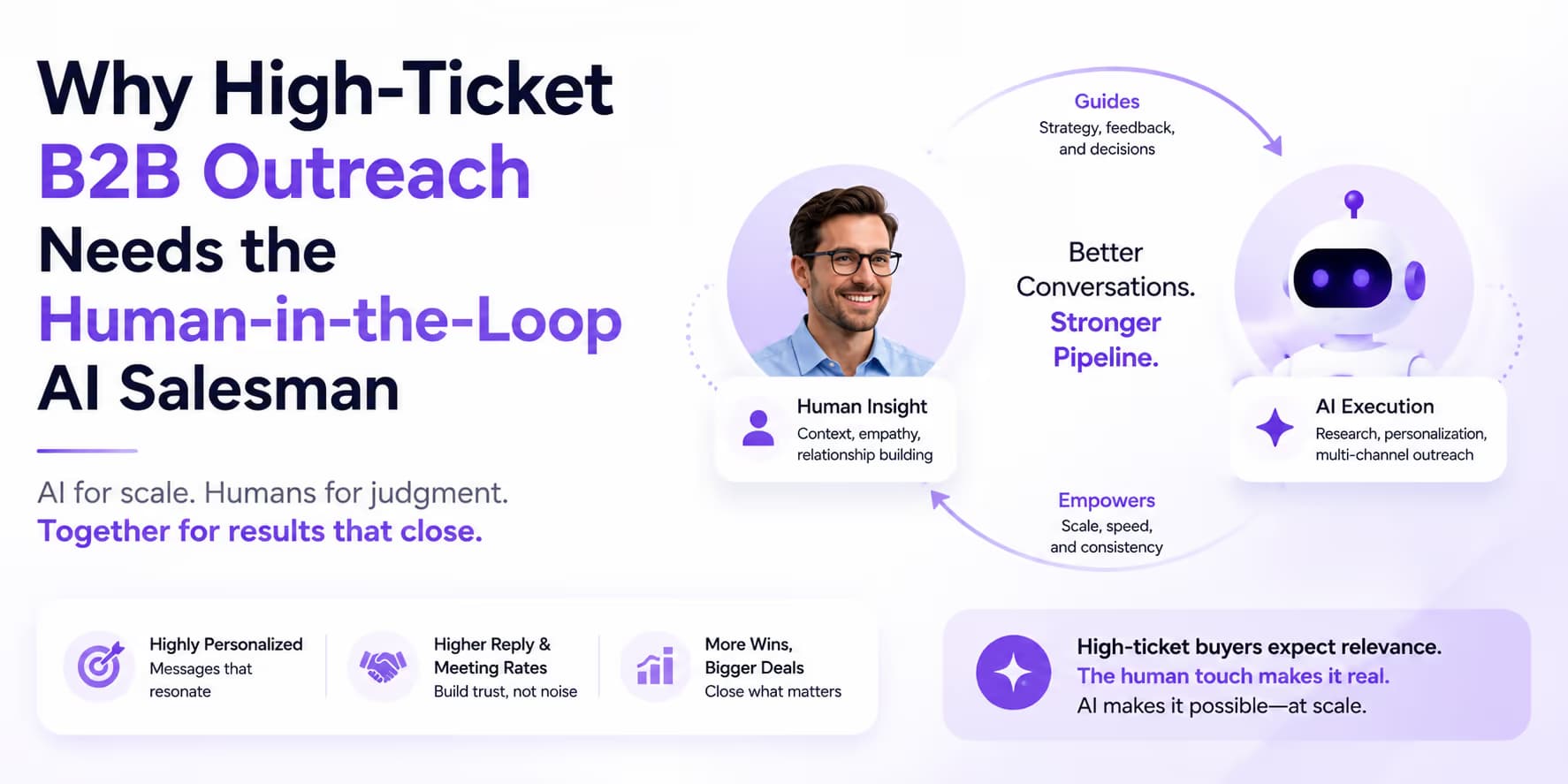
The solution to the limitations of pure automation is not a return to slow, fully manual prospecting. The manual path is too slow, expensive, and difficult to scale. Instead, the modern standard is Human-in-the-Loop (HITL) AI salesmanship. In this operational model, the AI acts as an autonomous research associate and copywriter, while the human acts as an editor, strategist, and relationship owner.
Fully autonomous outreach agents, such as 11x.ai or Artisan AI, promise a world where an AI handles all prospecting, messaging, and scheduling without human intervention. In practice, this setup introduces immense liabilities. Large language models (LLMs) are prone to hallucinations, tone deafness, and contextual blind spots. When an autonomous agent operates without human review, it will eventually send inappropriate or embarrassing messages to valuable target accounts. For instance, an AI might read a prospect's post about a tragic company layoff and interpret it as an opportunity to pitch an HR automation tool. A human observer would instantly catch this mistake, but a fully autonomous system will blindly send the draft, permanently damaging the brand.
A human-in-the-loop AI salesman bypasses this issue by dividing tasks based on structural strengths:
- The AI Responsibilities: The AI excels at pattern matching, processing vast quantities of unstructured web data, and executing repetitive steps rapidly. It monitors intent signals across millions of profiles, filters prospects using natural language ICP descriptions, performs real-time data enrichment, and drafts highly tailored messages based on verified triggers.
- The Human Responsibilities: The human excels at empathy, strategic alignment, and high-level validation. The human reviews the targeted account list to ensure fit, adjusts the messaging tone to match the company brand, validates the context of intent triggers, and edits the drafted messages to add human warmth and highly specific context that only an industry peer would know.
Under this framework, the salesperson's efficiency jumps. Instead of spending six hours a day researching contacts, scraping databases, and drafting emails, the salesperson spends thirty minutes reviewing, refining, and approving high-quality drafts. The rest of the day goes to conversations with people who replied. The job shifts from data entry to advisor work.
What a native workspace needs to handle
To make the human-in-the-loop model work in practice, sales reps must not be forced to navigate a complex stack of disconnected software. Traditional workflows often involve scraping data from a database, using a data orchestration platform like Clay or Gojiberry to enrich it, using an external AI tool to draft the message, and then importing that draft into a separate email sequencer. This multi-tool approach creates data friction, increases API costs, and makes human-in-the-loop validation highly inefficient.
One way to reduce this friction is to combine the outreach pipeline into a single workflow. In that model, the system needs to cover three phases of the outbound lifecycle:
1. Native enrichment cascading
Rather than relying on external spreadsheets and fragile API integrations, the workflow should use enrichment cascades to verify contact information, pull relevant public context, and surface key business triggers. The goal is to keep outreach based on current information instead of stale database rows.
2. Intent-driven draft generation
Instead of drafting generic cold outreach, the system should monitor real triggers such as hiring, funding, leadership changes, or relevant public posts. It should then turn those signals into a conversational, low-friction draft that a human can approve before anything is sent.
3. Advanced inbox classification
The outreach process does not end when the first message is sent. When a prospect replies, the response must be categorized correctly so the next step has context. A strong workflow separates positive interest, referral requests, timing objections, out-of-office notifications, and negative opt-outs instead of dumping every reply into one generic inbox.
Reply classification helps sales reps prioritize their actions. A positive response should receive immediate attention, while a timing objection, such as a prospect saying "reach out next quarter," should move into a respectful nurture sequence designed to keep the relationship warm. You can read more about how to structure these campaigns in our playbook on how to build a high-converting B2B sales sequence on LinkedIn or explore how to optimize your daily routine in our founders' 15-minute daily routine guide.
The high-ticket outreach blueprint: implementing human-in-the-loop workflows
Implementing an effective human-in-the-loop outbound strategy requires a systematic, repeatable process. For founders and enterprise sales leaders targeting high-ticket buyers, use the following step-by-step blueprint:
Step 1: Define your ICP using plain English
Avoid rigid database filters that exclude relevant prospects. Describe the ideal customer profile in plain language, such as "SaaS founders who recently raised seed funding and are looking to scale outbound without hiring full-time SDRs." A good system should use that context to locate nuanced account fits that basic keyword searches would miss.
Step 2: Establish contextual triggers
Connect outreach to real events. For example, if you sell an engineering management tool, monitor when target companies hire new engineering managers. That hiring signal becomes the relevance bridge for outreach, making the message contextual rather than random.
Step 3: Review and refine drafts
Dedicate fifteen minutes every morning to review the outbound queue. Read the drafted connection requests and initial notes. Check for flow, warmth, accuracy, and whether the signal actually supports the message. For writing high-converting connection notes, refer to our blueprint on how to write a LinkedIn connection request that gets accepted and implement our proven 10 LinkedIn cold message templates that actually book demos.
Step 4: Manage replies and prevent leakage
As responses compile, review them by intent rather than by channel alone. For prospects who ghost you after showing initial interest, apply our structured follow-up framework outlined in our guide on how to re-engage ghosted leads. If you are choosing between channels, analyze the structural trade-offs in our comparison of social outreach vs. cold email.
The math of outreach: high-volume spam vs personalization
The comparison between pure-play automated spam and human-in-the-loop personalization is visible in the campaign analytics. When you treat outbound sales as a numbers game, you exhaust your addressable market and risk severe account penalties. When you treat outbound as a relationship-building process, you achieve higher conversions with a fraction of the volume.
Consider the following operational comparison table:
| Metric / Dimension | Pure Automation (Spam Model) | Human-in-the-Loop AI Salesman (Omentir) |
|---|---|---|
| Target Accounts / Week | 1,000 accounts | 100 accounts |
| Research & Personalization | Basic merge tags (First Name, Company) | Deep intent triggers, real-time social data |
| Review / Edit Gate | None (Fully automatic sending) | Mandatory human validation (15 mins/day) |
| Average Reply Rate | 1% to 2% | 15% to 25% |
| Positive Response Rate | Under 5% of replies | 40% to 50% of replies |
| Demos Booked / Month | 2 to 4 meetings | 10 to 15 meetings |
| Risk of Account Suspension | Extremely High (Spam complaints, rate limits) | Negligible (Natural human timing, high relevance) |
| Long-Term Relationship Equity | Negative (Damages brand with future prospects) | Positive (Builds a warm network of industry peers) |
High-ticket B2B sales require trust, and trust cannot be fully automated. The best systems use automation for repetitive research, enrichment, and first-draft work while keeping humans in control of account fit, tone, and final approval. This balanced approach protects the brand and keeps the sales motion grounded in real buyer context.
Review the workflow before scaling
Use the human-in-the-loop model above to decide where automation helps and where human judgment still needs final control.