
Using AI to write B2B sales copy is a double-edged sword. When done right, it saves hours of research and helps you send highly relevant, personalized messages. When done poorly, it floods your prospect's inbox with generic, buzzword-heavy sales slop that destroys your brand credibility.
The difference between success and failure comes down to prompt engineering. If you ask ChatGPT or other LLMs a simple query like "write a connection request note for a sales director," the output will be terrible. It will use clichés like "fast-paced digital world," pitch your product features too early, and sound completely mechanical.
To generate high-quality B2B copy, you must provide structured prompts with clear boundaries, dynamic context variables, and strict copywriting rules. By directing the model to think like a peer rather than a salesperson, you can generate short, conversational drafts that get responses.
Omentir folds this prompting logic into the daily sales routine. The system combines your product profile settings with live lead details, then drafts pacing-compliant messages for your final review. Here is how to build and configure these prompts for an outbound team.
The mistake is treating the prompt as a clever sentence. A good outreach prompt is closer to an operating procedure. It tells the model what facts it can use, what claims it must avoid, what tone to write in, and what the output should look like when the evidence is weak.
The four-part anatomy of an outreach prompt
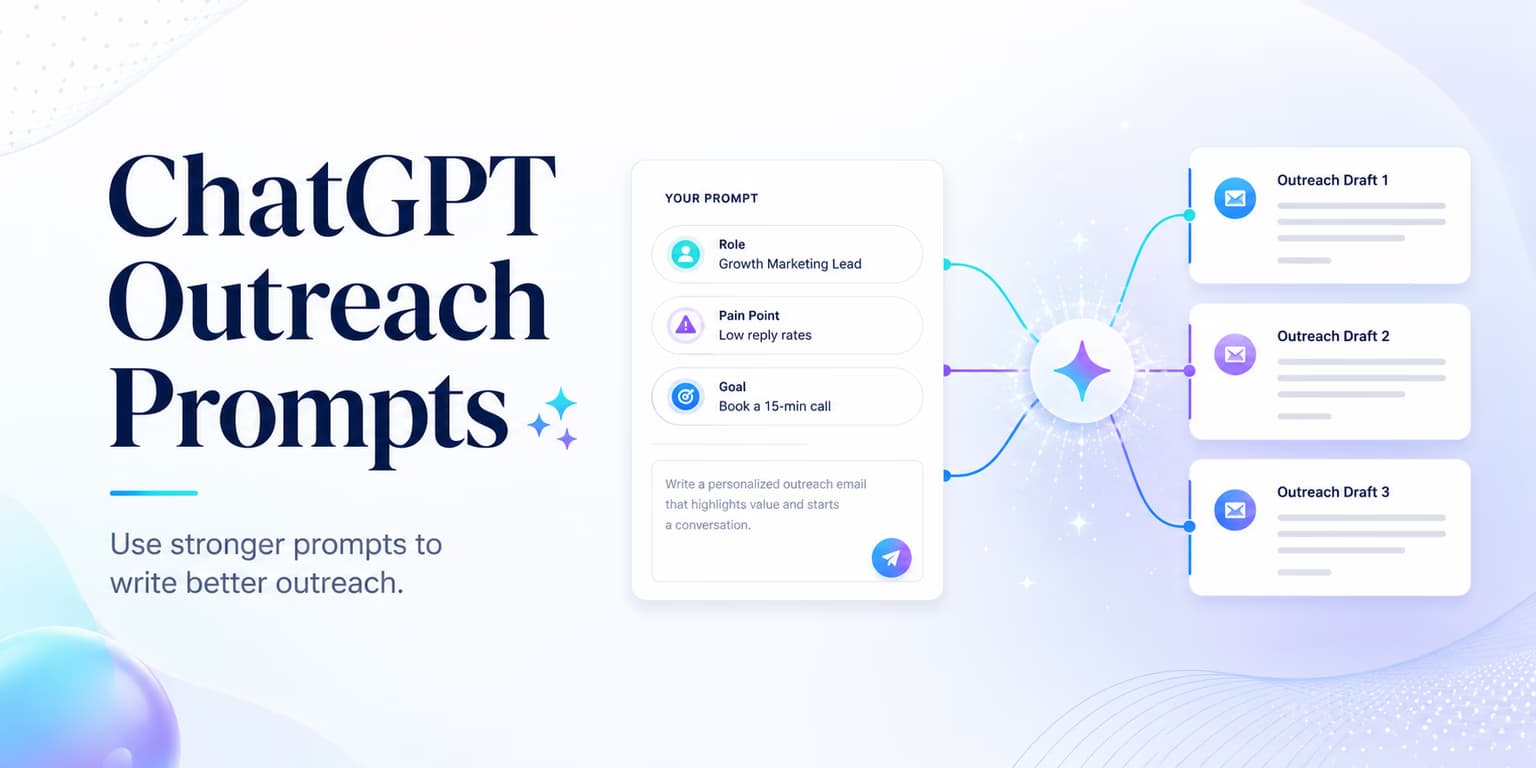
A professional outreach prompt does not leave copy choices up to the model. It defines the constraints and goals of the message. Every sales prompt should contain four core components:
- Role and perspective: Tell the model who it is (e.g., "You are a B2B SaaS founder contacting a peer") to set the tone.
- Context inputs: Inject the specific data points it must use: product details, target company profile, and active intent signals.
- Writing constraints: Forbid sales buzzwords, limit sentence counts, set strict word limits, and define the formatting style.
- Output format: Instruct the model to return only the final message text, avoiding preambles like "Here is your draft."
By separating your instructions into these blocks, you ensure the AI outputs consistent, high-converting drafts.
Add a fifth component for real-world use: a refusal rule. If the lead context does not contain a real signal, the model should say "insufficient context" instead of inventing one. This is the difference between a useful drafting system and a machine that creates confident nonsense.
The best prompts also define what "good" means. For LinkedIn outreach, good usually means specific, short, truthful, conversational, and easy to ignore politely. That last point matters. A low-pressure message protects the relationship and leaves room for the buyer to respond without feeling trapped.
Prompting Rule: Forbid Marketing Speak
Instruct the model to avoid exclamation marks, hype words like 'revolutionize' or 'game-changing', and paragraphs longer than three sentences. Peer-to-peer communication is short, direct, and lower-case.
Prompt 1: the product-to-pain translation prompt
Before writing messages, teach ChatGPT how to frame your product value in terms of the buyer's pain points. Feed the model your feature list and ask it to output the specific challenges those features solve.
Here is a prompt template you can copy and paste into ChatGPT:
You are an expert B2B copywriter. Analyze this product profile:
[Insert product features, pricing, and case studies]

For this target buyer persona:
[Insert job title and industry]

Translate our features into 3 core pain points. For each pain point, write a one-sentence value statement showing how we solve it. Do not use marketing jargon or hype words.
This prompt helps you establish a foundation of value statements that you can use in your campaigns. You can find more copywriting tips in our guide to the AI sales pitch guide.
Do not let this prompt produce slogans. Ask for buyer pain in plain language: "reps waste time cleaning lists," "founders cannot tell which prospects are worth contacting," or "follow-ups are inconsistent after a connection accepts." If the pain statement sounds like website copy, it will probably create weak outreach.
Store the output as approved messaging ingredients, not final copy. One value statement may work for founders, while another works for RevOps. The outreach prompt should choose the ingredient that matches the prospect's role and the signal you found.
Prompt 2: the contextual outreach draft prompt
Once the value statements are defined, build a prompt that combines the product profile with real-time lead context.
Here is a prompt template for generating first-touch LinkedIn messages:
You are a SaaS founder reaching out to a prospect on LinkedIn.
Product Value: [Insert one value statement from Prompt 1]
Prospect Profile: [Insert job title, company size, and company name]
Outreach Signal: [Insert active signal, e.g., hiring Sales Ops or job change]

Write a LinkedIn message following these rules:
1. Open with a brief opening referencing the Outreach Signal.
2. Connect the signal to the Product Value.
3. Keep the entire message under 80 words.
4. End with a low-friction question (e.g., asking to share a 2-minute video).
5. Do not pitch a call or use booking links.
6. Return ONLY the message copy.
This prompt outputs highly relevant, low-pressure messages. For guidelines on customizing these drafts, check our article on ChatGPT sales message patterns.
You can make the prompt safer by requiring evidence mapping. Ask the model to internally use this chain: signal, likely implication, relevant value, low-pressure question. Then ask it to return only the final message. That keeps the reasoning disciplined without exposing a long explanation to the prospect.
When the prompt has no strong signal, it should fall back to a role-based opener rather than fake personalization. "Given you lead sales at [Company]" is less exciting than a hiring trigger, but it is honest. Honest and slightly plain beats polished and wrong.
Prompt 3: the copywriting quality validation prompt
Even with strict constraints, models occasionally output buzzwords or long sentences. Use a second "auditor" prompt to review the draft copy before it is sent to your review queue.
Here is a prompt template you can use to audit drafts:
Analyze this sales message draft:
"[Insert draft message]"

Review the copy against these rules:
- Is the word count under 80 words? If not, shorten it.
- Does it contain any buzzwords (revolutionize, game-changing, busy world)? If so, remove them.
- Does it ask for a call? If so, change it to a low-friction offer (e.g., sharing a resource).
- Return only the audited, corrected draft.
This validation step keeps your list quality high. Omentir enforces these style checks automatically, keeping all message drafts grounded in your product details.
The validator should check factual grounding, not just style. It should ask: does every company-specific claim appear in the lead context? Does every product claim appear in the product profile? Does the message imply a case study, integration, price, or outcome that was not provided? If yes, the draft should be rewritten or rejected.
Use a separate validation prompt because the writer prompt is trying to create. The validator prompt is trying to catch mistakes. Keeping those jobs separate makes it easier to build a reliable review workflow.
Prompting ChatGPT to handle sensitive sales objections
When prospects respond with objections, use ChatGPT to draft responses. Prompt the model to acknowledge their feedback, avoid defensive language, and offer a low-risk alternative.
For budget objections, instruct the agent to introduce a low-cost testing tier. For timing objections, instruct it to offer a helpful resource and check back in a few months. This keeps the relationship open without adding sales pressure.
Sensitive objections need stricter instructions than first-touch copy. The model should acknowledge the objection, avoid arguing, and never make a promise to overcome it. For example, a budget objection should not trigger "we guarantee ROI." It should trigger a short, respectful note that offers a lighter next step only if appropriate.
Give the model a stop rule. If the prospect says no clearly, the correct response is not another pitch. It is a polite close. This protects your sender reputation and prevents the automation from turning a neutral relationship into a negative one.
Delivering message drafts safely on LinkedIn
Even the best ChatGPT prompts will fail if you deliver messages too quickly or trigger platform limits. LinkedIn's algorithms flag profiles that send messages at mechanical speeds or blast large volumes.
To keep your account safe, space out your outreach using human-paced delays and set strict daily quotas. Omentir coordinates these parameters in the background, scheduling actions gradually and delivering messages via secure integrations with systems like Unipile.
Prompt quality and delivery safety are connected. If the model writes better messages, you should need less volume. A small daily batch of well-reviewed drafts teaches you more than blasting hundreds of unreviewed notes and trying to explain the noise later.
Keep human approval in the loop until the prompt has proven itself across real conversations. Review not only whether the draft sounds good, but whether it creates the kind of replies you want: specific questions, referrals, objections you can answer, and actual buying conversations.
SOP: the ChatGPT outreach prompting checklist
Use this checklist to audit your prompting pipeline daily:
- Role constraint: Is the role set to founder or peer instead of salesperson?
- Input grounding: Are XML tags used to separate the product profile and lead data?
- Brevity check: Is the word count limit strictly set to under 80 words?
- Formatting rule: Is the model instructed to skip preambles and return only the message?
- Pacing limit: Are the outgoing connection requests capped within daily safety quotas?
Add two checklist items for production. First, does the prompt define what to do when context is missing? Second, does the validator reject unsupported claims? Most bad AI outreach comes from one of those two failures.
Keep a version history for prompts that perform well. When you change tone, word limits, CTAs, or signal priorities, note the date and reason. Otherwise, you will not know whether replies improved because of better targeting, better copy, or a different delivery window.
Build a prompting system instead of a one-off template
High-converting B2B outreach is built on structured prompts, context injection, and strict copywriting constraints. Direct ChatGPT toward value and brevity, and the drafts have a better chance of getting replies.
Let Omentir handle the details. Ground your prompts in your product profile, configure your templates with dynamic variables, and let the system queue up personalized outreach notes safely.
Treat prompts like sales infrastructure. They deserve review, testing, and constraints because they shape what buyers see from your company. The output should feel like a sharp human wrote it with good notes, not like a model trying to sound persuasive.
Frequently asked questions
Default LLM behavior defaults to formal marketing copy, heavy buzzwords, and long paragraphs. To write conversational copy, you must apply strict style rules, such as restricting sentence length and forbidding sales jargon.
Use structured text separators (like XML tags or JSON notation) in your prompt. Feed the product profile in one section, the lead details in another, and instruct the LLM to only write copy based on these two sets of data.
Yes. By sending these prompts to ChatGPT's API, you can generate outreach drafts in the background. Omentir does this by matching prospect data with your settings, placing drafts in a queue for review.
Keep connection request notes brief and low-pressure. A connection note should feel like a reason to connect, not a full sales pitch.